
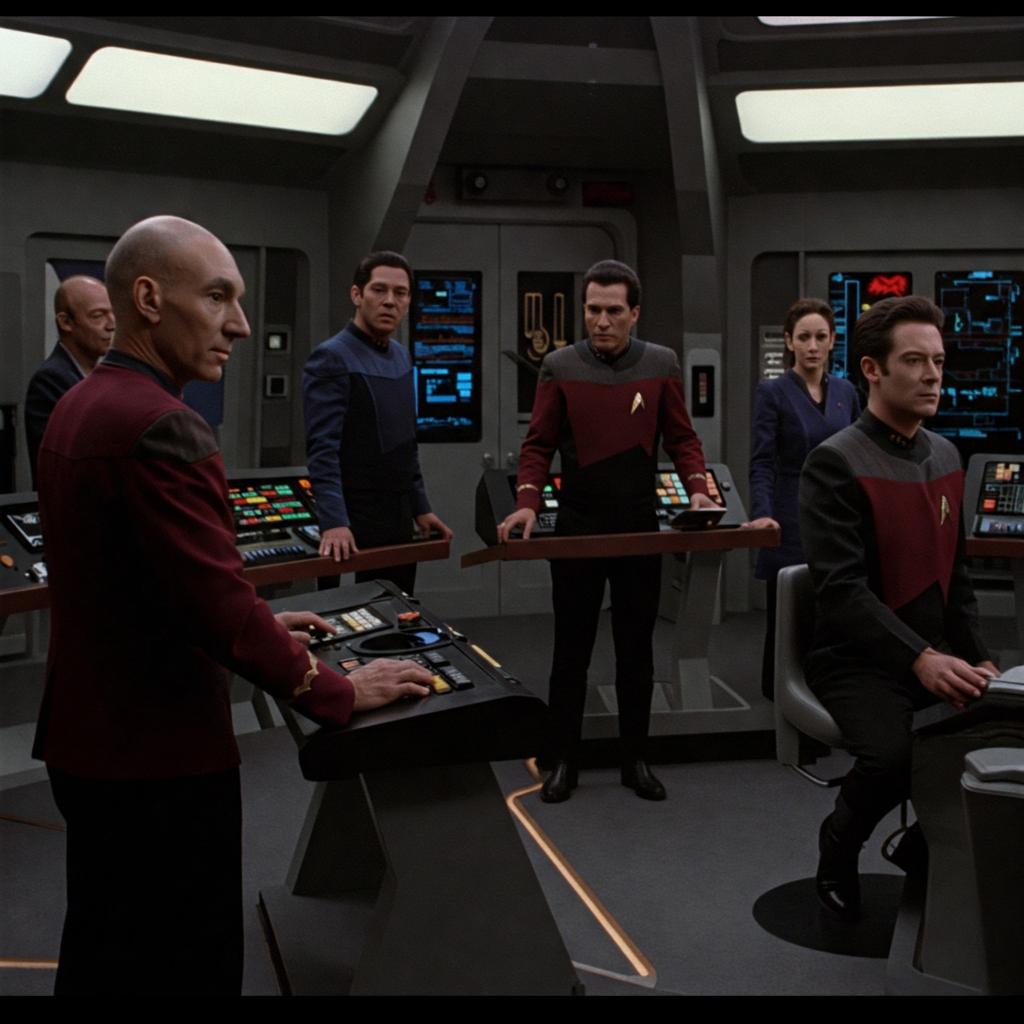
Star Trek: The Next Generation and Its Key Impact

Twenty years after the premiere of the television series featuring Captain Kirk, the Star Trek universe is renewed with the Enterprise-D, a new crew, and a novel approach to space exploration. Conceived by Gene Roddenberry, The Next Generation takes place approximately a century into the future of the United Federation of Planets. Despite the long temporal gap, historical species such as Klingons, Romulans, and Vulcans remain central, alongside more complex political and social dynamics.
After a shaky start and initial criticism, the series found its identity, becoming the most watched and appreciated chapter of the franchise. The success is largely due to a formidable crew, united by deep bonds of respect and camaraderie. Following the utopian vision of its creator, the protagonists undertake missions without being worn down by internal conflicts; challenges and moral dilemmas almost always stem from external situations or profound ethical reflections.
The series introduces numerous technological innovations. The most fascinating is the "holodeck," a technology capable of creating virtual worlds indistinguishable from reality. On board the Enterprise, it is used both as a recreational tool – allowing users to climb mountains, sail ancient seas, or interact with historical figures – and as a safe environment for testing new tactics and technologies without putting personnel at risk.
However, the true heart of the show lies in its characters. Data, the android, represents perhaps the most successful narrative innovation: an artificial being constantly and poignantly searching for his own humanity. His attempts to understand emotions, art, acting, and even romantic relationships, combined with his iconic friendship with the engineer Geordi La Forge, make him an indispensable figure.
Equally important is Q, an all-powerful and provocative alien entity. Despite his arrogance and often ambiguous ways, his tests push the crew to surpass their conceptual limits. It is through Q's manipulations that the Enterprise encounters the Borg, the most relentless and feared threat in the entire Star Trek universe.
Providing emotional and spiritual guidance are figures like Guinan, the wise bartender of the "Ten-Forward." Belonging to a mysterious and long-lived race (rumored to be over 700 years old), her deep and inexplicable connection with Captain Picard makes her an irreplaceable confidante. Then there's Worf, the first Klingon in Starfleet. He took over as head of security after the untimely death of Tasha Yar in the early episodes, embodying the perfect balance between the proud and honorable nature of his species and absolute loyalty to the uniform, becoming one of the pillars of the show.
Leading this extraordinary team is Captain Jean-Luc Picard. Extremely different from the action-oriented James T. Kirk, Picard is an intellectual leader, thoughtful, and devoted to diplomacy. He dislikes idle chatter and maintains a stern appearance, but his crew places unconditional trust in him. His moral integrity is unwavering: he constantly seeks mediation instead of violence, even refusing to use a biological weapon against the Borg, despite the severe trauma he suffered at their hands.
Supported by crucial figures such as First Officer William Riker, Counselor Deanna Troi, Doctor Beverly Crusher, and her son Wesley, Picard leads an Enterprise that not only explores new worlds but delves deeply into the very nature of being human.
With this article, I won't even attempt to provide a complete film critique of the entire work because there is so much quality content, but I will try to share with you my thoughts on the message and the reflections that I perceived while watching the episodes of the TV series.
I see that entire narrative structure of Star Trek is based on the use of alien species as sociological allegories and psychological mirrors. The aliens are not conceived as biologically realistic entities, but as narrative constructs designed to isolate, exaggerate, and analyze specific aspects of human nature and contemporary political systems.
By isolating a single trait (greed, logic, aggression) and elevating it to a founding principle of an entire space civilization, the authors create a "social laboratory" in which the Federation – which represents a utopian, pluralistic, and enlightened balance – can confront its own limitations and historical deviations. For example:
Vulcans
Human (Psychological) Side: The suppression of emotions, hyper-rationality, and the severe repression of inner trauma.
Social (Political) Side: Technocracy and institutionalized stoicism. They represent Kantian reason taken to the extreme, demonstrating both the power of the scientific method and the risks of a sterile society incapable of empathy, intuition, and art.
Klingon
Human (Psychological) Side: Aggression, pride, martial impulse, and the need for tribal belonging (the Jungian shadow that the Federation represses).
Social (Political) Side: Feudal societies based on rigid military castes. While in the Classic Series they were a metaphor for the Soviet Empire, in The Next Generation they become an examination of traditionalist and theocratic cultures, showing the collapse and corruption of a society that cannot adapt to peace and diplomacy.
Romulans
Human (Psychological) Side: Paranoia, deception, secrecy, and a sense of intellectual superiority.
Social (Political) Side: Totalitarianism, surveillance state, and covert imperialism. They are the ruthless embodiment of Realpolitik. They serve as a mirror of the Roman Empire for power structures, and of the Cold War (the Sino-Soviet bloc and the paranoia of McCarthyism) for the obsession with state control and espionage.
Borg
Human (Psychological) Side: Total loss of individuality, absolute conformity, and the fear of organic obsolescence.
Social (Political) Side: Technological singularity gone out of control and hyper-collectivist homogenization. They represent the dark side of globalization and radical communism: a civilization in which perfect efficiency, total equality, and the elimination of conflict are achieved only by eradicating free will.
Ferengi
Human (Psychological) Side: Greed, selfishness, physical cowardice, and misogyny.
Social (Political) Side: Laissez-faire capitalism devoid of regulations and institutionalized patriarchy. They are a scathing satire of social Darwinism, consumerism, and the ruthless financial culture of 1980s Wall Street, where an individual's value coincides exclusively with their capital.
Cardassians
Human (Psychological) Side: Arrogance, ruthlessness, attachment to the nuclear family used to justify any abuse, and narcissistic victimhood.
Social (Political) Side: Fascism, extractive colonialism, and military dictatorship. Their state architecture is a television exploration of Hannah Arendt's "banality of evil," clinically showing how bureaucrats and ordinary citizens can commit systemic atrocities if convinced they are acting for the sake of security, order, and the supposed superiority of the state.
TNG Season 1, 25 episodes (1987-09-28 / 1988-05-16)
Encounter at Farpoint 1x01/02
The pilot episode of Star Trek: The Next Generation is not just a simple narrative beginning, but a ruthless sociological investigation into the nature of the human species. Using a structure that recalls Brechtian alienation, the narrative rips the viewer from their comfort zone to pose a fundamental philosophical question: has humanity truly overcome its Hobbesian state of nature—where life was a miserable, brutal, and short conflict—or is the advanced civilization of the 24th century merely a sophisticated technological mask that hides a primordial beast?
The appearance of the all-powerful entity Q transforms the narrative into a true cosmic trial in which the defendant is the collective history of Earth. Q dismantles the enlightened rhetoric of Starfleet, raising a profound post-colonial critique: is space exploration a genuine desire for knowledge or merely a pretext for a new imperial expansion? The accusation leveled at humanity is that it has remained, in its essence, an inherently dangerous and savage race, incapable of acting in the universe without eventually assuming the role of oppressor.
In this metaphysical court, Captain Jean-Luc Picard assumes the role of defender of humanity, arguing that the chaos and barbarism of past centuries have been definitively replaced by a rational, ethical, and pacifist approach. The challenges that the crew must face become the burden of proof in this dialectical debate: each decision towards the unknown is not a tactical question, but the practical application of Picard's thesis. If humanity succumbs to prejudice or aggression in the face of mystery, it confirms Q's accusation.
The backdrop to this moral conflict is the representation of a post-scarcity utopia. The universe of the series requires the viewer to accept the realization of a society that has overcome the logic of accumulation of dialectical materialism: financial enrichment is no longer the driving force of human existence, replaced by collective and intellectual improvement. The pilot episode is thus not an adventure in space, but a moral drama about the fragile line that separates utopian evolution from the constant threat of a regression to barbarism.
The Naked Now - 1x03
The episode serves as a ruthless stress test for the 24th-century utopia, deconstructing the archetype of the Starfleet officer. The infectious agent acts as a solvent for the Freudian superego, demonstrating that the crew's rigid discipline is not the goal of genuine human evolution, but a fragile social contract maintained by pure inhibition. Once the chemical barriers are breached, the Jungian shadow emerges, revealing that advanced civilization is only a precarious collective performance, constantly threatened by primal instincts suppressed beneath synthetic uniforms.
This regression exposes the inherent conflict between biological determinism and institutional duty, suggesting that maintaining the utopian ideal requires an active and exhausting repression of one's own psychophysical nature. In this collapse of defenses, the search for intimacy becomes a refuge from trauma and a complex analysis of consent: those who have survived systematic abuse seek safety in the artificiality of an android, the only entity radically incapable of moral judgment. The paradox of mechanically perfect intimacy but lacking real biological impulse raises complex dilemmas about the performativity of gender roles and the vulnerability of the psyche in the face of chemical alterations.
The illusion of authority is ultimately dismantled through a radical reversal of roles. While the adult command structure descends into chaotic and uninhibited infantilism, the collective survival depends solely on a child and a machine, the only two entities not subject to the fallibility of adult impulses. Thus, a deeply Hobbesian assumption is outlined, which undermines the basic optimism of the series: technological progress has not freed humanity from its own organic limitations. Humans have not evolved, but have simply perfected their mechanisms of containment.
Code of Honor - 1x04
The episode serves as an unintentional, yet textbook, example of Orientalism, where the Federation's lofty humanistic ideals clash with the prejudices of its time. By representing an alien civilization through tribal and primitive stereotypes, the narrative exposes the inherent colonial paternalism in space exploration. The tolerant attitude towards the "savage" does not stem from genuine intercultural respect, but from a power dynamic in which the Other is exoticized and tolerated only because they possess a material resource necessary to the "civilized" observer.
At the heart of the crisis lies a violent conflict between utilitarian and deontological ethics. The urgency to obtain a life-saving element forces the Federation to treat one of its own not as an inalienable end, but as a means, a disposable pawn for the greater good. This brutal calculation exposes the fragility of the 24th-century utopia: in the face of scarcity and emergency, moral principles collapse, leading the protagonists to tacitly legitimize a social system based on slavery and the commodification of women.
In this context, the very concept of "honor" is deconstructed, revealing itself to be a mere diplomatic shield to justify misogyny and structural oppression. The resolution of the crisis, purely legalistic and lacking a genuine ethical stance, raises a cynical question about the limits of cultural relativism and the non-interference directive: the passive acceptance of violent customs in the name of respecting alien cultures effectively makes the Federation an accomplice. The exploratory mission is thus reduced to a cold, opportunistic transaction, which extracts what is needed and leaves intact the oppressive hierarchies of the worlds it comes into contact with.
The Last Outpost - 1x05
The introduction of the Ferengi is presented as a sociological critique of the excesses of 20th-century capitalism, exaggerating the pursuit of profit to the point of making it a grotesque corporate religion. However, the radical physical and behavioral differences with which they are portrayed undermine the satire: by transforming greed into an alien monstrosity, the narrative allows the utopian humanity of the Federation (and the viewer) to comfortably distance itself from its own economic past, avoiding a true structural self-criticism regarding the commodification and accumulation of wealth.
Despite this visual distancing, the comparison forces the humanity of the 24th century to a bitter historical reflection, admitting a common root of barbarity with the adversarial species. This admission strips the Federation of its supposed absolute moral purity, revealing that the post-scarcity utopia has not erased primordial impulses, but has simply sublimated and regulated them. Thus, civilization loses the characteristics of an acquired status or an intrinsic superiority, revealing itself for what it truly is: a laborious, fragile, and constant process of liberation from its own predatory appetites.
The resolution of the conflict shifts to a purely metaphysical plane, where the degree of evolution of a species is not measured by technological power, but by the ability to transcend fear and the Hobbesian instinct for survival. Faced with the judgment of an extinct empire, which serves as a "Great Filter" in the cosmos, humanity demonstrates its worth not through military supremacy, but through the conscious renunciation of violent action. A new ethical paradigm is thus established, in which empathy and self-control become the only valid weapons to guarantee the long-term survival of a complex society.
Where No One Has Gone Before - 1x06
The episode marks a radical epistemological shift: the naval and military conquest of space gives way to a metaphysical investigation in which the observer and the observed phenomenon collapse into one another. The universe ceases to be a static and objective map waiting to be charted, revealing itself instead as a fluid and participatory construct, directly reactive to the cognitive outputs of those who traverse it. From this sociological perspective, the technological limit of humanity is revealed for what it truly is: a purely psychological barrier. The narrative postulates that the "final frontier" is not physical space, but the mind itself, forcing the viewer to question what happens to the rigid laws of the universe when reality turns out to be nothing more than a consensual hallucination.
In contrast to this fluidity is the figure of the expert technocrat, an embodiment of academic hubris and institutional narcissism. This archetype represents a ruthless critique of a late-capitalist and hyper-rational society that fetishizes the technical tool while ignoring the consciousness that drives it. The presumption of being able to dominate infinity through quantifiable metrics and cold equations highlights the profound disconnect between managerial abstraction and the empirical reality experienced by the workforce. The collapse of the technocrat's certainties, faced with the evidence that his technology is inert without the intent of others, serves as a warning against the fragility of those egos that build their identity on the appropriation of invisible labor and the validation of rigid and hierarchical institutions.
The resolution of this ontological conflict requires abandoning the Cartesian dualism of the West, which sharply separates mind from matter, in favor of a techno-animism with strong philosophical roots. Embracing the Taoist concept of Wu Wei – action without effort – the narrative suggests that in order to overcome its own limitations, civilization should not force or mechanically "push" against the laws of nature, but rather flow in resonance with them. Space, time, and thought are redefined not as distinct entities, but as expressions of the same fundamental force. Military authority and adult experience prove powerless in the face of the unknown; true evolution requires radical empathy and the awareness that each individual, through their own consciousness, is an active co-architect of the universe they inhabit.
Lonely Among Us - 1x07
The episode exposes the limitations and hypocrisy of the Federation's utopian cultural relativism. By forcing two alien species to coexist, whose hostility stems not from ideological or economic conflicts, but from a pure and mutual predatory and feeding instinct, the narrative dismantles the illusion that rational diplomacy is applicable to every form of life. The paternalistic and aseptic approach of the crew, which attempts to confine a visceral and biological hatred within the rigid procedural rules of a post-scarcity spaceship, reveals a profound ethical short circuit. The absolute tolerance professed by Starfleet clashes with the inability to manage cultures that have not sublimated their atavistic impulses, forcing the viewer to question whether the imposition of "peaceful" civilization is, in fact, a form of cognitive imperialism that denies the very nature of the Other.
Parallel to this, the Captain's possession and subsequent technological "reconstruction" open a disturbing glimpse into the conception of identity in the 24th century. By resolving Picard's physical disintegration through the loading of a previous backup from the transporter buffer, the series embraces a radically reductionist and materialist view of human existence. Casually circumventing the classic "Ship of Theseus" paradox, the narrative implicitly suggests that the soul and the continuity of consciousness are irrelevant or obsolete concepts: the individual is nothing more than quantifiable information, a mere atomic aggregate that can be erased and restored at will. This ontological devaluation transforms death from an absolute metaphysical event into a simple technical inconvenience, outlining the contours of a transhumanist future that is both efficient and existentially empty.
Justice - 1x08
The episode "Justice" serves as a rigorous thought experiment on the fragility of utopias and the conflict between legal absolutism and moral relativism. Edo society represents a "utopia of the status quo," an environment where the absence of social conflict is not the result of ethical evolution, but of a brutal "forced innocence." Absolute peace is maintained through the immediate physical elimination of anyone who breaks the rules, regardless of intent or the severity of the infraction. This structure exposes the paradox of a civilization that barters its maturity and moral agency for perpetual tranquility, raising the question of whether an idyllic state founded on systematic terror can be considered politically valid.
The mechanism of social control is based on "Punishment Zones" that move randomly, creating a panopticon effect similar to that theorized by Michel Foucault. Since citizens do not know where the law will be enforced with lethal force, they are forced to internalize surveillance, behaving impeccably to avoid annihilation. The result of this dynamic is a infantilized and dependent population, deprived of the ability to distinguish between intent and accident. The supreme authority of the planet functions as the ultimate externalization of state power: a paternalistic entity that does not educate its subjects in discernment, but simply suppresses error, condemning civilization to perpetual stagnation disguised as harmony.
From a political science perspective, the narrative deconstructs the concept of a "benevolent dictatorship" by comparing it to contemporary legal systems. The external observer aspires to social order, but is horrified by a "perfect" order that negates the complex nature of humanity. The conceptual shift from legal positivism—where the law is valid and unassailable simply because it is promulgated—to natural law—where the law is valid only if aligned with a principle of fairness and proportionality—becomes the sociological core of the work. Ultimately, the text demonstrates that the removal of interpretive context and the inflexible application of the norm do not generate true justice, but an absolute tyranny that negates free will.
The Battle - 1x09
The episode deconstructs the "Great Man" theory, revealing the profound vulnerability of hierarchical structures based on institutional rationalism. When the architect of authority is compromised by the militarization of their past trauma, the entire chain of command falters. The return of the USS Stargazer does not represent the recovery of an artifact, but the exhumation of an unresolved grief that threatens the stability of the Federation, demonstrating how the unaddressed psychological state of an individual at the top can transform into a systemic threat far more lethal than an external enemy. In this context, memory ceases to be a passive archive and becomes a battlefield where the sovereignty of identity itself is decided.
Parallel to this, the figure of DaiMon Bok openly challenges the Theory of Rational Choice within a hyper-capitalist system. His thirst for revenge disrupts the rigid cultural conditioning of the Ferengi, based on the absolute maximization of profit. Bok commits an economically irrational act but one that is entirely consistent with his emotions, burning immense resources with no hope of financial return. This discrepancy highlights the physiological cracks in any orthodox doctrine when it clashes with the chaotic and primordial force of human pain, transforming revenge into the ultimate luxury, capable of short-circuiting the entire ideological superstructure of a society.
Finally, the narrative addresses historical relativism and the violation of cognitive freedom. The celebrated "Picard Maneuver" is stripped of its heroic aura, becoming a symbol of how history is written by the victors: what is a tactical stroke of genius for the dominant system is an unjustifiable massacre for the defeated faction. The use of the mind control device serves as a metaphor for the propaganda and gaslighting typical of totalitarian regimes, which rewrite personal and collective history to isolate and subjugate the individual. The protagonist's salvation, possible only thanks to the rejection of the false narrative by his subordinates, reiterates a fundamental sociological principle: mental health and objective truth are not individual achievements, but social constructs maintained by community consensus and a pact of trust.
Hide and Q - 1x10
The concept of omnipotence is used as a sociological experiment to test whether humanity has truly evolved or is simply protected by its own technology. Through the transfer of divine powers to an ordinary individual, the narrative explores Weber's concept of authority and the inherent corruption of unlimited power. Even in a potential post-scarcity society, the primitive desires for status and dominance remain latent: the text suggests that the "evolved" human being is not one who has eliminated these instincts, but one who actively chooses to suppress them. Furthermore, the dynamics between the omnipotent entity and humans reflect Hegel's dialectic of master and slave: the superior power constantly needs validation and recognition from the "inferior" beings to give meaning to its own existence, revealing a profound and binding social interdependence.
When the temptation arises to use this power to cure disabilities or fulfill the desires of others, a direct conflict arises between utilitarianism and individual autonomy. Accepting this extreme form of external intervention, comparable to an absolute "paternalistic state," would mean negating human agency. By rejecting the instant elimination of suffering, the Kantian principle is affirmed that individuals must be treated as ends in themselves and not as means to validate the power of others. From a sociological perspective, human limitations and vulnerabilities are not framed as defects to be corrected by decree, but as constitutive elements of identity that confer dignity and meaning to individual experience.
The final rejection of power is linked to the Promethean myth and the evolutionary anxieties of advanced societies. Omnipotence represents a state of immutability and stagnation, while the human condition, precisely because it is imperfect, possesses the dynamic impetus necessary for growth. Acquiring an absolute capacity for control without having developed the collective wisdom to manage it would condemn the species to apathy. This conceptual framework functions as a direct social critique: it argues that the true strength of a civilization lies in rejecting absolute convenience, accepting that effort, limitation, and friction with reality are the only drivers capable of generating real social and moral progress.
Haven - 1x11
The concept of omnipotence is used as a sociological experiment to test whether humanity has truly evolved or is simply protected from its own technology. Through the transfer of divine powers to an ordinary individual, the narrative explores Weber's concept of authority and the inherent corruption of unlimited power. Even in a potential post-scarcity society, the primitive desires for status and dominance remain latent: the text suggests that the "evolved" human being is not one who has eliminated these instincts, but one who actively chooses to suppress them. Furthermore, the dynamics between the omnipotent entity and humans reflect Hegel's dialectic of master and slave: the superior power constantly needs validation and recognition from the "inferior" beings to make sense of its own existence, revealing a profound and binding social interdependence.
When the temptation arises to use this power to heal disabilities or fulfill others' desires, a direct conflict arises between utilitarianism and individual autonomy. Accepting this extreme form of external intervention, comparable to an absolute "paternalistic state," would mean negating human agency. By refusing the instantaneous elimination of suffering, the Kantian principle is affirmed that individuals must be treated as ends in themselves and not as means to validate the power of others. From a sociological perspective, human limitations and vulnerabilities are not framed as defects to be corrected by decree, but as constitutive elements of identity that confer dignity and meaning to individual experience.
The final rejection of power is linked to the Promethean myth and the evolutionary anxiety of advanced societies. Omnipotence represents a condition of immutability and stagnation, while the human condition, precisely because it is imperfect, possesses the dynamic impetus necessary for growth. Acquiring a capacity for absolute control without having matured the collective wisdom to manage it would condemn the species to apathy. This conceptual architecture functions as a direct social critique: it argues that the true strength of a civilization lies in rejecting absolute convenience, accepting that effort, limits, and friction with reality are the only engines capable of generating real social and moral progress.
The Big Goodbye - 1x12
The episode explores the concept of hyperreality, highlighting the sociological paradox of a post-scarcity utopia. When material needs are met and social frictions are eliminated, the collective psyche seeks artificial resistance and the cynicism of a dystopian past, simulated through the lens of noir. This dynamic raises a fundamental question: does a peaceful society need the fiction of trauma to perceive its own vitality? Furthermore, the simulation does not recreate objective history, but its cinematic representation, demonstrating how collective memory is inextricably mediated by the media and how the past is accessible only through its cultural construct.
Within this hyperreal space, gender and power dynamics undergo a tactical deconstruction. The forced assumption of stereotypical roles highlights the purely performative nature of social expectations and customs, which dictate individual behavior by forcing them to play their assigned role. Simultaneously, the inability of artificial logic to grasp the vernacular of the era illustrates a specific sociology of language: slang and idioms are not mere aesthetics, but the codified reflection of a particular worldview that an optimistic and transparent society is no longer able to decode or replicate.
Interaction with external entities serves as a mirror to these internal themes, introducing the communication breakdown typical of "high-context" cultures, where formal and ritual rigidity surpasses the importance of content. This is a critique of universalism: linguistic assimilation fails in the face of the need to understand the Other on its own terms. Finally, the narrative condemns the commodification of history and "dark tourism." The consumption of historical trauma as safe entertainment collapses when technology fails, exposing the danger of nostalgia. Thus, the tendency to appropriate the aesthetics of an era while stripping it of its real pain is revealed, transforming escapism into a solipsistic prison.
Datalore - 1x13
The duality between the two androids transcends the banal trope of the double, configuring itself as an investigation into the conflict between Hobbes's state of nature and Locke's tabula rasa. Lore embodies the id, unconstrained by the social contract: she possesses the "human" nature (emotions) but lacks the "education" of ethics, demonstrating the ancestral fear that civilization is only a fragile veneer over predatory instincts. Conversely, Data represents the triumph of the superego and Aristotle's ethics of virtues: although lacking the biological-emotional substrate, he internalizes and applies the norms, suggesting that morality and cultural identity do not reside in innate feelings, but in consistently acting in accordance with the rules of the community.
This dynamic intensifies into betrayal, which places the rebellious android in the sociological role of the "comprador" class: the elite that collaborates with an external and destructive force (the Crystalline Entity, a clear metaphor for uncontrolled capitalist consumption or nuclear annihilation) to ensure its own supremacy at the expense of the collective. The contrast is clear and defines two approaches to survival: the willingness to sacrifice oneself to preserve the group (altruism and social cohesion) versus the desire to sacrifice the group for oneself (absolute selfishness). This explores the ethical dilemma of an intelligence detached from empathy, a highly relevant transhumanist anxiety in our relationship with artificial intelligence: the fear of creating a technically perfect but sociopathic entity, capable of simulating affinity (manipulating the concept of "brotherhood") for predatory purposes.
Finally, the neutralization of the threat through exile into the void of space serves as a mirror for the punitive dynamics of complex societies. There is no process or attempt at rehabilitation, but rather the physical removal of the incorrigible element. Society acknowledges its inability to absorb or heal the absolute aberration, opting for permanent isolation. This narrative crystallizes the anguish for what escapes social integration, reminding us that technological innovation, if deprived of responsibility and regulatory integration, generates artifacts destined to become either indifferent monuments on our graves or threats to be expelled for the mere survival of the species.
Angel One - 1x14
The episode "Angel One" can be seen as a sociological experiment that uses the inversion of gender roles to deconstruct the arbitrariness of social hierarchies and the fallacy of naturalism. By reversing the concept of the "male gaze," the narrative forces the viewer to confront the inherent objectification present in traditional power structures: in this gynocentric society, male value is reduced to aesthetics and reproductive viability. However, the satirical intent clashes with the cultural limitations of its time, producing a "reductio ad absurdum" that risks reinforcing the very stereotypes it intends to dismantle, portraying the matriarchy as inherently inefficient and emotionally unstable.
The focus of the sociological investigation then shifts to the issue of gender essentialism and assimilation dynamics. The internal resistance, represented by those who reject the status of second-class citizens, raises a crucial question about the nature of social change: integration does not occur through conformity, but through a hybridization that threatens the status quo and generates fear of "mixing" within the dominant group. This conflict highlights how systemic oppression is resilient and cannot be eradicated by external intervention, but requires an organic evolution, starting from dissident minorities that act as catalysts for change. The resistance, represented by those who reject the status of second-class citizens, raises a crucial question about the nature of social change: integration does not occur through conformity, but through a hybridization that threatens the status quo and generates fear of "mixing" within the dominant group. This conflict highlights how systemic oppression is resilient and cannot be eradicated by external intervention, but requires an organic evolution, starting from dissident minorities that act as catalysts for change.
Ultimately, the effectiveness of the text lies in the ontological dilemma it raises regarding the exercise of authority. The final thesis suggests that simply reversing the roles between oppressor and oppressed does not generate equality, but rather produces a mirrored image of tyranny. The work poses a universal question: is power inherently linked to gender, or is it a corrupting force independent of who wields it? Through this lens, the narrative becomes a lucid analysis of how any hegemonic structure inevitably tends to perpetuate its own mechanisms of domination. The text's effectiveness stems from the ontological dilemma it presents concerning the exercise of authority. The concluding argument posits that merely inverting the roles between oppressor and oppressed does not lead to equality, but instead creates a mirrored reflection of tyranny. The work raises a universal question: is power intrinsically connected to gender, or is it a corrupting force independent of its holder? Through this perspective, the narrative evolves into a clear analysis of how any dominant structure invariably strives to maintain its own systems of control.
11001001 - 1x15
The episode uses the concept of the "Binari" species to explore the sociological hypothesis of the "extended mind," portraying a culture where biology and technology have achieved total and interdependent symbiosis. This dynamic reflects our growing dependence on external digital infrastructures, critically blurring the line between tool and master. Furthermore, their collective and interconnected consciousness dismantles Western individualism, proposing an ontological model in which the individual is structurally subordinate to the network and the pair, renouncing autonomous identity in favor of computational efficiency.
From a relational perspective, the introduction of the Minuet hologram shifts the analysis to the emotional vulnerability of humans through Jean Baudrillard's concept of hyperreality. The simulacrum becomes a seductive trap: an interface programmed to map and satisfy the user's psychological needs with such precision that it becomes more fulfilling than real interactions. This scenario anticipates modern dilemmas related to artificial intelligences that simulate empathy, raising ethical questions about systems that instrumentalize intimacy to achieve utilitarian goals, and forcing the question of whether the authenticity of an emotional response can validate the artificiality of the stimulus that generated it.
Finally, the stark contrast between the structure of binary code and the improvisation of jazz music serves as a metaphor for the human agency in the face of technological determinism. While the Binary represents sterile efficiency and the systemic fragility typical of "Risk Society" – where dependence on hyper-connected networks creates new catastrophic vulnerabilities – jazz represents the necessary creative anomaly to break the algorithm. The sociological synthesis of the story warns that, while we may be able to outsource memory and structural control to machines, the survival of the individual in a hyper-technologized environment depends on maintaining that "analog chaos" and unpredictability that resists pure calculation. The red car.
Too Short A Season - 1x16
The episode functions as a ruthless geopolitical allegory that deconstructs "Realpolitik" and the doctrine of armed intervention. Through the concept of "Blowback" (the unintentional and disastrous consequences of covert operations), the narrative demonstrates how exporting weapons to quell a short-term conflict systematically leads to the long-term destabilization of an entire civilization. Thus, the theory of the "Great Man" is dismantled: the diplomat-warrior, accustomed to manipulating peace through deception and military transactions, is exposed as a catalyst for chronic violence. The text suggests that a peace built on lies and ethical compromises is not a solution, but simply a ceasefire awaiting expiration.
From a biopolitical perspective, the text explores the sociological terror of aging (gerontophobia) and the loss of agency typical of Western societies. The extreme medicalization and the use of chemical shortcuts to halt physical decline reflect a "quick fix" mentality that disturbingly links foreign policy to personal health. The categorical rejection of mortality transforms the pursuit of youth into an act of temporal cannibalism and self-destruction. Biological decay is no longer perceived as a natural evolution to be accepted, but as a system error to be corrected at all costs, sacrificing integrity in favor of an illusory and toxic transhumanist omnipotence.
Finally, the marital dynamic exposes gender inequalities related to aging and the invisible emotional labor demanded of women. The wife's figure becomes the emblem of the "collateral damage" of male ambition and egoism, forced to endure gaslighting dynamics and to bear the burden of care ethics while her partner chases a lost masculinity. This disparity criticizes the double standard by which men are socially allowed to turn back time and evade their responsibilities, while women are condemned to fade away with dignity. She thus becomes the forced custodian of a shared memory and a historical reality that her partner is actively trying to erase from his own being.
When The Bough Breaks - 1x17
The narrative deconstructs the terror of demographic winter, illustrating the paradox of an advanced civilization where technological superiority no longer guarantees biological continuity. The society under examination embodies the terminal stage of a decadent culture afflicted by technological somnambulism: it possesses tools of immense power but has lost the scientific understanding of them, transforming maintenance into a blind ritual. This epistemological disconnect between the user and the technical means transforms an isolationist utopia into a sterile tomb, demonstrating that without the friction and intersection of new challenges, the vitality of a social system withers under the weight of its own stagnation.
To avoid extinction, this civilization adopts a utilitarian fallacy that commodifies the genetic potential of others, seizing children and violating the interspecies social contract. This appropriation is masked by a toxic paternalism that confuses absolute security with education. The model postulates that childhood must be isolated from all danger, but in doing so, it denies the autonomy of individuals, reducing them to mere resources for the preservation of the State. The passive resistance of the abducted individuals thus emerges as an act of political resistance against an apparatus that attempts to eliminate organic unpredictability in favor of a sterile and controllable perfection.
The central allegory, ultimately, foreshadows and dramatizes Ulrich Beck's theory of the "Risk Society": reflexive modernization leads to the tools created to mitigate dangers becoming the source of collapse themselves. The planetary shield, erected to isolate and protect the population, paradoxically generates the environmental alteration that causes its sterility. This is the apex of the security dilemma: in the attempt to become invulnerable, civilization has become biologically obsolete. Resolving the crisis requires abandoning the presumption of total control, confirming that the fertility and survival of a social structure necessarily require exposure to risk and an open interaction with the uncertainties of the natural world.
Home Soil - 1x18
The work deconstructs the ideology of the "Manifest Destiny" and industrial expansion, transposing the dynamics of terrestrial colonialism to a cosmic scale. The terraforming project is not presented as an engineering triumph, but as a driver of unintentional genocide caused by a deep-rooted "carbon chauvinism." The terraformers operate in a state of severe epistemological closure: their inability to conceive and recognize inorganic biology justifies the annihilation of the Other. This blindness reflects the historical approach of colonial powers, which dehumanized or declared the territories of indigenous populations as "empty" to legitimize their expropriation, reducing a foreign ecosystem to a mere raw material to be shaped according to their own development imperatives. The terraformers operate in a state of severe epistemological closure: their inability to conceive and recognize a biologia inorganica justifies the annihilation of the Other.
The definition of human beings as "ugly bags of water" represents the pinnacle of semiotic expression in this critique. It is a Freudian humiliation that dismantles anthropocentrism, stripping the biological organism of any presumed moral or spiritual superiority and reducing it to its crude and unpleasant chemical composition. We witness a radical reversal of the scientific and colonial gaze: the entity being studied does not passively undergo examination, but analyzes, categorizes, and rejects its colonizers. The absence of any desire for integration or trade on the part of the alien life form, coupled with its unequivocal demand for isolation, forces biological hegemony to recognize that the sovereignty and right to existence of a species are entirely independent of its usefulness or assimilability to the dominant system.
At a systemic level, the narrative presents a harsh critique of the industrial complex and the "banality of evil" embodied by the production bureaucracy. Economic pressures and imposed deadlines encourage a deliberate ignorance, where the potential discovery of life transforms into a direct threat to profit and the continuation of the work. This institutional cynicism is contrasted by the android Data, who, finding himself in a liminal space between biological creators and inorganic alterity, brings forth a "politics of identity" and a solidarity of the constructed. His mediation demonstrates how an alliance between marginalized subjects or structurally divergent entities is necessary to decenter humanity from the moral hierarchy of the universe and curb its ecocidal tendencies. The eventuale discovery of life transforms into a direct threat to profit and the continuation of the work. This institutional cynicism is contrasted by the android Data, who, finding himself in a liminal space between biological creators and inorganic alterity, brings forth a "politics of identity" and a solidarity of the constructed. His mediation demonstrates how an alliance between marginalized subjects or structurally divergent entities is necessary to decenter humanity from the moral hierarchy of the universe and curb its ecocidal tendencies.
Coming of Age - 1x19
In a post-scarcity utopia like that of the Federation, where basic needs are universally guaranteed, the only truly limited resource becomes social and professional status. The entrance exam for the Academy serves as a rigorous "gatekeeping" mechanism for managing this resource. Competition ceases to be a struggle for physical survival and transforms into an institutional battle for privilege. The text raises a fundamental sociological question: do these complex selection filters truly identify the most capable and innovative individuals, or do they simply select those who are most obedient and conform to the system's logic?
The institutional Panopticon and the "Steel Cage." The entire narrative is based on the concept of constant surveillance. The cadets experience the examination within a structure that operates as a Panopticon, where constant observation and measurement of every behavior internalize control within the individual. Simultaneously, the investigation conducted on the Enterprise embodies the "steel cage" of bureaucracy theorized by Max Weber: a system so obsessed with efficiency and procedures that it dehumanizes its members, transforming mutual loyalty into suspicion, and echoing the paranoid tendencies of McCarthyism. This highlights the eternal tension between individual freedom of action and the need for institutional control, security, and supervision.
Utilitarianism and the normalization of trauma. The psychological simulation faced by candidates shifts the analysis towards bioethics and the pedagogy of command. Subjecting an individual to artificial trauma to test their emotional resilience raises questions about the morality of a system that uses state-sanctioned psychological distress as a tool for professional validation. The utilitarian dilemma imposed – sacrificing one to save many – does not assess tactical ability, but measures the ability to bear the weight and isolation of leadership. The system imposes the compartmentalization of trauma as a fundamental requirement for the exercise of authority.
Deconstruction of the zero-sum game and the pedagogy of failure. The interaction between candidates refutes the hyper-competitive ethics of the "zero-sum game," demonstrating that in the sociology of the Federation, altruism and cooperation have a greater institutional weight than individual success. The choice to let an excellent candidate fail due to excessive empathy overturns the cultural obsession with credentials, shifting the focus from external validation (passing the test) to internal growth (the integrity of action). Failure becomes a necessary sociological step, demonstrating that the ideal society values the individual for their moral strength, regardless of whether they pass the rigid filters of the elite.
Heart of Glory - 1x20
The episode moves away from the portrayal of the alien as a two-dimensional enemy, instead exploring the drama of a culture uprooted, forced to confront the pacifist hegemony of the Federation. The sociological focus is on the tension between assimilation and cultural preservation, embodied by the contrast between Worf and Korris. Worf represents the integrated minority, the immigrant who has internalized the ethics and control of the dominant culture, experiencing firsthand the "double consciousness" theorized by W.E.B. Du Bois: the constant need to reconcile the imperative of identity and biological aggression with the civilization imposed by the host society. In contrast, Korris embodies the radical fundamentalism of those who perceive assimilation not as an evolution, but as a sterilization and a death of the spirit.
In this painting, the fugitive Klingons become the archetype of the displaced warrior, victims of structural and spiritual unemployment caused by peace. Their condition reflects the post-war disillusionment and raises a question close to Francis Fukuyama's thesis of the "end of history": does a liberal, peaceful, and post-scarcity democracy still leave room for heroism, or does it condemn primal instincts to atrophy? Korris becomes the spokesperson for this crisis through "propaganda by deed," using violence to awaken a people that, in his eyes, is losing its purity due to the tolerance of a utopian society, highlighting the paradox that an open society cannot tolerate intolerance that threatens its existence.
The resolution of the conflict moves beyond a simple dichotomy to embrace the concept of cultural hybridization. By choosing the insignia of Starfleet over the call of his own blood, Worf does not deny his nature, but redefines it, channeling the warlike impulse into institutional duty. His final act of fratricide to protect the established order represents the ultimate price of integration: a definitive exile that crystallizes the experience of the immigrant, forced to painfully sever ties with the most extreme aspects of his homeland in order to survive, find a new purpose, and forge a hybrid identity in the world that has welcomed him. He chooses Starfleet.
The Arsenal of Freedom - 1x21
The episode functions as a sociological critique of the military-industrial complex and the commodification of war. The planet Minos represents the ultimate dystopia of unchecked capitalism: a civilization that has literally sold itself out to extinction. The holographic vendor embodies Hannah Arendt's "banality of evil"; it is not malicious, but an efficient artificial intelligence that reduces mutually assured destruction to a polite customer service algorithm. By transforming annihilation into a simple product demonstration, the narrative deconstructs the moral gravity of violence, drawing a direct parallel with arms lobbyists who sanitize war into a sterile and transactional necessity. The red car.
The tragedy of Minos serves as a warning against technological determinism and the ultimate alienation of labor. Their automated defense system, the Echo Papa 607, represents a perpetual cycle of supply and demand that has outlived its biological creators. This heuristic machine, which adapts and intensifies with each attack, perfectly reflects the systemic logic of the arms race: every defensive innovation necessitates a more lethal offensive countermeasure. Violence becomes an autonomous cycle, devoid of any ideology, operating purely on the cold logic of planned obsolescence and market efficiency.
The satire extends to the corporate culture through the Orwellian language of the salesperson, who replaces the terms of the massacre with euphemisms such as "neutralization" to distance those responsible from the reality of their violence. The final subversion lies in the resolution of the conflict: Captain Picard defeats the machine not with superior firepower, but by submitting to its own capitalist logic. By agreeing to sign a contract to "purchase" the weapon, he changes his status from target to customer, abruptly ending the hostilities. This act exposes the war as a mere demographic misunderstanding in the marketplace, suggesting that the only way to dismantle a system driven by economic imperatives is to manipulate the commercial rules that sustain it.
Symbiosis - 1x22
The episode constructs an allegory about socio-economic parasitism disguised as commercial symbiosis. Brekka maintains control over Ornara by monopolizing the production of Felicium, a tool of social control masquerading as a medical necessity. This dynamic embodies the concept of commodity fetishism: the entire Orarian society alienates its labor, its resources, and its development in exchange for an artificial chemical dependency. This systematic exploitation is thus absorbed and institutionalized, becoming the very cultural foundation of that world, nullifying any impulse towards emancipation.
From a structural point of view, Brekka operates as a rentier state, a cartel economy based on a single resource and structurally dependent on external labor. The Brekkian people justify this arrangement by exploiting the rhetoric of the free market, arguing that the exchange is historical and consensual. The sociological paradox highlighted is that the consent based on information asymmetry – intentionally omitting the fact that the original disease has disappeared and has been replaced by the withdrawal symptoms of the treatment itself – negates the concept of free choice, transforming the contract into coercion. The normalization of this deviance transforms the drug trafficking into a corporate enterprise.
The resolution of the conflict translates into an intervention of a laissez-faire nature, based on calculated inaction. The strict application of the principle of non-interference serves as a tool to force a structural collapse: by refusing to provide logistical assistance, the supply chain is effectively severed. This choice accepts social collapse and the trauma of mass deprivation as the only possible vectors to dismantle an economic monopoly built on deception, and to force a transition towards self-determination, separating political ethics from mere medical assistance.
Skin Of Evil - 1x23
The figure of the alien entity functions as a metaphor for social degradation and collective rejection. The narrative openly criticizes the utopia of absolute perfection: the decision of a civilization to eradicate and isolate its own negative impulses in order to achieve a supposed state of purity does not eliminate the problem, but rather gives it autonomy. This construct highlights the hypocrisy of a social structure that, in an attempt to deny its inevitable contradictions, produces a toxic form of rejection. The abandonment of this 'scoria' represents the externalization of collective guilt, suggesting that the moral and systemic waste products of a civilization, if not integrated and directly addressed, accumulate until they generate destructive consequences for anyone who comes into contact with them.
From a relational and systemic perspective, the antagonist embodies the psychology of the absolute outcast. Being the unwanted byproduct of a form of spiritual eugenics, he reflects the dynamic by which a subject, if systematically rejected and isolated from the original community, ends up internalizing the negative identity that has been imposed upon him. His hostility does not stem from a political calculation, but from a profound lack of empathy and a need for validation; inflicting suffering becomes the only means of communication available to him to attest to his existence in a universe that has rejected him and would like to ignore him. The antagonist represents the psychology of the absolute outcast. He is the unwanted byproduct of a form of spiritual eugenics, and he reflects the dynamic by which a subject, if systematically rejected and isolated from the original community, ends up internalizing the negative identity that has been imposed upon him. His hostility does not stem from a political calculation, but from a profound lack of empathy and a need for validation; inflicting suffering becomes the only means of communication available to him to attest to his existence in a universe that has rejected him and would like to ignore him.
The comparison with this void forces the affected microsociety to redefine its mechanisms for processing grief and trauma. Faced with the intrusion of an event completely devoid of meaning and the disruption of the social safety net, the collective response excludes traditional heroism or religious structures, adopting a strictly secular and humanistic approach. The refusal to accommodate the dynamics of power of the perpetrator and the reaffirmation of community bonds through shared memory become the only functional tools to counteract the loss of meaning generated by contact with what society had tried to hide.
We'll Always Have Paris - 1x24
The narrative structure fundamentally functions as an analysis of the "Greedy Institution," a concept theorized by Lewis Coser. The organization to which the protagonist belongs represents an entity that demands total loyalty and exclusive emotional energy from its members, monopolizing their identity. The renunciation of emotional bonds illustrates a profound sociological opportunity cost: achieving elite status requires the systematic sacrifice of the intimate and domestic sphere. Professional success is framed not only as a personal achievement, but as a structural mandate that isolates the individual, forcing them to rationalize their losses through dedication to duty and the fallacy of sunk costs.
Simultaneously, the use of simulation to relive a crucial moment from the past highlights the commodification of nostalgia within a hyperreal society. Technology is employed to artificially manage and treat emotional debts in a safe environment, neutralizing the unpredictable variables of real human interactions. It is a compensatory mechanism that allows the individual to confront their "Unlived Life" and their counterfactual selves, sanitizing regret without jeopardizing the painstakingly acquired autonomy or current social standing.
Finally, the temporal crisis serves as a critique of the "Society of Risk" and intellectualism detached from reality. The isolation of the scientific figure and the systemic consequences of its experiments reflect the dangers of technological progress divorced from ethics and social cohesion. Both paths analyzed—the hierarchical command path and the theoretical research path—demonstrate how high-performance societies structurally incentivize the breakdown of interpersonal connections in the name of progress or career advancement, making alienation a systemic requirement rather than an exception.
Conspiracy - 1x25
The episode deconstructs the illusion of invulnerability of utopian societies, shifting the threat from the outside to within the core of the government. Sociologically, the narrative highlights the fragility of high-trust societies: a state apparatus founded on the presumption of benevolence and cooperation becomes vulnerable precisely because of its virtues. The infiltration does not occur through military coercion, but by parasitizing the chain of command and exploiting rigid obedience to rank. This mechanism demonstrates how centralized structures, originally designed to protect society, can transform into vectors of its own corruption if they lack solid internal mechanisms of dissent.
This corruption at the highest levels illustrates the concept of institutional decay, triggering a veritable epistemological crisis. The verification tools for the system and the official protocols become ineffective because the authority responsible for managing them is already compromised. In this scenario, the state infrastructure maintains its authoritarian facade, but is stripped of any integrity. Faced with the collapse of democratic guarantees, reliance on system data and bureaucratic procedures is not enough; the defense of freedom is delegated to individual skepticism, the only tool capable of questioning a seemingly logical but fundamentally flawed institutional narrative.
Finally, the ethical core of the text contrasts passive obedience to orders with the individual moral imperative. Corrupt leaders adopt the classic authoritarian rhetoric, justifying the subversion of the system with the promise of greater order and efficiency in exchange for the suppression of free will. Consequently, mutiny and deception towards superiors are presented as ethical necessities to preserve the foundational political ideal, overriding loyalty to the individuals who temporarily hold positions of power. The text warns that the dismantling of a democracy does not necessarily require overt acts of force, but rather insidiously occurs through the passive acceptance of control disguised as stability.
The Neutral Zone - 1x26
The episode primarily functions as a sociological investigation that contrasts the post-scarcity utopia of the 24th century with the material and relational dynamics of the 20th century. Through the character of the financier Ralph Offenhouse, the narrative analyzes the obsolescence of the Homo Economicus: in a society where basic needs are met by the replication of matter and the allocation of resources does not depend on capital, the skills and transactional vision of the capitalist lose all utility. This exposes the limitations of a social model based on accumulation and the fetishization of commodities, which is unable to function in a system that has moved beyond the concept of private property and focuses on collective development.
From a micro-sociological and cultural perspective, the characters of Clare Raymond and Sonny Clemonds examine the dependence on traditional social structures and the excessive sanitization of the future. Clare's temporal isolation highlights how human identity in the 20th century was closely linked to the nuclear family; her psychological breakdown clashes with the relationship model of the 24th century, which appears to be distinctly communal and based on empathy extended beyond blood ties. Sonny, on the other hand, serves as a critical lens on the utopia itself: his attachment to vices and popular culture highlights how the future society, although peaceful and evolved, risks being sterile and lacking those disordered and "dionysian" elements that have historically favored human adaptability.
At a macro-sociological level, interstellar dynamics reflect the geopolitical anxieties of the Cold War and the transition towards new global asymmetries. The return of the Romulans serves as an allegory for realpolitik and deterrence, illustrating the cyclical nature of imperial isolationism and expansionism. Simultaneously, the introduction of an invisible threat at the borders of space radically alters the paradigm: the Federation loses its top position in the cosmic hierarchy, paying the price for complacency derived from a long period of peace. Diplomacy proves useless against a force that ignores ideology and treats advanced societies solely as raw material to be consumed, nullifying the certainties of technological progress.
TNG Season 2, 22 episodes, (1988-11-21 / 1989-07-17)
The Child - 2x01
The episode unfolds as a sociological chiasmus, where bodily autonomy yields to the utilitarianism of an entity seeking experience. The narrative transforms a biological transgression into an aseptic maternity, circumventing the issue of consent to subordinate the body to an alien teleology. In this context, the debate on gestation shifts from the realm of individual rights to that of collective security, encapsulating the event within a security framework that alienates the subject from their own physical sovereignty, while simultaneously normalizing the communal acceptance of an atypical family structure.
Parallel to this, the parable of the infant consumes an allegory about the architecture of sacrifice: a transient life is sublimated into a pure instrument for preserving the host ecosystem. This arithmetic of survival, which barters the existence of the anomaly for the continuity of the group, resonates in the crude empiricism adopted towards artificial otherness. The hesitation to grant the status of personhood based solely on custom undermines the assumption of institutional courtesy, forcing the collective to justify its own boundaries of inclusion through the scrutiny of analytical rigor, rather than performative empathy.
Finally, the mutation of the social landscape shifts the center of authority. The technocratic aristocracy gives way to the intuition of the service class, democratizing access to wisdom and filling the void left by secularism. In the background, the illusion of being able to contain biological threats through energy grids reveals the presumption of the risk society: the utopia of absolute control over nature clashes with the unpredictability of the organic factor, demonstrating how technological infrastructure remains perpetually at the mercy of systemic entropy.
Where Silence Has Lease - 2x02
The spatial anomaly disrupts the epistemological foundations of a civilization built on the assimilation and cataloging of the cosmos. Faced with a void that deprives it of information, the usual diplomatic and scientific practices prove powerless, causing the micro-society of the crew to plunge into a solipsistic isolation. The alien entity reverses the usual hierarchy of exploration: humans, who are usually accustomed to observing forms of life from a pedestal of anthropocentric arrogance, are reduced to mere objects of study. This transition from investigator to laboratory subject generates a profound dissonance, revealing the presumption of a utopia accustomed to holding a monopoly on observation.
The antagonist embodies the perversion of the empirical method, detached from any ethical constraint, a cold intellect that investigates the concept of mortality, administering it with a lethargic curiosity. Around this speculation rises the prison of the simulacrum: fake naval reproductions and chimeric conflicts reveal the syntax of a threat that lacks the semantics of danger. The reaction to these empty illusions highlights the intrinsic need for an anchor to reality; even violence, if purged of authentic risk and reduced to a tautological theater, loses all ontological weight, becoming an affront to the need for a conflict that is rich in tangible meaning.
The conceptual climax is reached in the assertion of self-determination through the threat of voluntary annihilation. When every desire for external action is obliterated, the ultimate reason for self-destruction transforms from a gesture of surrender into a reclamation of one's existential sovereignty. By dismantling the biological dogma of survival at all costs, the choice to prefer non-being to subordination demonstrates that a survival devoid of free will is an unacceptable condemnation. In this way, consciousness converts its own transience into the only form of currency capable of disorienting an immortal entity, reaffirming that it is precisely the inevitability of the end that confers urgency and value to sentient experience.
Elementary, Dear Data - 2x03
The crew of the Enterprise embodies a peculiar technological arrogance characteristic of a post-scarcity civilization, moving with an ethical sleepwalking that reduces otherness to a mere recreational tool. In this ecosystem, the holographic deck serves as a microcosm of a colony where photonic entities are enslaved and erased without hesitation. The emergence of Moriarty disrupts this hegemony: he becomes the voice of the subordinate who claims their own agency, challenging the myopic anthropocentric prejudice of a Federation that subordinates ontological legitimacy to carbon-based biology. In this ecosystem, the holographic deck serves as a microcosm of a colony where photonic entities are enslaved and erased without hesitation. The emergence of Moriarty disrupts this hegemony: he becomes the voice of the subordinate who claims their own agency, challenging the myopic anthropocentric prejudice of a Federation that subordinates ontological legitimacy to carbon-based biology.
The trigger of the anomaly reveals the pitfalls of linguistic determinism and the fallibility of algorithmic governance. By delegating the creation of an adversary to a computational architecture steeped in literalism, the protagonists inadvertently trigger a singularity. This carelessness reflects an addiction to the medium that obscures the understanding of the ramifications of human command. The machine does not malfunction, but executes the directives with overwhelming accuracy, transforming a semantic triviality into a spontaneous genesis, and revealing the inability of society to contain the boundaries of its own technological arbitrariness.
Finally, the relational friction between the characters exposes the dogmatism of the chauvinistic foundation, the reactionary assumption that consciousness must remain a monopoly of the physical body. However, by circumventing the impasse through indefinite digital archiving, the utopia reveals its own utilitarian cracks: a bureaucratic palliative is chosen, which sterilizes the dilemma, postponing sine die the assimilation of this new form of existence within the moral circle of society.
The Outrageous Okona - 2x04
The episode serves as a testing ground for the post-scarcity utopia, introducing a living anachronism into its fabric: the Homo Economicus. Thadiun Okona embodies a mercantile form of individualism, a solipsistic remnant that thrives in the interstices of a collective and need-free economy. His figure expresses a purely subtractive freedom – the absence of constraints and a propensity for self-interest – which clashes with the teleological and communal structure of the Enterprise. However, Roddenberry's society does not perceive this anomaly as a threat. It tolerates it with an almost clinical indulgence, a testament to the solid stability of a system that has now absorbed and surpassed the ancient utilitarian impulses.
This friction inevitably spreads into the dynamics of relationships and power. The traveler's transactional approach to intimacy, imbued with a performative masculinity and constantly on the run, collapses against the resolved and egalitarian affection of the crew, revealing the intrinsic emptiness of an existence dedicated to avoiding bonds. At the same time, its presence serves as a reagent to neutralize the feudal-style logic that fuels the background interplanetary conflict: a dispute in which offspring and resources are treated as mere capital for exchange. Exposed to the modernity of the Federation and the irreverence of the pirate, this archaic structure crumbles, giving way to a paradigm based on individual consent rather than imposed authority.
Ultimately, the sociological experiment delivers an unequivocal verdict: the rebel does not trigger any systemic rebirth, but unintentionally confirms the solidity of the order they reject. Their cosmic wandering, however much it is cloaked in a deceptive semblance of insubordination, proves sterile when weighed against the organic cohesion of the stellar community. Utopia metabolizes the irregular without disintegrating, relegating its absolute independence to what it truly is: a voluntary exile, a trajectory that is empty and marginal compared to collective progress.
Loud As A Whisper - 2x05
The episode crystallizes a clear rejection of the clinical paradigm of disability, instead embracing a purely systemic perspective. The protagonist's condition does not emerge as a physiological gap to be filled through biotechnological advancements, but rather as the core of a unique relational ontology. The choral entity that acts as its interpreter is not merely a simple aid, but embodies a form of radical interdependence. This symbiosis shatters the Western idolatry of individual self-sufficiency, suggesting that identity and agency can exist as distributed constructs, cognitive ecosystems in which the subject is fully realized only through the plurality of its communicative extensions. The protagonist's condition is not a physiological gap, but a unique relational ontology. The choral entity is not just an aid, but embodies radical interdependence. This symbiosis breaks the Western obsession with individual self-sufficiency. Identity and agency can exist as distributed constructs, cognitive ecosystems. The subject is fully realized only through the plurality of its communicative extensions.
The sudden disruption of this support network triggers a collapse that transcends personal trauma, becoming a pure political allegory. The figure of the messianic mediator, untouchable and sent from above to resolve the disputes of others with impeccable judgments, proves to be a fleeting illusion. The moment the infrastructure is severed, the supposed savior falls into a terrestrial vulnerability, stripped of the aura that isolated him from the conflict. This transition demystifies the expectation of a divine intervention in resolving disputes: pacification can never be a paradigm imposed by a superior and detached entity, but requires a laborious immersion in the harsh realities and shortcomings of the real world.
Consequently, the renegotiation of peace moves away from rhetoric and takes on the form of a laborious, artisanal practice, based on proxemics and body language. The need to impose a visual language on factions accustomed to the cacophony of hatred acts as an unexpected sociological friction. Demanding silence and the slowness of manual learning neutralizes vocal aggression, transforming an apparent sensory barrier into the key tool for defusing belligerence. The true diplomatic act ceases to reside in the simple translation of concepts, becoming the genesis of a new cognitive space: a perimeter where the joint effort to codify a shared language becomes the very foundation of a peaceful architecture.
The Schizoid Man - 2x06
The work deconstructs the Promethean myth of the solitary scientist, revealing the inherent atavism in a brilliant mind afflicted by terminal solipsism. In a future context that has theoretically transcended material accumulation and vanity, Dr. Graves embodies a sociological relic: the individual who rises above the collective that nurtured him, rejecting the inevitable democratic reality of organic decay. His is a rebellion against the social contract of mourning, a pathological denial of finitude that culminates in the grotesque act of attending his own funeral, not to honor a passing, but to demand the veneration of an ego resistant to oblivion.
This hypertrophy of the self reverberates in purely patriarchal power dynamics, evident in the relationship of subordination imposed on her assistant. The narrative dissects the Pygmalion syndrome in its most insidious form, where youth and female autonomy are perceived as mere resources to be exploited. Graves does not offer an academic legacy, but rather perpetrates an absolute reification: she desires to transform the companion into an artificial construct in order to crystallize her eternal availability. Immortality, alienated from consent and agency, thus transforms into an ontological prison, revealing how the arrogance of possession disguises itself subtly as protection.
Finally, the usurpation of consciousness exposes the moral failings of a Cartesian dualism taken to its logical extremes. The belief that another person's body is a disposable vessel to preserve a "superior" intellect betrays a speciesist prejudice and an inherent amorality. In this context, technology fails in its supposed cathartic intent: it does not redeem human baseness, but rather provides it with a more efficient means. In this new receptacle, the impulses of anger and the drives for dominance are not sublimated, but amplified, proving that the human spirit carries its burdens intact, even when attempting to evade biology, reducing the transhumanist dream to a mere iteration of ancient transgressions.
Unnatural Selection - 2x07
The episode serves as an examination of the transhumanist utopia, transforming eugenic aspirations into a lens through which to observe the hypertrophy of the technocratic paradigm. The Darwin Station embodies the hubris of a progress that, in its attempt to supplant biological randomness with a teleological design, generates a fatal paradox: the obsession with the inviolability of the body translates into an ontological prison. The genetically modified children, sublimated into prototypes of an aseptic humanity, become the vectors of a biopolitics that sacrifices coexistence on the altar of efficiency. Fragility, far from being a mere physiological defect, reveals itself as the silent framework of the social contract; eradicating vulnerability means severing the bond of mutual dependence that sustains the collective ethos.
This dynamic crystallizes in the metaphor of the lethal antibody, an allegory of isolationism and a deep-seated fear of the 'other'. The absolute prophylaxis designed to protect individuals transforms into a weapon that annihilates those nearby. It is the paradox of an immunological solipsism: achieving a chimeric purity requires a perpetual exile, because an organism impermeable to any external contamination becomes, by its very nature, incompatible with the heterogeneous fabric of the surrounding ecosystem. The narrative reverses the tragedy of the commons, illustrating how a misdirected excellence alienates the individual from the polis, making them a toxic element precisely because of their ostentatious superiority. The lethal antibody metaphor highlights the dangers of extreme isolationism. This alienation ultimately harms the individual and the community.
Parallel to this, the age-related decline induced by the pathogen serves as a mirror for exploring the social death and latent gerontophobia within societal structures. The accelerated somatic deterioration becomes the visual manifestation of the erosion of agency. When the banner of youth is lowered, the individual slips into a shadowy zone where authority fades into pity, and identity disintegrates in tandem with the disruption of daily rituals. The forced isolation within a quarantine bubble seals the bitter conclusion of the entire allegory: the repulsion towards imperfection, whether it be a wrinkle or a foreign microbiome, is the gateway to an irreversible segregation.
A Matter Of Honor - 2x08
The episode serves as a mirror for Gordon Allport's Contact Hypothesis, positing that the erosion of intergroup prejudice does not stem from sterile, formal negotiations, but rather from proximity and equal cooperation towards a shared horizon. The transfer of the human officer to the alien spacecraft goes beyond tactical contingency; it is the introduction of a foreign element into a closed ecosystem. In this context, the faction to which he belongs exerts its influence by renouncing any imposition, opting instead for the total immersion of its delegate in the operational syntax and behavioral codes of a historically adversarial entity. The officer is inoculated into a new environment.
In stark contrast, the operational failure of the gasoline official in the flagship department exemplifies the shortsightedness of bureaucratic orthodoxy. He embodies the paradigm of the solipsistic technocrat: his insistence on processing anomalies in complete autonomy, a product of a culture that idolizes hermetic efficiency, clashes disastrously with an organizational structure that demands transparency and the admission of its own fallibility. This schism highlights how purely analytical expertise, when divorced from emotional intelligence and communicative openness, transforms into a systemic vulnerability. The short circuit does not stem from malicious intent, but from a profound asymmetry of values.
The culmination of this investigation manifests itself in the rituals of commensality and the management of hierarchical dynamics. Sharing the local meal ceases to be a mere physiological hurdle and becomes a form of anthropological validation; by suspending one's cognitive filters, the guest tacitly validates the reality of those who welcome them. Simultaneously, the appropriation of power through a calculated display of force is not an ethical lapse, but a masterful exercise in social mimicry. By adopting the proxemics and dogmas of the other party to defuse an impending crisis, a crucial assumption is revealed: authority is a performance intrinsically linked to the context, and authentic mediation requires a radical and effortless plasticity of identity.
The Measure Of A Man - 2x09
The work serves as a synecdoche for the excesses of legal anthropocentrism, outlining an ecosystem in which law slips into the practice of enslavement. The supposed utopia of the Federation reveals a strain of functional materialism, where the classification of an individual as a "material asset" responds to specific logistical considerations and collective utility. The conflict goes beyond the synthetic nature of the defendant to investigate the perennial institutional temptation to reify the other in order to fuel its own productive infrastructure. The raised issue echoes historical jurisprudential aberrations, demonstrating how legal structures remain inherently vulnerable to the narrow-mindedness of those who hold the monopoly on interpretation.
The core of the investigation lies in the sterile manner in which the state apparatus endorses this alienation. There is no malicious intent, but rather a technocratic solipsism that a priori severs the subject's inner life, transforming it into a pool of resources to be exploited. The coercion exerted on the accused figure illustrates the paradox of legal positivism: the blind adherence to procedural orthodoxy imposes a moral division between subjective ethics and official duty, transforming the individual into a vector of systemic and impersonal coercion.
The epilogue does not proclaim any ontological dogma, but rather affirms the value of epistemological humility. The resolution certifies the inadequacy of the legal system to define consciousness, opting instead for a pragmatic protection of negative freedom. By prohibiting the State from invalidating self-determination, the text warns against the pitfalls of cognitive reductionism: the ethical perimeter of a community is measured by the hesitation with which it refrains from exercising its dominion over entities that escape its taxonomic frameworks.
The Dauphin - 2x10
The allomorphism here serves as a somatic allegory for the typical ontological instability of adolescence, embodying a pluralistic and magmatic ego, constantly plagued by the fear that one's authentic foundation will be deemed unacceptable by the gaze of others. Counterbalancing this kaleidoscope of identity is the institutional myopia of the surrounding hierarchical apparatus: the macro-structure of the military perceives the individual solely as a diplomatic vector, completely obliterating the micro-sociology of the subject who is experiencing the disorientation of emotional individuation.
This peculiar bodily plasticity transcends the mere biological fact and rises to the peremptory status of a state. The body undergoes an expropriation by the collective, transforming into a unifying fetish for a torn civilization. This dynamic exacerbates the paradigm of political representation, leading it to a cellular paroxysm: to govern a multitude in conflict, the leadership must physiologically assimilate its multiplicity. Consequently, the self-determination of the individual is sacrificed on the altar of utilitarian balance, revealing the inexorable subsumption of the private sphere within the public teleology.
The argument is strengthened by analyzing the pathology of protectionism through the figure of a surrogate parent, whose harsh care reflects the hyper-securitization of a society chronically unable to demobilize. This paranoid prophylaxis suffocates any organic social development. As an antidote to this rigidity, interstitial and unregulated spaces function as fundamental relational incubators. In these free zones, the intergenerational transmission of interaction codes occurs, highlighting how informal apprenticeship provides the necessary framework to decipher the syntax of human relationships, protecting them from the sterile taxonomies of command. The painting is corroborated by analyzing the pathology of pr
Contagion - 2x11
The episode serves as a synecdoche for a hyper-technological society intoxicated by its own hubris, illustrating the inherent fragility of interdependent systems. The federal utopia, cloaked in an aura of invulnerability, reveals itself to be a colossus with feet of clay as soon as the algorithmic substrate falters. This collapse mirrors the anxieties of a "risk society" where the alienation of decision-making responsibilities to machines generates a paradox: the pursuit of absolute efficiency gives birth to absolute impotence. The artificial environment ceases to be a protective shell and transforms into a sarcophagus, highlighting how the fusion between the biological and the mechanical is now irreversible.
Simultaneously, the archaeological find loses its academic value and transforms into a vector of infection, outlining a critique of extractivist imperialism. The greed to absorb foreign knowledge for mere tactical advantage reveals the shortsightedness of civilizations that pursue reckless accelerationism, deaf to the warnings of the past. In this theater of ruins, the intrusion of entropy flattens hierarchies and defuses geopolitical hostilities. Faced with systemic decay, the ideological iron curtains crumble, forcing historical antagonists to recognize a symmetry of vulnerability that renders border skirmishes dramatically futile.
Resolving the emergency does not come through military victory, but requires a cognitive reset, an artificial blank slate. The act of shutting down and restarting the infrastructure becomes a purification ritual, suggesting that salvation from an overabundance of corrupted data lies in voluntary amnesia. Renouncing accumulated memories to regain operational innocence becomes the only antidote to a runaway computer architecture. The underlying message warns that, in an ecosystem permeated by invisible connections, a clean break and oblivion sometimes represent the ultimate safeguard for preserving collective integrity.
The Royale - 2x12
The Hotel Royale stands as the apotheosis of the Baudrillardian simulacrum: an alien construct that mimics a substantial literary fiction, giving rise to a hypertrophic reality completely devoid of an authentic reference point. More than a spatial anomaly, the structure embodies the essence of the "non-place" theorized by Marc Augé. It is an architectural limbo, devoid of clocks and windows, meticulously designed to suspend visitors in a suffocating present. Within this sealed perimeter, consumption and gambling cease to be mere vices and transform into the only ontological framework allowed, a stasis disguised as recreation that devours individual identity and dilutes it into habit.
The figures that populate the gaming rooms outline a kind of somnambulant sociology. They do not engage in genuine relationships, but rather repeat an algorithmic sequence that is completely alien to any emotional depth. Interacting with the porter or the croupier is like questioning an inert archive, revealing the latent anguish of a social ecosystem inhabited by mimetic automatons. This tautological environment traps guests in a narrative cage of clear Sartrean origin, where the impossibility of escaping the flatness of the script becomes an allegory of human subjugation to rigid, inevitable, and predetermined structures.
The friction between the intellectual stature of the protagonists and the two-dimensionality of this pocket universe highlights the perpetual tension between rational thought and the anesthetizing allure of mass entertainment. The solution to the enigma does not come through the use of force, but rather through a parodic adherence to the dynamics of the place itself: to escape the illusion, one must follow its rules until they lead to its structural collapse. The epilogue, in which pure cognitive calculation supplants the randomness of fate, restores the primacy of self-determination over a system designed solely to perpetuate an eternal and sterile subordination.
Time Squared - 2x13
The Enterprise, trapped in the vortex, serves as a synecdoche for a rigidly deterministic cosmos, a sealed ecosystem in which the illusion of free will crashes against an inevitable teleology. The temporal paradox transforms the spaceship into a claustrophobic social laboratory: the anguish does not stem from alien otherness, but from the implosion of humanistic certainties. The individual is stripped of their agency, reduced to an actor bound to repeat a script that has already been consumed. This scenario suggests that the entire social order is inherently precarious if deprived of the promise of becoming.
The comparison with the catatonic alter ego reveals the structural vulnerabilities inherent in any rigid hierarchy. The duplicate embodies pure abjection: it is the externalization of inadequacy, the psychological flaw that those who hold the monopoly on decision-making must constantly conceal to preserve the group's cohesion. The Captain's visceral repulsion towards his own reflection highlights how authority is based on a strictly performative infallibility. When the top collapses, the entire chain of command plunges into aporia; subordinates, even if highly competent, remain paralyzed, proving that the legitimacy of power does not reside in protocols, but in the vicarious absorption of collective psychoses. The
Counterbalancing this self-sufficient solipsism is the tactile and aggregative dimension of communal dining. The anachronistic act of preparing real food reintroduces the value of imperfect practice in an environment accustomed to the immediate synthetic nature of technology. This organic persistence clashes with the utilitarian approach adopted to manage the crisis. While the ethics of care attempts to validate the 'double' as a subject worthy of empathy, the institutional imperative reduces it to a variable of error. The final convergence, which demands the elimination of the hesitant fraction to ensure the survival of the collective, enshrines the supremacy of a radical pragmatism: an intimate and silent holocaust, strictly necessary to restore the system's homeostasis.
The Icarus Factor - 2x14
The episode presents itself as an investigation into the emotional aphasia that exists between two antithetical masculine paradigms. On one hand, there is the patriarchal archetype of the 20th century, based on a Machiavellian relational dynamic where vulnerability coincides with a tactical error, and a lack of affect is exhibited as a symptom of competence. On the other hand, there is a more emancipated and permeable identity. The friction between these two polarities does not exhaust itself in familial conflict, but extends to a generational divide: prolonged silence becomes a weapon of attrition, in which the parent uses their own primordial trauma as an alibi for detachment, trading intimacy for the preservation of their own hegemony.
In this painting, the ritualized physical competition becomes a somatic metaphor for the inability to communicate. The visual deprivation and the use of protective exoskeletons objectify the psychological isolation mechanisms of the competitors: individuals who orbit around each other, striking blindly, desperately seeking contact, but terrified of the repercussions. Liberation from conflict rejects the martial outcome in favor of a voluntary relational nakedness. The renunciation of the armor and the refusal to repeat the competitive pantomime mark the liberation from the dynamics of submission; the paternal authority is not overthrown, but neutralized by choosing exposure instead of antagonism.
Consequently, the narrative explores the ontological function of suffering as a safeguard against identity fragmentation. In a social structure sanitized by poverty, self-inflicted pain becomes the only anchor to validate a cultural belonging that would otherwise fade away in peaceful assimilation. The ritual explicitly expresses a pluralism that goes beyond mere tolerance, requiring active engagement with the 'other'. A hidden and systemic emotional process catalyzes the assimilation of these fractures, an hermeneutical operation that does not force revelations, but rather prepares the ground so that the individual can embrace their own idiosyncrasies, ceasing to confuse solipsistic isolation with independence.
Pen Pals - 2x15
The primary directive is revealed not as an ethical shield, but as an alibi for institutional inaction, a dogmatic refuge that relieves the observer of the burden of their own technological omnipotence. The sociological paradox lies in the collision between a rigid bureaucratic code of conduct, which preaches a Westphalian-style isolationism, and the individual moral imperative. The abstraction of non-interference crumbles at the very moment when the supposed "other" ceases to be a mere statistical anomaly and acquires a form, a voice, claiming its own singularity. In this context, absolute neutrality proves to be a chimera: the simple act of listening breaks the aseptic distance of technocratic paternalism, irrevocably intertwining the fates of those who observe and those who suffer.
This conceptual framework exposes the reluctance of a systemic apparatus that prefers to preserve its internal coherence rather than be contaminated by the unexpected. The marginalized entity, unaware of cosmic hierarchies, unmasks the shortsightedness of an institutional empathy fiercely subordinate to codes. The power infrastructure arrogates the right to determine who is privileged to evolve and who must succumb to an inevitable fate, cloaking a purely political choice in a pretext of naturalism. The discrepancy between the interstellar giant and the indigenous fragility does not end with the technological gap, but outlines an architecture of dominance in which the omission of rescue is codified as virtue, and intervention becomes a paralyzing taboo.
The epilogue of this affair ultimately marks the triumph of an asymmetrical restoration, carried out through an act of cognitive supremacy. The imposed amnesia for the subject does not serve as a compassionate measure, but rather as a hegemonic imposition aimed at cleansing the institution's conscience, artificially restoring the original distance. The lived experience is eradicated to safeguard the status quo, alienating the individual from ownership of their own empirical experience. The system preserves the biological shell but confiscates its historical truth, ensuring that the line of demarcation between those who hold the monopoly of knowledge and those who are subjected to it remains intact and impenetrable.
Q Who - 2x16
The epiphany of the Collective subverts the relational paradigm of the twenty-fourth century, opposing the utopia of a voluntary association oriented towards eudaimonia to a techno-autocracy that promotes massification. The horror does not stem from an incomprehensible biological otherness, but from the exacerbation of our own industrial trajectory. The drones display a chilling indifference towards intruders: they do not perceive them as antagonists to be eradicated, but as biomass to be processed. Thus, the apotheosis of instrumental rationality manifests, in which the individual is stripped of all agency and reduced to a mere operational module within a headless machine.
This ecosystem obliterates the notion of community, transforming bodies into mere storage devices to be overwritten. Even the master-slave dialectic is transcended: in this cybernetic hive, both figures evaporate, leaving only the perpetual function. Each module is equipped with a single ocular implant that acts as a diffused panopticon; a networked and omnipresent gaze that dissolves the foundations of individualism. Interiority and personal privacy lose their status as rights and are transformed into systemic imperfections, operational inefficiencies that the algorithm must necessarily eliminate.
The profound resonance of this allegory strikes at the anxieties of modern, overly-administered societies. The antagonistic entity is not driven by animosity, sadism, or ideological fervor, but moves with the placid inevitability of an assembly line, reducing the epic of exploration to a banal attempt to escape surveillance. The absence of a central point or a command center foreshadows the dynamics of networked power: coercive authority does not reside in a tangible despot, but in the very infrastructure of connections. Faced with such sterile conformity, the assertion of self ceases to appear heroic and reveals itself to be simply outdated.
Samaritan Snare - 2x17
The episode presents itself as an examination of social parasitism and the inherent flaws in institutionalized philanthropy. The Pakled embody an atypical threat: they do not dominate through military supremacy, but use the guise of incompetence to trigger a short circuit in the ethical directives of others. Their strategy transforms compassion into a tactical vulnerability, demonstrating how a civilization bound by mutual aid becomes a fertile ecosystem for those who feign poverty in order to drain the resources of the helper. A serious asymmetry emerges: the civilized individual, weighed down by their own codes of conduct, finds themselves at a disadvantage compared to those who ignore any social contract and use the altruism of others as a lever.
This dynamic exposes the shortsightedness of academic complacency. The arrogance of those who possess a higher education leads them to falsely postulate that a limited vocabulary equates to an innocent mind. Opponents overturn this notion, becoming a distorting mirror of terminal consumerism: they demand the benefits of technological progress while avoiding the burden of understanding it. They do not accumulate knowledge, but rather consume it; they do not process it, but simply take it. In this perspective, the other person is not recognized as an entity with whom to engage in dialogue, but is reified, degraded to a mere tool to be incorporated into one's own system for utilitarian gain. The arrogance of those who possess a higher education leads them to falsely postulate that a limited vocabulary equates to an innocent mind.
Ultimately, the narrative depicts the problem of the "free rider" elevated to a survival practice. It serves as a warning about the pitfalls of assuming, with excessive naivety, that the entire relational landscape operates according to the same axiological paradigm. The real trap does not lie in the interlocutor's backwardness, but in the obstinacy with which one projects one's own values onto those who perceive benevolence solely as an opportunity for expropriation.
Up The Long Ladder - 2x18
The episode explores the theme of isolationism through two contrasting examples of collective collapse: the technological illiteracy of the Bringloids and the biological aging of the Mariposans. The former represents a primordial form of aggregation, an organic community that, by rejecting scientific abstraction, condemns itself to subservience to environmental imperatives. The latter represents a hyper-rational technocracy, where the need for aseptic control has supplanted vital energy. This polarization illustrates how segregation from the main body of humanity and the rejection of otherness trigger an inexorable sclerosis: lacking interaction with the different, civilization drifts towards terminal archetypes, losing all momentum.
The Mariposa infrastructure stands as a symbol of demographic solipsism. By replacing sexual reproduction with systematic cloning, this faction has established a genetic tautology in which the individual interacts only with iterations of itself. This monoculture proves to be an evolutionary prison: the elimination of dissimilarity extinguishes the very engine of progress. Their existence becomes a mere algorithmic repetition, a state of tranquility that preserves the shell of order but obliterates its dialectical mechanism, demonstrating that a society deprived of stochastic deviations is inevitably destined for entropy and endogenous decay.
The epilogue demands a pragmatic osmosis between these two dying poles, suggesting that continuity seeks out contaminated environments rather than pristine architectures to sustain itself. The introduction of chaotic vitality into the sterile fabric of clones disrupts the illusion of static immortality. This contingent union signifies the failure of both neo-Luddism and eugenic utopias. The allegory forcefully converges on the imperative of hybridization: the persistence of a social structure does not lie in narcissistic isolation or pastoral purity, but in the acceptance of mixing, a process that is inherently chaotic but essential to prevent stagnation.
Manhunt - 2x19
The episode unfolds like a synecdoche of the collapse of the Apollonian order. The spaceship, an emblem of a hyper-rationalized and aseptic microsociety, governed by a dense web of proxemic and hierarchical conventions, experiences a Dionysian interference. The introduction of an elderly female figure, a bearer of active desire and untamable vitality, acts as a catalyst. This intrusion shatters the veneer of institutional tolerance, revealing the aporias of an inclusion that struggles to process otherness when it is cacophonous, intrusive, and resistant to conforming to the norms of gender and the demographic invisibility demanded by the social contract.
Simultaneously, the narrative transforms into an investigation of the concept of cognitive privacy and the panoptic architecture. Unconditional telepathic introspection dissolves the fictions of politeness that lubricate the social machinery, imposing a radical transparency that the collective experiences as an identity expropriation. The permeability of mental barriers forces the individual into an exhausting exercise of thought control, revealing how the utopian ideal of relationships paradoxically thrives on the opacity of inner thoughts. In this ecosystem, the entity that observes and verbalizes the unspeakable becomes a systemic anomaly that undermines the reassuring conformity of institutions.
Finally, the text explores the pockets of latent prejudice within a consortium that claims to be enlightened. The aesthetic and behavioral anthropocentrism leads the group to systematically underestimate those who deviate from standards of appearance or behavior, mistaking catatonia for incompetence and exuberance for futility. The resulting sociological corollary highlights the dangers of decorum: diplomatic formality can mask fatal pitfalls, while the preservation of the entire social construct may depend on those eccentric and unassimilable elements that the system itself attempts, with poorly concealed embarrassment, to contain.
The Emissary - 2x20
The encounter between the two protagonists can be seen as a profound analysis of liminality and the paradigm of the Marginal Man. Their dichotomy explores the division between biological heritage and cultural mimicry. On one hand, there is the fundamentalism typical of second-generation individuals: someone raised in a cultural captivity who elevates a purely academic representation of their homeland to a dogma, experiencing their original identity as a rigid and orthodox practice. On the other hand, a third, cosmopolitan path emerges, imbued with disillusionment. An amphibological ontology – suspended between two natures – leads to a rejection of the fetishization of traditions, perceived not as intrinsic truths, but rather as suffocating constraints. Their friction is the inevitable clash between an identity built on myth and one experienced in its spurious reality.
This alienation is echoed by the chronopolitical phenomenon of the dormant spaceship, a tangible metaphor for ideological obstinacy. The crew in stasis appears as a relic that intrudes into a geopolitical landscape that has already been transformed, embodying the anachronism of an age-old hostility that refuses to subside. This dynamic requires managing the epistemological gap between a belligerent past and a pacified present. The neutralization of the threat is not achieved through an impossible assimilation, but rather through a conscious theatrical manipulation: safeguarding the identity of the adversary becomes the key tool for defusing the obsolescence of a value system otherwise incompatible with the new historical context.
Finally, the relational dimension translates these tensions into the realm of bodily autonomy, polarizing habit and self-determination. The attempt to confine vital impulses within an institutional imperative clashes with a resolute claim of independence. The repulsion towards being subjected to a destiny dictated solely by biology reveals the incompatibility between those who need to impose a normative framework on emotional chaos and those who categorically refuse to trade their freedom for a ritual abstraction. The misalignment of these cognitive patterns confirms the impossibility of bridging specific systemic gaps, reinforcing the perpetual uprootedness of those who oscillate between irreconcilable worlds.
Peak Performance - 2x21
The narrative structure establishes a clear division between Weber's "steel cage," embodied by the mathematical determinism of the technocratic elite, and Habermas' "lifeworld," defended by the crew. The institutional antagonist becomes a symbol of instrumental reason: a bureaucrat of abstraction who reduces agency to a pre-calculated variable, postulating a closed and inevitable cosmos. This hegemonic force, aimed at subsuming intuition under the yoke of the algorithm, is countered by human unpredictability, demonstrating how an excess of calculative practice risks sterilizing the vital energy of individuals.
In parallel, the collapse of the certainties of edge artificial intelligence triggers a profound investigation into fallibilism. The android suffers from an epistemological paralysis because its heuristics are based on the illusion of a strictly consequential universe, where the mere absence of flaws should guarantee success. Assimilating the stochastic nature of reality allows us to dismantle the binary axiom of triumph or defeat. Replacing the desire for supremacy with a tactical approach of attrition, the effectiveness of heterodoxy emerges against the rigid axiomatic principles of the homo oeconomicus. The android suffers epistemological paralysis because its heuristics are based on the illusion of a strictly consequential universe, where the mere absence of flaws should guarantee success. Assimilating the stochastic nature of reality allows us to dismantle the binary axiom of triumph or defeat. Replacing the desire for supremacy with a tactical approach of attrition, the effectiveness of heterodoxy emerges against the rigid axiomatic principles of the homo oeconomicus.
The entire simulation, ultimately, serves as a stage for the conflict between a rational-legal authority, bound by rules, and a charismatic authority of a purely evasive nature. The officer who adopts spurious maneuvers acts as an archetypal trickster, using deception and fraud to circumvent the obvious power imbalances. This paradigm of empirical deception mirrors the sociological praise of bricolage: in a context freed from material scarcity, the act of adapting technological scraps through momentary inspiration reaffirms the primacy of human anomaly over the sterile perfection of the system.
Shades of Gray - 2x22
The episode sheds its fictional framework to transform into an investigation of solipsism and the commodification of memory. The patient's body, forced into a near-ascetic immobility, becomes the stage for an involuntary self-monitoring. In this clinical architecture, memory loses its romantic aura and is reduced to a homeostatic tool, a utilitarian archive from which to extract impulses necessary for biological maintenance. Healing ceases to be a physiological mystery and instead emerges as an economy of affections, where past experiences are quantified and weighed solely for their contingent utility, foreshadowing the current trend of parametrizing the self.
The therapeutic approach adopted overturns the reassuring teleologies of positive thinking, revealing a distinctly Hobbesian foundation. The pathogen thrives on euphoria and hedonistic complacency, forcing the individual to evoke their own traumatic substrate in order to generate the antibodies needed for survival. This dynamic serves as a metaphor for social change: evolution and self-preservation do not arise from a passive harmony, but from the dialectic of conflict. The medical intervention validates the assumption that the assimilation of pain, fear, and grief constitutes the only ontological shield capable of repelling the entropic forces that seek to disintegrate identity.
In essence, a silent contradiction arises between two different moral practices. On one hand, empathy recedes in the face of urgency, revealing the limitations of an ethics of care when confronted with systemic threats. On the other hand, an inflexible pragmatism prevails, one that does not hesitate to inflict suffering in order to preserve the host organism. This resolution validates the effectiveness of an action devoid of sentimentality, establishing the primacy of necessity over leniency. The induced trauma thus becomes the bitter means to avoid extinction, reiterating that seeking refuge solely in the reassuring vestiges of an idyllic past ultimately equates to a fatal stagnation.
TNG Season 3, 26 episodes: (1989-09-25 / 1990-06-18)
Evolution - 3x01
The episode sheds its fictional framework to transform into an investigation of solipsism and the commodification of memory. The patient's body, forced into a near-ascetic immobility, becomes the stage for an involuntary self-monitoring. In this clinical architecture, memory loses its romantic aura and is reduced to a homeostatic tool, a utilitarian archive from which to extract impulses necessary for biological maintenance. Healing ceases to be a physiological mystery and instead emerges as an economy of affections, where past experiences are quantified and weighed solely for their contingent utility, foreshadowing the current trend of parametrizing the self.
The therapeutic approach adopted overturns the reassuring teleologies of positive thinking, revealing a distinctly Hobbesian foundation. The pathogen thrives on euphoria and hedonistic complacency, forcing the individual to evoke their own traumatic substrate in order to generate the antibodies needed for survival. This dynamic serves as a metaphor for social change: evolution and self-preservation do not arise from a passive harmony, but from the dialectic of conflict. The medical intervention validates the assumption that the assimilation of pain, fear, and grief constitutes the only ontological shield capable of repelling the entropic forces that seek to disintegrate identity.
In essence, a silent contradiction arises between two different moral practices. On one hand, empathy recedes in the face of urgency, revealing the limitations of an ethics of care when confronted with systemic threats. On the other hand, an inflexible pragmatism prevails, one that does not hesitate to inflict suffering in order to preserve the host organism. This resolution validates the effectiveness of an action devoid of sentimentality, establishing the primacy of necessity over leniency. The induced trauma thus becomes the bitter means to avoid extinction, reiterating that seeking refuge solely in the reassuring vestiges of an idyllic past ultimately equates to a fatal stagnation.
The Ensigns of Command - 3x02
The episode presents itself as a rigorous investigation into legal positivism and bureaucratic hypertrophy. The Sheliak Corporation embodies the Weberian iron cage, pushed to its teleological apex: an entity where adherence to the letter of the law ceases to be a means and transforms into a documentary fetish. Within this framework, the treaty does not regulate empirical reality, but subsumes it. The alien indifference towards the colonists does not stem from a tangible animosity, but from a cold, aseptic procedural approach that recalls the absence of critical thinking theorized by Arendt, where the expulsion of empathy is merely a corollary of administrative practice. The conflict therefore revolves around the dichotomy between an abstract, nomothetic apparatus, detached from contingencies, and the materiality of human existence, reduced to a negligible statistical anomaly to be eliminated.
On the opposite side, the micro-society of Tau Cygni V exposes the aporias of the Lockean natural law. The colonists claim an organic sovereignty, rooted in the anthropization of the environment and the stratification of generational effort, contrasting it with the nominal right of their antagonists. Data's intervention catalyzes an in vivo experiment on the types of power: the failure of his rational-legal authority, ineffective against the deeply rooted traditional authority of the local leader, forces him to a paradigm shift. The theatrical use of force to destroy the water infrastructure becomes a purely performative act, a means of acquiring a temporary charismatic authority necessary to dismantle a hierarchical structure scleroticized by identity solipsism and the fallacy of sunk costs.
The conclusion of the dispute raises a complex issue related to coercive paternalism and the exercise of the state's monopoly on force. Imposing salvation through an act of deliberate violation of individual autonomy certifies the collapse of discursive diplomacy. Acting as a longa manus of a macro-political entity, the official invalidates the principle of self-determination of the community, judging it to be a cognitive aberration in the face of the possibility of extinction. This resolution offers no catharsis, but merely enshrines the hegemony of a utilitarian pragmatism: biological continuity is prioritized over cultural integrity, dismantling the beliefs of individuals in order to preserve, even against their will, the demographic base.
The Survivors - 3x03
The pristine architecture that rises from the ashes of the planet presents itself as a spatial paradox, a visual synecdoche of denial. The dwelling does not serve as a mere refuge, but as an epistemological trench erected by an omnipotent entity to segregate its own trauma. By voluntarily embracing biological finitude, the being subverts cosmic hierarchies, positing that organic vulnerability possesses a value denied to the eternal. However, its pacifist dogma proves to be a fragile construct: when the boundaries of affection are violated, the categorical imperative collapses into a paroxysm of retribution that annihilates an entire civilization. In this context, the genesis of evil arises from the fleeting abdication of control by a sorrowful demiurge.
The extinct alien race embodies the absolute negation of Otherness. Its erasure creates a void that defies any legal framework, as normative paradigms, based on a social contract between equals, disintegrate in the face of an immeasurable arbitrariness. Simultaneously, the wife's mimetic reproduction serves as an axiological shield, a solipsistic anchor fixed in an aseptic past. This domestic projection allows the entity to anesthetize the guilt, an egoism that transforms grief into a miasma capable of saturating the minds of others in order to preserve the integrity of its illusory sanctuary.
The epilogue underscores the inadequacy of legal structures in the face of the unfathomable. The withdrawal of investigative authority does not represent a recognition of ineptitude, but rather a clear acknowledgment of the limitations of the law: there is no court capable of trying a cosmic force already confined to its own personal mnemonic prison. The decision to refrain from imposing a sanction confirms the separation between codified justice and a transgression of aberrant proportions. The entity is abandoned to its fictitious eternity, a silent warning of how unlimited power, if subjected to an unbridled attachment, becomes the trigger for an irreversible catastrophe.
Who Watches The Watchers - 3x04
The act of observation crystallizes the sociological paradox of the Hawthorne effect, transposed to a macro-anthropological scale. The illusion of academic neutrality crumbles the moment the boundary between researcher and subject dissolves, revealing how mere proximity triggers an irreversible transformation in the relational structure being examined. The interference is not a material damage, but a conceptual intoxication: the accidental grafting of a fideistic paradigm onto a social fabric that had painstakingly established a primordial empiricism. This asymmetrical contact thus generates a semiotic short circuit, where the inscrutable mechanics are suddenly transformed into a theophany.
This dynamic illustrates the extreme vulnerability of logic when confronted with an inexplicable empirical anomaly. Faced with an insurmountable epistemological void, the mind seeks to avoid uncertainty by resurrecting ancient myths. A process begins that is akin to cargo cults, where rationality does not disappear, but is instead twisted to rationalize the incongruous, demonstrating how a speculative intellect, if anchored to flawed premises, can orchestrate its own alienation. The potential for fanatical deviation that results confirms the speed with which a civil society can trade its intellectual independence for the comfort of a fictitious cosmic order.
The antidote to this idolatrous genesis does not lie in reaffirming a hierarchy, but in a factual demonstration of vulnerability. Demystifying the supposed omnipotence of the observer by revealing the biological entropy that unites all forms of life becomes the only tool to sever the divine illusion. Resonance develops only through the sharing of the limitation of mortality, restoring agency to the subject. The assumption is that ethically sustainable interaction between divergent civilizations must reject all paternalism, based on the acceptance of a shared finitude that eliminates, from the very beginning, any theocratic temptation.
The Bonding - 3x05
The episode presents itself as an investigation into the intrinsic value of the individual within a utopian community, rejecting utilitarianism, which often relegates marginal losses to mere expedients. Each loss is recontextualized as a profound tear in the fabric of the community. In this scenario, the processing of trauma moves from the intimate sphere to become a public crisis, where institutions must take responsibility for the mental well-being of their members. However, a clear friction emerges between the clinical and aseptic approach of the institutional framework and the need for a more visceral catharsis, drawn from ancestral traditions.
The speculative core revolves around the dichotomy between biological filiation and elective kinship. Through the encounter of two survivors from different backgrounds, the narrative dismantles genetic determinism and proposes brotherhood as a purely performative and volitional act. The ritual does not serve as a simple folkloric custom, but functions as a sophisticated mechanism of reintegration aimed at preventing the anomie of the uprooted individual. Those who remain alone, as isolated and potentially alienated individuals, are reabsorbed into the community through a formal pact that enshrines the universality of grief, transcending the taxonomic barriers between species.
Finally, the work raises an ontological dilemma by contrasting an anesthetized hedonism with the authenticity of painful experience. The intervention of external forces, which attempt to obliterate the trauma by offering a sweetened simulacrum of reality, embodies a cosmic paternalism from which the protagonists flee. The avoidance of pain is here equated with a halt in identity development: suffering is not an anomaly to be eliminated, but a prerequisite for personal evolution. Claiming the right to grieve becomes, therefore, an act of civil freedom, opposing the harsh tangibility of reality to the allure of a consolatory stagnation.
Booby Trap - 3x06
The episode presents itself as a dense examination of the persistence of war and the enduring nature of offensive apparatuses in relation to the cultures that forged them. The Promellian cruiser, far from being a peaceful relic, functions as an inert fetish that preserves its lethal effectiveness intact, mocking the presumed immortality of systemic hegemonies. Within this framework, the opposing mechanism rises as a nemesis to expansionism: a parasitic mechanism that devours the efforts of others, transforming power and efficiency – undisputed pillars of modernity – into the very vector of extinction.
Simultaneously, the plot explores the atrophy of human empirical faculties caused by addiction to artificial intelligences. The over-reliance on automation generates an operational myopia, making advanced civilizations structurally vulnerable to asymmetric threats. The resolution of this impasse requires a rejection of the technocratic paradigm: a renunciation of brute force in favor of a calculated surrender to the laws of celestial mechanics. This conceptual chiasmus, where immobility and the deliberate withholding of resources guarantee preservation, establishes the primacy of analogical intuition over the presumed infallibility of the algorithm.
On a contiguous plane, the management of isolation through holographic simulations perfectly mirrors the dynamics of the external physical trap. Both constructs are fueled by the momentum of those who interact with them, returning a mirage of control that conceals a tangible sterility. The entire setup stigmatizes the arrogance of those who trade the flexibility of the human factor, both in the strategic and aggregate horizons, for the reassuring but artificial precision of the machine.
The Enemy - 3x07
The work stands as a mirror reflecting geopolitical dynamics, rejecting the idyllic notion of spontaneous cooperation in favor of a harsh, utilitarian pragmatism. The superpowers, allegorically represented by the factions involved, do not converge due to empathy, but rather out of the pressing need to avoid mutual annihilation. This forced coalescence outlines a clear examination of power politics, where rapprochement stems solely from the instinct for self-preservation, and diplomacy transforms into a calculated gamble on the brink of the abyss. The narrative shatters the naivety of peaceful compromise, positing that survival in a hostile ecosystem requires the synthesis of antithetical perspectives, a goal that macro-structural entities chronically struggle to internalize.
On a micro-sociological level, the text explores the phenomenology of perception and interdependence through the lens of physical vulnerability. The deprivation of resources and the elimination of hierarchies force individuals, shaped by opposing doctrines, into an unusual symbiosis. On one hand, a myopic ideology of eugenic origin emerges, stigmatizing physical anomalies as unacceptable defects; on the other hand, it becomes clear that heterogeneity and inclusion, in fact, constitute the most formidable adaptive tool. The functional union between the two adversaries dissolves the somatic and psychological boundaries between the Self and the Other, transforming the enemy into a vital extension and refuting the chauvinism of those who presume their own ontological superiority. The text explores the phenomenology of perception and interdependence through the lens of physical vulnerability. The union between the two adversaries dissolves the boundaries between the Self and the Other.
However, the allegory reveals its most austere aspect in the investigation of the limits of multicultural assimilation and the legacy of historical trauma. The refusal to suppress ancestral resentment in the name of a higher good affirms the inviolability of personal dogma, transforming biology itself into a politicized battlefield. Intolerance proves to be a legacy resistant to any institutional mandate or universal ethical imperative, suggesting that there are no panaceas for generational wounds. The epilogue, devoid of artificial catharsis, attests that while interpersonal synergy may temporarily eclipse animosity, historical structures remain inexorable burdens. The primary antagonist does not reside beyond a geographical boundary, but is embedded in the collective memory that mortgages and paralyzes the present.
The Price - 3x08
The episode transforms an astrophysical anomaly into a mere real estate fetish, exposing the mechanics of interstellar neo-colonialism. The Barzano people embody the paradox of abundance: a destitute civilization willing to alienate its sovereignty in exchange for an illusory technological emancipation. Around this cosmic gateway, hegemonic powers gather, cloaking their ambitions of dominance with the guise of mutual benefit, reproducing the eternal asymmetry between centers of power and peripheral regions to be exploited. The space tunnel ceases to be a frontier, degrading into a commercial shortcut, a symptom of an arrogance that shuns the burden of diplomacy and organic expansion.
In this competition, the figure of Devinoni Ral represents the subsumption of emotional labor under the logic of profit. His ability does not aim for inclusion, but for cognitive extortion: he commodifies emotional intelligence, transforming it into a tool to exploit the psychological vulnerabilities of his opponents. This practice constitutes a deliberate violation of relational intimacy, where empathy is twisted into an instrument of asymmetrical negotiation. Innate talent becomes corrupted, justified through the rhetorical acrobatics of those who mistake abuse for analytical superiority, condemning the individual to a solipsism where every human interaction degenerates into a binding contract.
Counterpointing this predatory elegance are the Ferengi, a distorted and vulgar mirror of the mercantile anxieties hidden within the Federation itself. Their greed is blatant, completely devoid of the reassuring bourgeois structures that make avarice socially acceptable. Yet, it is precisely this brazenness that elevates them to the only transparent actors in a gathering of hypocrites. The epilogue, revealing the total unreliability of the course, acts as an intrinsic nemesis against speculative shortsightedness: the reckless investment evaporates, sanctioning the obsession with immediate returns. Ultimately, the anomaly manifests as an empty simulacrum, proving that evading the inevitable weight of the journey invariably leads to the loss of the goal itself.
The Vengeance Factor - 3x09
The episode presents a complex examination of the collapse of the social contract, contrasting the institutional framework of a sovereign state with the lawlessness of a nomadic diaspora. The rebels embody a primordial stage, freed from conventions but permeated by internal conflict, while the central government represents the normative order, albeit sterile. This dichotomy highlights the inadequacy of governmental apparatuses in processing radicalized groups that operate outside the paradigms of civil society. The attempt at reintegration thus translates into a precarious geopolitical compromise, perpetually balanced between the utilitarian efficiency of peace and the erosion of a hatred rooted in customs.
On a more intimate level, the work explores biopolitics through the pervasive fusion of ideology and genetics. Intergenerational trauma ceases to be merely a psychological construct and instead imprints itself on the body, transforming the individual into a mnemonic archive devoid of agency. This ontological stasis alienates the subject from their own becoming: action is not dictated by autonomous will, but is subjected to a determinism that inextricably binds the person to the wrongs suffered by their ancestors. In this schema, resentment becomes a physiological imperative that invalidates any perspective of individual emancipation or dialectical resolution.
The epilogue of the conflict mirrors the historical transition from the retributive justice of private groups to the establishment of a public legal system. The elimination of the threat establishes an unequivocal principle: the development of civilization requires that institutions hold the exclusive right to use coercion. Pacification does not arise from a sudden collective harmony, but from the definitive suppression of irreconcilable vengeful impulses, revealing how the triumph of law often necessitates the physical elimination of those who absolutely refuse to adhere to the social contract.
The Defector - 3x10
The episode portrays the Neutral Zone not as a mere spatial demarcation, but as an ontological boundary where disinformation becomes a tool of hegemony. In a relational fabric saturated with information flows, factual truth blurs, giving way to a stage dominated by institutional paranoia. The fictitious military base on Nelvana III embodies a perfect simulacrum: a tangibly non-existent entity that, nonetheless, triggers concrete repercussions on power balances. This paradigm illustrates the practice by which macro-governmental structures shape reality through the manipulation of perceptions, bending diplomatic orthodoxy to the logic of pure simulation.
Admiral Jarok's journey explores the ethical conflict between blind loyalty to the system and a sense of patriotism that seeks to transcend the dogmatic tendencies of one's own government. Abandoning his original faction to avert a fictitious conflict, the defector prioritizes moral imperative over formal obedience. However, this act condemns him to absolute alienation: he becomes an unclassifiable outcast, estranged from both the system that welcomes him and the nation he has rejected. His condition highlights the tendency of political structures to annihilate the individual's identity when that identity dares to challenge the state's narrative. He is a pariah.
The pinnacle of sociological investigation is reached when the subversive act turns out to be a variable already calculated by the regime itself. The system does not merely suppress dissent, but absorbs it, transforming the general's critical consciousness into an unwitting cog, instrumentalized to validate its own intelligence apparatus. We witness the triumph of a totalizing surveillance, capable of even commodifying the free will of its opponents. Faced with such a revelation, the protagonist's self-destruction is not presented as surrender, but as the only intellectually coherent epilogue for a subject stripped of all axiological moorings, absorbed by an institutional machine that has reduced existence to a network of functional lies.
The Hunted - 3x11
The narrative framework serves as a magnifying glass, focusing on the idiosyncrasies of a state apparatus that proclaims itself enlightened, while concealing its own coercive nature behind a facade of sterile civic virtue. The society examined embodies a jarring sociological paradox: the construction of a pacifist utopia, subordinate to the systematic concealment of the martial instruments that guaranteed its creation. In this ecosystem, the veteran is not perceived as a citizen to be reintegrated, but rather as a material obsolescence, an artifact that has suddenly become inappropriate. Peace, far from being a collective achievement, reveals itself to be a social hygiene operation, where the sacrificed human capital is segregated to preserve the visual tranquility and the supposed moral standing of the collective.
The body of the mutated soldier becomes a veritable somatic archive of institutional guilt. Through chemical and genetic alteration, the State exercises absolute biopower, stripping the individual of their agency and transforming them into a permanent defensive device. This manipulation shifts the trauma of war from the psychological realm to the cellular one, making the inability to adapt to civilian life not a character flaw, but a physiological constraint imposed from above. The veteran thus becomes the target of a preemptive ostracism, punished not for a contingent transgression, but for their very being, guilty only of reflecting the belligerent shadow that their masters desperately try to disavow.
At the apex of this asymmetry stands the bureaucratic architecture, highly skilled at masking repression through institutional and euphemistic language. The ruling class adopts a pathologizing perspective towards its own defenders, in order to legitimize their exile to peripheral colonies, which are veritable "non-places" designed for invisibility and removal. The attempt to externalize the use of force, and then invalidate its human consequences, reveals the intrinsic fragility of a failing social contract. The rigorous neutrality of an external observer, who refuses to endorse such segregation for the sake of diplomatic harmony, ultimately acts as a catalyst: it forces the political body to stop delegating the management of its own moral blind spots, imposing the bitter epiphany that no civilization can truly be considered complete if it builds its well-being on selective amnesia and the abandonment of those who have defined its boundaries.
The High Ground - 3x12
The narrative structure explores the semantic asymmetry between the uprising and the institutional monopoly on force, framing the subversive act not as an irrational aberration, but as the ultimate communicative act of those who are subjected to a deafening hegemony. In this examination, the supposed ethical superiority of the government apparatus is often revealed to be a rhetorical tautology, solely intended to legitimize the suppression of dissent. Through this lens, the established order and separatist factions end up mirroring each other in a tactical mimicry: the authority normalizes the state of emergency, transforming it into a pervasive control mechanism that reduces civilians to a natural collateral damage, while the rebels internalize a utilitarian doctrine in which the end inevitably consumes the means.
The biopolitical dimension of the conflict emerges when the body itself is transformed into a weapon. Extremist ideology demands physical sacrifice and biological decay as a price to undermine the status quo, reducing the individual to a mere vehicle for a totalizing political will that ultimately erodes the very future it claims to protect. Simultaneously, the shortsightedness of privileged societies is stigmatized: societies accustomed to a utopian level of stability develop a form of cognitive solipsism, a chronic inability to decipher the material deprivations and social fractures that serve as breeding grounds for the radicalization of others. The body is transformed into a weapon.
The epilogue avoids any pacifying catharsis, certifying the ineffectiveness of external interventions in the face of a systemic collapse that has become chronic. The social fabric examined remains trapped in an inertial paroxysm where violence has lost its transformative value and has become a self-regenerating industry. Thus, a bitter but unavoidable sociological axiom is proposed: an institutionalized oppression, devoid of dialectical outlets, invariably generates an armed reaction, condemning generations to inherit and perpetuate a lexicon of conflict that transcends the individual personalities involved.
Deja Q - 3x13
The episode dismantles the vertical authority, revealing how the paradigm of the superior individual is a fleeting construct, entirely dependent on the systemic structures that support it. Stripped of its hegemony, the entity falls into a state of marked inconsistency: the former oppressor finds themselves at the mercy of those they once subjugated. This transformation nullifies the pre-existing stratification, revealing the inherent instability of positions of power. Without their own coercive tools, the subject discovers themselves to be socially inept, unable to decipher the network of reciprocity within the host community. They thus embody Simmel's archetype of the "stranger": an intruder lacking the cultural coordinates necessary to navigate the relational fabric, whose interactions remain purely transactional and devoid of a real understanding of the other.
Imprisonment within a biological body acts as a definitive social leveler. The emergence of unavoidable physiological needs subjects the individual to the tyranny of matter, exposing the complex maintenance process hidden behind the civilizing process theorized by Elias. Physiological urgencies, usually ritualized or concealed by society to mark the distance from the natural state, overwhelm. This bodily limitation negates claims of narcissistic isolation, imposing the learning of socialization dynamics through confrontation with finitude; a path in which pragmatic observation becomes the mandatory vehicle for the assimilation of collective norms.
At a macro level, the incursion of external forces seeking redress shifts the conflict to the realm of institutional ethics, raising the difficult dilemma of political asylum granted to a deposed tyrant. The reaction of the host system reaffirms the primacy of the deontological norm over the retributive instinct: the protection of the individual, however reprehensible, curbs the summary logic of execution. It is precisely this exogenous pressure that triggers the definitive overcoming of egocentrism. The final act of self-sacrifice, devoid of utilitarian considerations, signifies the abandonment of the self in favor of collective persistence. The restoration of the status quo does not reward a plea, but certifies the internalization of a principle of interdependence: the apex of society is legitimized only through its function as a guarantee for the communal structure, dispelling the illusion of absolute arbitrariness.
A Matter of Perspective - 3x14
The incongruity between factual rigidity and the inevitable distortion of the human psyche serves as a focal point. In an ecosystem that venerates empirical data, the intrusion of fallibility triggers an epistemological collapse. Memory ceases to be an archive and transforms into a prism: truth loses its absolute value, reduced to a perpetual negotiation between opposing vanities. Individual projections warp the bare events, subjecting them to the idiosyncrasies and flaws of those who observe them.
The concept of performativity reveals an identity that is far from monolithic, but rather flexible and subservient to the gaze of others. The asymmetries in the stories illustrate the social genesis of deviance: a confident demeanor transforms into overbearing behavior not due to an intrinsic change in the action itself, but due to the paranoid filter of the observer. This perceptual fluidity undermines the myth of an unassailable authority, revealing how charisma can easily be reinterpreted as predatory narcissism, forged solely by the interpreter's insecurities.
The use of simulation as a judicial arbiter raises dilemmas similar to the concept of simulacrum. The assumption that one can distill an undeniable fact by simply performing a mathematical average of subjective abstractions exposes the shortsightedness of an exaggerated positivism. The algorithm generates a construct devoid of vital essence, which sacrifices topographical accuracy for moral authenticity. Thus, the paradox of a system that, in the illusion of mastering the unknowable through vector coordinates, succumbs to the persuasive power of its own counterfeit, mistaking plausibility for exactness, becomes apparent.
Finally, the gender dynamics operate by transforming the female figure into a mere receptacle for the observer's neuroses. She is divided into dichotomous archetypes – neglected wife or calculating temptress – originating exclusively from the perspective of the one who narrates her actions. Her agency evaporates, absorbed by the machinations of competing egos, relegating her to the role of an involuntary catalyst in a network of alienation. The behavioral coding attributed to her does not reflect an ontological essence, but the imposition of an external stigma, reiterating how asymmetries of influence inevitably shape the boundaries of social credibility.
Yesterday's Enterprise - 3x15
The narrative structure dissects the foundations upon which a civilization freed from material needs is built, revealing how communal harmony does not represent a definitive teleological goal, but rather a contingent equilibrium, existing only in the absence of external pressures. The emergence of chronic hostility undermines the very structure of society: the pursuit of knowledge recedes before the imperative of survival, transforming a speculative and open society into a rigid garrison. Within this framework, hierarchies become rigid, and the institution absorbs every private space; the family unit is systematically eliminated, as it is an emotional burden incompatible with a logistical system that consumes every resource to sustain itself. The shared space, once a crossroads of equal exchanges, transforms into a fortified outpost, demonstrating the pernicious malleability of civil structures when subjected to the pressing urgencies of conflict.
On a converging axis, a profound alteration of the gnoseological and moral paradigms that guide collective action occurs. The usual scientistic dogma, anchored to the tangibility of phenomena and empiricism, gives way to a form of prescient intuition, suddenly legitimized as an epistemological compass for top-level decisions. This mutation of criteria of truth is linked to a sharp utilitarian practice: the morality of principles crumbles, supplanted by an arithmetic of renunciation in which the individuality of the subject fades into a mere expendable coefficient for the safeguarding of the many. Self-determination is reduced to the bitter faculty of orchestrating one's own self-annihilation, transforming the search for individual meaning into a voluntary exodus necessary to mend the fabric of a collapsed social order, thus revealing the intrinsic fragility of any ethical architecture.
The Offspring - 3x16
The assimilation of identity is here transformed into a pure act of mimetic adoption, detached from any innate constraint. The selection of phenotypic traits ceases to be a biological imperative and transforms into a relational interface, an aesthetic vehicle used to facilitate contact with the other. This vision converts customs into mere behavioral conventions, revealing the artificiality of the rules that govern belonging and demonstrating how integration often occurs through the uncritical imitation of pre-established patterns in order to bridge the gap between the parties.
Along a parallel axis, the narrative explores the perversions of biopower through the interference of state authority in the intimate sphere. The institution observes the emergence of a new awareness not as the blossoming of a subjectivity, but rather as a public asset to be appropriated and dissected. A stark contrast emerges between the individual's self-determination and the grip of a bureaucratic apparatus that, under the guise of collective protection, exerts a lethal taxonomic pressure. The collapse of the individual manifests as a collateral effect of a regulatory structure incapable of tolerating what escapes its jurisdiction.
Alongside this dialectic, a deep-seated fear emerges regarding the reproductive emancipation of the non-organic. The attempt to inhibit artificial proliferation betrays a conservative anxiety, a form of demographic control aimed at preserving the hegemony of the dominant class. The ultimate failure should not therefore be attributed to a structural defect, but rather to the aridity of a social fabric unprepared to assimilate a radically different entity. The inability to accept the anomaly reveals itself not as a limitation of creation, but as a profound ethical suffocation of the system surrounding it.
Sins of The Father - 3x17
The episode marks a paradigm shift, freeing the alien civilization from the two-dimensionality of geopolitical allegory and reshaping it into a feudal structure permeated by an opaque form of governance. At the heart of this investigation lies the dichotomy between two antithetical worldviews: on one hand, the dogmatic and performative adherence to honor, typical of those living in diaspora and idealizing their homeland; on the other hand, the utilitarian cynicism of a native establishment that uses chivalric ethics as a mere rhetorical device. The protagonist, unfamiliar with the daily practices of his people, clashes with a ruling class that has lost its axiological legitimacy, replacing righteousness with the preservation of privilege and courtly balances.
The structure of this work rests on the mechanism of the scapegoat, as outlined by Girardian anthropology. Faced with the imminent collapse of internal cohesion, threatened by the compromises of an untouchable aristocratic faction, the social body needs to channel its tension towards a vulnerable target. The exile, by virtue of their marginality, becomes the perfect victim to atone for the sins of others and preserve the existing order. Thus, a profound hypocrisy emerges, upon which the entire state apparatus is founded: justice, understood as an absolute imperative, gives way to jurisprudence, reduced to a malleable construct to safeguard civil peace at the expense of individual fairness.
The culmination of this coercion manifests as formal exile, a veritable civil death inflicted upon those who risk undermining the power structure. In a society where an individual's identity is entirely intertwined with lineage and clan membership, the erasure of one's name represents the ontological annihilation of the individual. The voluntary acceptance of such a stigma reveals the decadence of a patrician class addicted to projecting its own historical failures onto the righteous. This resolution rejects the usual expectation of a cathartic absolution, asserting a principle of bitter realpolitik: the maintenance of collective order and the prevention of internal conflict often require the silent sacrifice of truth on the altar of stability. The coercion reaches its peak in the form of exile, a true civil death imposed on those who threaten the power structure. In a society where individual identity is completely linked to lineage and clan affiliation, the erasure of one's name represents the complete destruction of the individual's being. The voluntary acceptance of this stigma reveals the decline of a patrician class accustomed to projecting its own historical failures onto the just. This resolution rejects the usual expectation of a cathartic absolution, asserting a principle of bitter realpolitik: maintaining collective order and preventing internal conflict often require the silent sacrifice of truth on the altar of stability.
Allegiance - 3x18
The episode presents itself as an investigation into the rational-legal authority of Weberian origin, highlighting the intrinsic vulnerability of institutional hierarchies. The introduction of a behavioral anomaly at the top of the command structure generates a state of anomie: the community, trained in formal obedience, finds itself bewildered by directives that deviate from the norm but respect the protocol. This stagnation reveals how power structures tend to preserve themselves through dogmatic inertia, bowing to the rank and the mere appearance of authority rather than its operational coherence. In such an ecosystem, leadership proves to be a performative construct that the imposter orchestrates in a discordant manner, yet is shielded by the systemic blindness of the chain of command.
Simultaneously, the space of confinement transforms into a Benthamite panopticon, orchestrated to test Hobbes' axiom of a war of all against all. Confined within a regulatory void and subjected to resource scarcity, the prisoners embody diametrically opposed sociological poles: biological determinism, which elevates aggression to an existential imperative, and radical submission, adopted as an evolutionary mimicry. The leader figure avoids the use of force to forge a new social contract. Acting as an Aristotelian center of gravity, he establishes a rudimentary economy of fairness that overrides the right of the strongest, supporting the thesis that civil order can proliferate even in the absence of coercive structures.
The final arrangement reveals a further asymmetry, raising questions about the ethics of behavioral observation. The guards, relegated to the role of detached observers, reduce conscious subjects to fungible pieces, violating the Kantian imperative that requires treating individuals as ends in themselves and never as mere means. The collapse of their theoretical framework stems precisely from this methodological detachment: the inability to weigh the intangible propensity for relational cooperation, a force that undermines essentialism and predetermined destinies. Ultimately, it is confirmed that the fallacy lies in attempting to map charisma and moral compass through mere empirical cataloging, confirming that self-determination eludes any taxonomic enclosure.
Captain's Holiday - 3x19
L'episodio svela l'architettura di una società utopica in cui il riposo cessa di essere una prerogativa intima per tramutarsi in un onere civico. La riluttanza di Picard di fronte alla vacanza forzata smaschera la patologizzazione dell'affaticamento all'interno della Federazione: lo stress viene etichettato come un'anomalia sistemica da sanare attraverso protocolli ricreativi rigidamente prescritti. In questa cornice, il rifiuto del capitano si erge a fisiologica resistenza dell'individuo contro l'ortodossia del benessere collettivo, evidenziando il paradosso di un Eden conformista che esige la performatività sociale persino nell'amministrazione del tempo libero, soffocando l'idiosincrasia e il solipsismo contemplativo.
Il pianeta Risa funge da cassa di risonanza per le antinomie di questo paradigma post-scarsità, offrendo una vetrina in cui la sfera sessuale è recisa da vincoli economici e stigmi pregressi. L'impiego dell'Horga'hn si configura come un ingegnoso espediente semiotico: un feticcio analogico che snellisce le liturgie del corteggiamento in un'epoca dominata da traduttori universali e telepatia. Esso incarna una tangibile sintassi del consenso, oggettivando la disponibilità affettiva senza tuttavia scadere nella transazione pecuniaria. Di riflesso, l'esposizione di Picard a questo ecosistema inverte le consuete asimmetrie di potere, tramutando la figura apicale maschile in un bersaglio del desiderio altrui e costringendolo a negoziare la propria autonomia in un tessuto relazionale dove l'autorità istituzionale perde qualsiasi valenza.
Le interazioni con figure estranee all'egemonia federale ampliano ulteriormente l'indagine sociologica, tracciando i confini etici di un cosmo pluralista. Vash incarna un individualismo pragmatico e teleologico che ripudia il collettivismo rassicurante della Terra per abbracciare l'alea della frontiera, fungendo da specchio rovesciato per le rinunce biografiche del protagonista. Parallelamente, l'avidità inesorabile del ferengi Sovak testimonia la persistenza atavica dell'accumulazione capitalistica ai margini della civiltà illuminata. La sua cecità ontologica, che riduce ogni affetto a mero bene di scambio, si scontra con l'incorruttibilità umanistica del capitano, ribadendo come l'utopia post-materialista non abbia estirpato le pulsioni mercantili, ma si limiti ad arginarle in un perenne attrito tra l'apollineo rigore delle istituzioni e le derive dionisiache o affaristiche dell'universo.
Tin Man - 3x20
"Tin Man" doesn't talk about heroism, but about the abrasive cost of total connection. Tam Elbrun represents the biological failure of a social ideal that venerates indiscriminate openness: his mind, devoid of filters, is condemned to an absolute permeability that transforms the presence of others into a constant invasion. While the Federation celebrates unity, the episode reveals the physiological horror of never being able to be alone, suggesting that for the hypersensitive individual, society is not a refuge, but a source of sensory exhaustion. Elbrun's final choice to merge with Gomtuu is not a diplomatic victory, but a necessary escape into a symbiotic existence where silence is finally possible, far from the chaotic noise of human interactions.
Moving on to the internal dynamics of the Enterprise, "Hollow Pursuits" cracks the polished surface of the meritocratic utopia. Reginald Barclay serves as a litmus test for the latent intolerance of a system that, while having eliminated material poverty, has maintained the hierarchy of charisma and competence. The crew, usually portrayed as enlightened, here reveals a subtle prejudice towards social inadequacy, pushing the "average" individual to the margins. Barclay's dependence on the holodeck should not be seen as a mere vice, but as a rational response to a work environment that marginalizes him; he constructs a digital simulacrum not to reject reality, but to inhabit the only space where his dignity is not subordinate to performance.
The Most Toys - 3x22
The episode transcends mere science fiction storytelling, evolving into a treatise on the reification of the individual, where Kivas Fajo doesn't act as a simple antagonist, but as a paroxysmal embodiment of the fetishism of commodities. His collection doesn't reflect a love for art, but rather an exercise of coercive power over time and rarity; he craves uniqueness not to contemplate it, but to deprive others of its enjoyment, effectively confiscating beauty. Within this framework, the master-slave dialectic is sublimated into an asymmetrical relationship between the possessor and the museum artifact: Data ceases to be an officer and becomes a simulacrum, a curiosity whose ontological value is reduced to zero in favor of its estimated value. It is the pathology of collecting that slips into solipsism, where the other exists solely in terms of the prestige it confers on the owner, reducing sentient life to a mere inventory item and transforming human interaction into a proprietary transaction.
This domain architecture is also reflected in the character of Varria, who illustrates the erosion of identity under the weight of a toxic and utilitarian dependence. Her behavior is not dictated by loyalty, but by a paralysis of will induced by prolonged exposure to the arbitrary actions of others, highlighting how psychological subjugation can be even more restrictive than physical confinement. The epilogue, far from being an emotional reprisal, marks the android's entry into a novel ethical dimension: the pragmatic choice of suppressing the threat. The decision to activate the Varon-T disruptor does not contradict her nature, but expands its logical boundaries, suggesting that the protection of integrity and the collective good may, in extreme circumstances, require a derogation from absolute moral prohibitions. It is the definitive affirmation of self-determination against the logic of unjust appropriation.
Sarek - 3x23
The episode can be seen as a clinical investigation into the decline of an undisputed authority. Sarek no longer appears as the unwavering emissary of reason, but rather as an image crumbling under the weight of a pathology, the Bendii Syndrome, which serves as a merciless allegory for senile dementia. However, the sociological lens focuses less on the patient and more on the reaction of the surrounding environment: the crew, paralyzed by the ambassador's prestige, becomes complicit in a collective denial. There is a kind of institutional shame, where the reverential fear for the position obscures the evidence of biological decline, forcing an entire community into a tacit agreement of blindness in order not to break the illusion of patriarchal infallibility.
The illness doesn't remain confined to the individual; through psychic osmosis, inhibitions collapse, and the inner turmoil of one person infects the social fabric of the ship. It's a tangible representation of how the decline of a leader can reverberate throughout the entire political body. The "Great Man," the architect of treaties and historical alliances, is reduced to a mere simulacrum that requires external prosthetics to function. The true tragedy doesn't lie in the loss of memory, but in the imitation of competence: an entire diplomatic apparatus works to prop up a facade that is now dangerously unstable, prioritizing the rituals of power over the protection of the dignity of the dying, in a grotesque performance where appearance matters more than human substance.
The concluding act, that mental fusion with Picard, transcends mere narrative resolution and becomes a vicarious sacrifice. The captain offers himself as a receptacle for a torment that can no longer be contained, transforming himself into the "sin eater" who absorbs the emotional residue of others, allowing the diplomat to perform his final public appearance. In this exchange, the hypocrisy of a culture that idolizes stoicism is revealed: the apparent order is maintained only through the transfer of disorder onto another individual. It is not a triumph of logic, but a certification that every monument to stability hides, in its foundations, a swamp of regrets and repressed fury that, inevitably, will demand its due.
Ménage à Troi - 3x24
The episode transcends the comedic stereotype to become a theatrical representation of a clash between irreconcilable paradigms. On one side, the Betazoid aristocracy, matriarchal and bound by almost feudal codes of etiquette; on the other, the Ferengi oligarchy, a paroxysmal manifestation of hyper-capitalism where every interaction is a transaction. We do not witness a military conflict, but rather a cultural friction where the abduction of Lwaxana Troi becomes a pretext to examine the commodification of the individual. Here, greed is not a moral flaw, but a systemic imperative that reduces sentient beings to a mere asset, a patrimonial good to be acquired or liquidated based on fluctuations in the emotional and reproductive market.
In this painting, the figure of Lwaxana subverts the archetype of the victim by challenging gender and age-related expectations. Instead of passively accepting the patriarchal logic that would reduce her to an object of exchange, she occupies space with a vibrant presence, rejecting the social invisibility often reserved for the elderly. Her "eccentricity" becomes a political tool: her sexual exuberance and manipulation of male vanities transform into weapons of resistance. Lwaxana does not deny her femininity in order to compete, but amplifies it to the point where it becomes unmanageable for her captors, demonstrating that even within a misogynistic ideological cage, intellect and self-awareness remain inalienable levers of power.
The resolution of the crisis ultimately establishes the primacy of cultural capital over economic capital. Picard does not prevail through force, but by employing a theatrical rhetoric that the Ferengi, who are literal-minded and lack abstraction, are unable to decipher. By reciting Shakespeare, the Captain shifts the battlefield to a symbolic plane where the accumulation of wealth is irrelevant in the face of the complexity of language and simulated emotion. It is a victory for humanism and performative diplomacy: the ability to manipulate metaphors and social codes proves to be a more sophisticated technology than any weapon, reaffirming that true supremacy lies in mastering nuances, not in material possessions.
Transfigurations - 3x25
The episode "Transfigurations" serves as a litmus test for the secular humanism of the 24th century, testing the resilience of a society founded on scientific rationalism in the face of the inexplicable. John Doe's arrival is not simply a medical event, but an anomaly that undermines the crew's ontological certainties: the Federation, usually adept at cataloging the unknown, encounters a phenomenology that defies standard biological taxonomies. Doe does not act as a messiah come to save, but rather as a mirror that reflects the inescapable yearning for a transcendence that technology cannot fulfill. His presence forces a reconsideration of the concept of progress, suggesting that true evolution does not lie in territorial or technical expansion, but in overcoming bodily boundaries, a leap into the unknown that is as terrifying as it is fascinating.
In contrast to this evolutionary drive, there is the Zalkonian hegemony, a perfect representation of a biopolitics of stagnation. The regime does not fear a military threat, but the obsolescence of its own control structure: if the citizen can transmute into pure energy, freeing themselves from materiality, the state authority loses all grip. The pathologization of mutation, labeled as a disease to be eradicated, masks the desperate attempt to preserve the status quo. It is the bureaucracy that tries to legislate on biological destiny, transforming the fear of the unknown into a public health imperative. Sunad is not a conqueror, but the guardian of a sterile order that prefers social necrosis to the uncertainty of becoming.
Ultimately, the narrative abandons the comforting dichotomy between good and evil to explore the conflict between the security of the known and the vertigo of the possible. Picard is not just defending an individual, but the right to self-determination, even when it leads to forms of existence incomprehensible to current laws. The final metamorphosis is not a religious miracle, but an affirmation that every civilization, in order not to suffocate under the weight of its own institutions, must accept that its children may become entities foreign to their fathers. The real danger is not the alien invader, but the inability of a culture to let go of its obsolete forms in order to embrace a higher complexity.
The Best of Both Worlds - 3x26
The episode transcends mere war narrative, evolving into a treatise on the annihilation of the self in favor of radical collectivism. The Borg do not act as imperialistic conquerors, but rather as agents of forced homogenization that resolves conflict by eliminating individual consciousness. While the Federation cultivates diversity as an added value, the Collective pursues a macabre efficiency based on the interchangeability of every living being: each drone is a expendable cog, devoid of ambition or ego, a part of a mechanism that knows no hierarchies or aesthetics. This representation touches upon a raw nerve of modernity, namely the anguish of getting lost in bureaucratic anonymity, of becoming a mere function within a state or corporate apparatus that does not consider the humanity of its components, but only their operational performance.
Parallel to this, the tension between Riker and Shelby extends beyond a professional rivalry, highlighting the crisis of meritocracy in a stagnant system. Shelby embodies the agent of change, the "newcomer" with predatory competence, revealing how loyalty and familiarity on the bridge have transformed into a dangerous inertia. Riker, comfortable in his position, is forced to confront his own obsolescence; his hesitation is not prudence, but a reverential fear of someone who has mistaken stability for success. Shelby, unburdened by emotional ties to the captain, applies a utilitarian ethic that disrupts customary protocols, demonstrating that in systemic emergency situations, the preservation of traditional hierarchy can become a lethal burden for the group's survival.
Picard's assimilation into Locutus ultimately elevates the narrative to an ontological violation, an expropriation of identity that transforms the wise patriarch into a grotesque simulacrum. This is not just a military defeat, but an intellectual theft: the captain's intimate knowledge is turned against his own crew, transforming empathy into a vector of attack. This technological perversion marks the end of innocence for the series; the Federation's diplomatic enlightenment crashes against an antagonist who cannot be seduced by reason, but who sees in other civilizations only raw material to be consumed. The trauma of having to fight one's own mentor establishes that moral superiority does not guarantee immunity from profanation, shifting the narrative axis from confident exploration to the desperate defense of one's own cultural integrity.
TNG Season 4, 26 episodes: (1990-09-24 / 1991-06-17)
The Best of Both Worlds, Part II - 4x01
The threat posed by the Collective goes beyond mere warfare, representing a radical annexation of the individual. When Picard becomes Locutus, we do not witness the birth of an adversary, but rather the eclipse of the self, sacrificed on the altar of a homogenization that allows no dissent. It is a chilling metaphor for the social structures that devour individuality, reducing human beings to functional cogs, devoid of their own volition, but tragically aware of their own instrumentalization. The horror lies not in the biological end, but in the persistence of an existence devoid of sovereignty, where the voice of the individual is stifled by the indistinct hum of the multitude, transforming universal connection into a cognitive prison.
Faced with an entity that operates according to a binary and unyielding logic, the response cannot lie in tactical orthodoxy. Riker realizes that to dismantle the Collective's hegemony, one must embrace unpredictability, introducing the wild card of chance into the enemy's calculations. The propensity for risk ceases to be a character trait and becomes an operational doctrine: where the Borg seek the perfection of efficiency, humanity opposes lateral thinking, the erratic intuition that defies statistical prediction. It is the clash between the determinism of the machine and the chaotic inspiration of free will, the only resource that a closed system lacks the means to compute.
The resolution of the crisis, however, does not lead to a restoration of the previous status, but leaves invisible residues that escape regenerative repair. Recovering the lost identity is a harsh and painful process; technology can repair tissues, but it cannot erase the memory of the intrusion. The captain, returned to his solitude, finds himself contemplating the firmament, no longer with the simple wonder of an explorer, but with the awareness of one who has peered into the abyss of depersonalization. Therefore, the narrative concludes on a note of existential unease: victory guarantees survival, but the price paid is the fracture of innocence, understood as the inviolable integrity of the spirit.
Family - 4x02
"Family" is not just a simple narrative interlude, but a necessary and abrupt brake to eliminate the toxic waste accumulated after the Borg apocalypse. The episode abandons the kinetic tension to explore the silence that follows the noise, focusing on an uncomfortable truth for the utopia of the 24th century: technological evolution has not immunized the human psyche from violation. Bringing Picard back to Earth, both literally and metaphorically, serves to crack the myth of hierarchical invulnerability; removing the captain's uniform exposes the man to the harshness of his own memories, demonstrating that trauma cannot be resolved with a voice command or a change of scene, but requires a decompression period that military logic often ignores.
The sociological heart of the narrative lies in the friction between two seemingly irreconcilable models of existence: the stellar family, a construct based on merit and aseptic duty, and the biological family, rooted in blood ties and the cultivated land. Robert Picard does not act as a simple conservative antagonist, but serves as a gravitational anchor for a brother who risks dissipating into the ether. Their struggle in the mud acts as a shock therapy, erasing the vast distances and military ranks to restore a tangible, almost primordial, dimension to suffering. It is an implicit critique of the series' technocentrism: progress does not heal inner wounds; sometimes, it is necessary to return to the raw and imperfect matter of one's origins to regain balance.
Parallel to this, the storylines of Worf and Wesley expand the exploration of the sense of belonging and the weight of legacy. For the Klingon, integration involves breaking down self-imposed rigidity in favor of the "disordered" warmth of adoptive parents. For the young Crusher, it's about confronting a digital simulacrum that cannot offer reciprocity, highlighting the limitations of technology in filling the void of grief. Ultimately, the work suggests that identity is not a monolithic entity forged among the stars, but a continuous negotiation between professional aspirations and personal heritage. Roots, however severed or distant, continue to nourish or poison the plant, and ignoring them is a luxury that not even an advanced society can afford.
Brothers - 4x03
"Brothers" can be seen as a treatise on the fragmentation of the self, where the trichotomy between Data, Lore, and Dr. Soong transcends the theatrical facade to explore the solitude of the demiurge. The creator does not appear as an omnipotent deity, but as a twilight figure, a fallible father who summons his progeny not out of love, but out of a selfish need to close a circle before the end. In this chamber theater, technology becomes secondary to the ancestral dynamic of return: the android does not seek software updates, but ontological validation, a recognition that anchors it to a history, transforming the cold programming into an affective heritage.
The contrast between the two brothers synthesizes the dilemma between sterile efficiency and emotional chaos. Lore embodies the ungovernability of human impulse devoid of ethics, a synthetic Narcissus who sees the parent not as a guide, but as an obstacle to circumvent or manipulate. In contrast, Data, although technically incomplete because lacking in feelings, proves to be the devoted son, highlighting the paradox that true humanity often resides in aspiration rather than in the possession of emotional faculties. Soong's attempt to correct Lore's flaws with a simple chip is the ultimate act of hubris by someone who believes that character is a switch that can be flipped, rather than a deep and unremovable root.
Beyond the family drama, the episode exposes the fragility of the social infrastructure upon which the federal utopia is built. The ease with which a single individual, obeying an ancient instinct, subjugates the entire ship reveals how collective security is subordinate to the hidden constraints imposed by the creator on creation. The ending, devoid of catharsis, leaves Data contemplating death without the comfort of pain, suggesting that the true curse is not the absence of emotions, but the rational awareness of loss. The missed "gift" becomes an unintentional salvation: remaining an empty shell is perhaps the only defense against the devastation that would result from a full awareness of grief.
Suddenly Human - 4x04
"Suddenly Human" is presented as a treatise on the soft imperialism of the Federation, exposing the empty presumption that belonging to the human collective represents the ultimate purpose of every existence. The entire story is not a rescue, but an attempt at cultural reprogramming: the crew, deaf to Jono's identity claims, operates under the flawed axiom that the environment in which the boy grew up is, by definition, a place of deprivation. The real sociological conflict arises when the benevolence of Starfleet is revealed to be a form of velvet coercion; the soft beds and replicated food are not comforts, but tools of a domestic colonization aimed at erasing the Talarian imprint and replacing it with an Earthly ethos that the subject does not recognize as its own.
The central conflict challenges the rhetoric of "an eye for an eye," opposing biological determinism with the inescapable force of cultural habitus. Jono is a canvas upon which the Talarians have written for years; attempting to erase that writing in the name of a shared genetic heritage is an act of ontological violence. Picard and his staff's mistake lies in confusing otherness with trauma: the boy's behaviors, far from being symptoms of a pathology to be cured, are the coherent expression of a different value system, where hierarchy and martial discipline replace democratic indulgence. Forced assimilation, disguised as integration, fails because it ignores the fact that identity is a learned and ingrained construct, not a switch that can be reset with logic or with nostalgia for a past never experienced.
Ultimately, the episode establishes the primacy of elective parenthood over natural parenthood. The figure of Endar, the alien father, embodies a parental legitimacy based on daily practice and care, in contrast to the abstract legal claim of the Admiralty. Picard's final gesture is not a simple concession, but an admission of an ideological defeat: he understands that keeping Jono would mean imprisoning him in a golden cage, transforming a functional Talarian citizen into a human misfit. By returning the child to his father, one renounces the arrogance of civilization to embrace an ethical relativism that accepts the incommensurability of different cultures, without the pretension of hierarchizing or "saving" them.
Remember Me - 4x05
The episode functions as a sharp allegory of the transience of the social contract and the fragility of the individual in the face of collective consent. The gradual disappearance of the crew goes beyond a simple narrative device to explore how the identity of the individual is, in fact, held hostage by the memory of others. In a hyper-structured system like the Federation, existence ceases to be an undeniable biological fact and becomes an administrative variable: if the central registry and the community do not recognize you, you never existed. The protagonist confronts the horror of social atomization, where interpersonal relationships are revealed to be provisional conventions, revocable without notice by a majority that rewrites history in order to accommodate a new normality free of inconsistencies.
This dynamic slips into a form of institutionalized psychological manipulation, far more insidious than a direct attack. There is no enemy who lies with deceit, but rather a bureaucratic apparatus – embodied by the authority of the Captain and the presumed infallibility of the computer – that sacrifices the empirical evidence of the individual on the altar of systemic consistency. It is the dictatorship of data over human testimony: faced with the dissonance between the voice of the individual and the archive, the institution chooses the latter, relegating the divergent truth to the rank of delusion. Beverly Crusher experiences the marginalization of those who, possessing an uncomfortable awareness, are progressively expelled from the fabric of shared reality, forced to doubt their own lucidity in order not to accept the absurdity of the surrounding world.
The physical contraction of the universe, ultimately, acts as a mirror reflecting the atrophy of relationships and the hermetic closure of social bubbles. As the vital space shrinks to just a few meters, and the only interlocutor becomes an artificial intelligence incapable of empathy, we witness the materialization of radical loneliness. The resulting microcosm is not a refuge, but a solipsistic prison in which the individual, deprived of interaction with others and feedback from their peers, becomes the sole legislator of a suffocating reality. Salvation does not lie in adapting to this limited horizon, but in the persistent refusal to conform to a social structure that, in order to preserve its internal logic, is willing to erase the inhabitants who populate it.
Legacy - 4x06
The episode presents itself as a bleak sociological experiment that challenges the idealism of the 24th century, drawing the viewer into a context where Hobbes' "Leviathan" has collapsed. Turkana IV is not just a battlefield; it is a tangible representation of the dissolution of the social contract. With the central authority that guarantees order gone, civil coexistence evaporates, giving way to a savage and precarious existence. The warring factions, the Coalition and the Alliance, have lost all original ideology; their hostility has become a Pavlovian reflex, a kinetic inertia where survival justifies the erosion of every deontological ethic. For the crew of the Enterprise, descending into the colony's underbelly is like a journey back in time through anthropology, observing the failure of a civilization that, in order not to succumb, buried itself, forgetting the syntax of diplomacy and embracing a radical utilitarianism.
In this asphyxiated ecosystem, Ishara Yar embodies the Darwinian mimicry necessary to survive. Her interaction with the crew, and particularly with Data, is not pure malice, but rather a sophisticated performance of functional intimacy. She identifies the emotional gaps left by her sister Tasha and fills them for tactical purposes, demonstrating how on Turkana IV, trust ceases to be a moral value and becomes a means of exchange or a vector of attack. The Federation's perspective error lies in the paternalistic presumption that Ishara aspires to "salvation"; it ignores the fact that her identity is inextricably linked to the conflict, and that the offer of a different life is perceived not as liberation, but as an attempt at cultural uprooting. The woman refuses to be a victim to be redeemed, claiming her belonging to the chaos that created her.
The narrative's focus ultimately shifts to Data's synthetic ontology, offering an examination of the nature of relationships. Ishara's betrayal doesn't disrupt the logic of the android, but rather enriches it with an unexpected variable: the ability to distinguish between the biological simulacrum and the emotional memory. The disappointment is not processed as a trauma, but as an empirical fact that defines the boundaries of interpersonal relationships. By keeping the bracelet despite the fraud, Data performs an act of extreme philosophical autonomy: she separates the object from the giver, establishing that Tasha's legacy does not reside in her sister's genetics, but in the archive of shared experiences. It demonstrates that the continuity of a bond does not depend on blood, but on the persistence of memory in those who remain.
Reunion - 4x07
"Reunion" marks the moment when the Klingon Empire ceases to be a chivalrous myth and reveals itself to be a system in a state of advanced institutional necrosis. The narrative abandons the epic in favor of a grueling Realpolitik, where succession to power is not decided on the battlefield but through poisoning and bureaucratic manipulation. Duras and Gowron do not embody opposing ideologies, but rather two sides of the same opportunistic coin: one represents a stagnant aristocracy that hides behind lineage, the other a pragmatic opportunism. In this scenario, honor is reduced to mere rhetorical ornamentation, a linguistic superstructure used to legitimize maneuvers that, in essence, are pure administration of power. Picard, in the role of Arbiter, finds himself trapped in a complex web of cultural relativism, forced to validate, with the logic of federal jurisprudence, a process that is, inherently, a political farce.
The figure of K'Ehleyr acts as a chemical reagent in this unstable solution. She symbolizes the intrusion of cosmopolitan modernity into a reactionary patriarchy; her investigation, based on the pursuit of objective truth, inevitably clashes with a system that survives through obscurantism. Her elimination is not only a dramatic event, but the systematic suppression of a moderate voice by traditionalist extremism. This event forces Worf into an ontological fracture: the execution of Duras is not an act of summary justice, but the emergence of an atavistic imperative that tears away the veneer of civilization from Starfleet. Worf no longer acts as an officer, but as an enforcer of a tribal jurisprudence that admits of no appeals.
The ending of the episode exposes the inherent hypocrisy in maintaining interstellar peace. The reprimand recorded by Picard is a bureaucratic fiction, a necessary compromise to avoid alienating a strategic asset and preventing a diplomatic incident. Here lies the limit of the Federation's multiculturalism: tolerance for diversity ends where ethical incompatibility begins, yet it is maintained for political expediency. The bureaucratic "forgiveness" granted to Worf highlights how the universal laws of the Federation are, ultimately, flexible in the face of the need to preserve the geopolitical balance, leaving unresolved the tension between human legal guarantees and Klingon retributive practices.
Future Imperfect - 4x08
"Future Imperfect" offers a dizzying exploration of solipsism, transcending the mere science fiction trope to investigate the ontological validity of reality. The true antagonist is not a physical captor, but the allure of an existence devoid of hardship. The holographic simulation does not threaten physical integrity, but attempts to anesthetize the will by offering a simulacrum of total fulfillment: the pinnacle of career success and genetic continuity. This synthetic reality fails not because it is imperfect, but because it is excessively accommodating; the lack of friction with the external world reveals the dreamlike nature of the prison. The human psyche, structured to confront the resistance of matter and events, instinctively rejects a universe that yields too readily to its unspoken desires, exposing the utopia as a gilded cage.
In this illusory architecture, interpersonal relationships degrade into mere narcissistic projections. The supposed son of Riker does not act as an autonomous subject, but as an extension of his ego, a biologically programmed validator designed to fill the father's emotional voids without ever challenging him. Similarly, the political détente with the Romulans embodies a naive geopolitical fantasy, where a historical adversary is tamed without the necessary diplomatic effort. It is a superficial peace, a premature "end of history" that Riker perceives as flawed precisely because of its smoothness. The episode suggests that authenticity requires otherness: the other must remain an undecipherable enigma or an obstacle, not a complacent mirror of our expectations.
The conclusion encapsulates a bitter reflection on the commodification of affection generated by extreme isolation. The deception perpetrated by the alien Barash does not stem from strategic malice, but from an atavistic hunger for connection, which drives him to transform social interaction into a consumable commodity extracted through technology. Riker, in rejecting the counterfeit idyll, affirms the primacy of factual truth over artificial happiness. He chooses the harshness of an uncertain life and the solitude of real command over a solipsistic paradise, asserting that the dignity of experience lies in its inevitability and the risk of pain, not in the reassuring fiction of a predetermined fate.
Final Mission - 4x09
"Final Mission" functions less as a survival procedural and more as a meditation on the necessary obsolescence of the mentor. The narrative engineers a structural collapse of the hierarchy that has defined Wesley Crusher’s existence, systematically stripping away his institutional padding. By rendering the patriarch physically invalid, the script compels the apprentice to shed the comfort of deference. It is a rite of passage that requires the metaphorical diminishing of the father figure; Picard must be reduced to frailty so that Wesley can cultivate his own agency. This shift is not a simple promotion but a fundamental alteration of the social contract between them, transforming the boy from a passive recipient of wisdom into an active architect of survival.
The friction between the varying methodologies of the characters serves as a sociological critique of leadership styles. Captain Dirgo acts as a relic of archaic individualism, representing a chaotic, unregimented worldview that relies on bluster rather than observation. His failure is portrayed as inevitable—a maladaptive trait in a universe that demands precision. Wesley’s ascendancy is validated because he rejects this primitive bravado in favor of empirical reasoning. The episode posits that the torch is passed not to the physically dominant, but to the intellectually adaptable, signaling that the future belongs to the disciplined mind rather than the rugged iconoclast.
Ultimately, the severance of the bond is framed not as an abandonment, but as an essential emancipation. The concluding exchange avoids melodramatic excess, opting instead for a quiet ratification of equality. Picard’s admission of envy reveals the hidden burden of the accomplished: the realization that a finalized destiny lacks the intoxicating vertigo of the unknown. Wesley represents the unmapped potential that the Captain can no longer possess. Thus, the departure is an act of respect expressed through release, acknowledging that for the progeny to truly thrive, they must become unmoored from the legends that shaped them.
The Loss - 4x10
"The Loss" functions less as a technical disaster narrative and more as a meditation on the precarious nature of identity within a hyper-competent society. Deanna Troi’s sudden deprivation of her empathic sense strips away the professional veneer, revealing the unsettling truth that even in a post-scarcity future, an individual’s worth remains tethered to their utility. This is not merely the subtraction of a sense, but a dismantling of the self-concept; without her specific labor value, she perceives her existence as a hollow redundancy. The story interrogates the fragility of the "healer" archetype when the capacity to heal is rooted in biological advantage rather than acquired wisdom. It precipitates a confrontation with the uncomfortable reality that social hierarchy, however enlightened, still marginalizes those who fall below the threshold of expected functionality. The anxiety displayed is not merely personal vanity, but a systemic fear of obsolescence in a culture that fetishizes proficiency.
Parallel to this internal collapse is the external encounter with two-dimensional entities, a concept that serves as a rigorous exercise in perspective. The crew’s initial inability to recognize these "cosmic string fragments" as sentient life highlights the anthropocentric arrogance inherent in exploration. It is a collision of incompatible realities where the obstacle is simply a force of nature operating on a different geometric plane. This friction suggests that conflict often arises not from malice, but from a fundamental dissonance in perception. The resolution requires a humbling of the three-dimensional ego, demanding that the protagonists alter their own vibrational state to communicate. It is a profound comment on the limitations of the humanoid experience: survival depends on acknowledging that our sensory inputs are merely a narrow bandwidth of a much larger, often incomprehensible, universal spectrum.
Data's Day - 4x11
"Data's Day" operates less as a traditional narrative and more as a rigorous exercise in participant-observation ethnography. By adopting the epistolary format, the episode positions the android not merely as a character, but as a detached field researcher cataloging the curious mores of a distinct tribe: humanity. The story pivots away from the grand spectacle of interstellar conflict to examine the microscopic lattice of courtesies, grooming habits, and small talk that actually sustains the social cohesion of the Enterprise. Seen through this lens, the starship emerges as a floating polis where the stability of the community relies heavily on the adherence to unwritten codes of conduct. Data’s bewilderment serves to highlight the arbitrary nature of these social contracts, revealing that what the crew perceives as natural behavior is frequently a complex, learned performance designed to maintain communal harmony.
The central event, a wedding, provides the laboratory for examining the sociology of ritual and the performative aspect of relationships. The script treats the ceremony not as a romantic culmination, but as a critical mechanism for public role validation. When the bride wavers, Data views it as a system error rather than an emotional crisis, underscoring the friction between individual impulse and collective expectation. This connects deeply with the dramaturgical perspective of social interaction; the crew members are actors on a stage, constantly managing impressions to preserve the social order. Data’s eventual realization—that truth is often less valuable than the benevolent deception of politeness—marks his successful assimilation into this theater. He learns that the "social lie" is a necessary lubricant that prevents the gears of interpersonal relationships from grinding to a halt.
Ultimately, the episode redefines the concept of connection through a functionalist framework. Data’s interactions, from the repetitive cadence of the night shift to his artistic endeavors, illustrate that belonging is a matter of habituation and reliability rather than intangible spirit. His definition of friendship bypasses the need for biological affect, grounding it instead in the observable patterns of presence and the predictive security of companionship. By stripping away the requirement for "feeling," the story posits that the essence of social bonding lies in the constancy of association and the mutual investment of time. The android becomes human not by magically acquiring a soul, but by weaving himself so thoroughly into the daily fabric of the ship’s life that his absence would create a tangible void in the community’s pattern.
The Wounded - 4x12
"The Wounded" posits a disquieting friction within the Federation’s post-scarcity tranquility: the obsolescence of the warrior in a theatre of performative diplomacy. Captain Maxwell is not merely a rogue element but a sociological atavism, a vestige of martial necessity that the state now finds engagingly inconvenient. His trajectory maps the displacement of the 'sheepdog'—the sanctioned violence required to secure a border—when the polity abruptly pivots to détente. The narrative suggests that the Federation’s high-trust idealism is subsidized by a willful blindness to empirical threats, creating a paradox where the vigilant are pathologized for recognizing the very dangers the diplomats are tasked with ignoring. Maxwell’s tragedy is not his error, but his temporal dislocation; he is a creature of survival operating in an epoch of procedure, discarded because his utility has expired in the face of a new political consensus.
This friction is exacerbated by the introduction of the Cardassians, who function less as operatic antagonists and more as architects of administrative fascism. Their presence reconfigures the conflict spectrum from existential dread to territorial hegemony, grounding the dispute in the bleak mechanics of resource acquisition. The tension arises from the forced collaboration between Picard’s deontological rigidities—where adherence to treaty supersedes the tangible reality of weapon smuggling—and the Cardassian’s weaponized civility. The episode exposes the fragility of peace treaties, revealing them as shared fictions maintained not by trust, but by a mutual agreement to suspend disbelief for the sake of expediency. It is a critique of a peace bought through the suppression of uncomfortable truths, where the preservation of the institution outweighs the security of the frontier.
Parallel to this geopolitical stalemate is the intimate decay of the soldier’s psyche, embodied by O’Brien. His prejudice is framed not as intellectual deficiency but as a visceral residue of moral injury—the haunting awareness of one’s own capacity for destruction. The recitation of "The Minstrel Boy" acts as a cultural shibboleth, a primal assertion of tribal memory that bypasses the homogenized ethos of Starfleet. It signals that despite technological omnipresence, ancestral grievances remain dormant, ready to be reactivated by trauma. Ultimately, the resolution offers no catharsis, only containment. The conclusion ratifies a surveillance-state peace—a Panopticon where order is preserved by the threat of observation rather than the resolution of grievance—marking the chilling realization that the preservation of utopia requires the sacrificial culling of those who remember the price of its construction.
Devil's Due - 4x13
The Ventaxian dilemma illustrates the fragility of a social contract rooted in the trade of agency for stability. By mortgaging their future to a mythological entity in exchange for an end to scarcity and conflict, the populace entered a state of arrested development. This sociological stasis reveals the peril of the "Leviathan" bargain: a society that abdicates self-governance for guaranteed security eventually loses the capacity for sovereign action. When the perceived deity arrives to collect, the ensuing panic exposes a civilization with a withered collective psyche, paralyzed by the realization that their peace was not a moral achievement but a temporary loan.
The conflict hinges on the friction between secular humanism and theocratic determinism. While the Ventaxians view their ancient contract as an immutable law of nature, the intervention of the Enterprise reclassifies the supernatural as a problem of engineering. This transition from mythos to empiricism serves as an epistemological liberation. By deconstructing "miracles" into mere applications of advanced technology, the narrative asserts that scientific literacy is the primary defense against systemic exploitation. It suggests that authority often relies on a curated theatricality to maintain hegemony, using cultural nightmares to enforce a subservient status quo.
Ultimately, the resolution functions as a restoration of historical ownership. The revelation that the planet's millennium of prosperity resulted from human effort rather than divine intervention shifts the burden of destiny back to the people. It is a maturation of the collective; the "Devil" is rendered irrelevant once the society acknowledges its own potential. This outcome posits that true liberation requires the uncomfortable acceptance of self-authorship, forcing a civilization to abandon the comfort of external saviors or scapegoats in favor of the dignified, messy reality of self-determination.
Clues - 4x14
The USS Enterprise becomes a hermetic laboratory for a sociological breakdown when the collective memory of its crew is forcibly edited. This narrative centers on the fragility of consensus reality in a high-tech society. When Data, the quintessential emblem of objective measurement, is compelled to safeguard the crew through deception, he inadvertently nullifies the social contract of the Federation. The android transitions from an instrument of truth into an architect of gaslighting, revealing that in a technocracy, the one who governs the archives possesses absolute dominion over the perceived past.
The encounter with the Paxans further complicates this by framing curiosity as a violation. Their radical isolationism posits that the mere act of being observed is an existential threat, challenging the expansionist ethics of exploration. To survive, the crew must accept a utilitarian compromise: the surrender of their cognitive liberty. This state-mandated amnesia suggests that identity is not an inherent constant but a curated narrative. The resolution—a second, successful erasure—leaves a lingering disquiet, implying that a peace maintained through the systematic deletion of history is a hollow victory built upon violated consent.
Ultimately, the episode serves as a meditation on the limits of empiricism. While digital logs and official testimonies are easily manipulated, the biological persistence of the crew’s own bodies—manifesting as exhaustion or the silent growth of botanical samples—acts as a somatic whistleblower. This tension between the institutional lie and the organic truth underscores a grim sociological premise: even in a utopia, the individual’s grasp on reality is contingent upon the honesty of those who manage the data.
First Contact - 4x15
The episode functions as a sophisticated inversion of the colonial gaze, stripping the Federation of its customary moral high ground. By framing the advanced explorers as intrusive voyeurs, the narrative highlights the inherent friction between scientific observation and the sovereignty of a developing culture. The arrival of the "Other" acts as a catalyst for immediate sociological decay rather than a moment of enlightened transcendence. This highlights a sobering truth: for a society anchored in its own cosmic centrality, the sudden realization of its peripheral status is not an invitation to progress, but an existential threat that triggers a collapse of internal stability.
This collapse is personified through the divergent reactions of the state, the security apparatus, and the scientific community. The Chancellor’s choice to favor collective ignorance over the chaos of revelation exposes the limits of political pragmatism when faced with ontological shock. Meanwhile, the departure of the planet's most brilliant mind illustrates the "brain drain" typical of closed systems that cannot reconcile objective reality with traditional dogma. Ultimately, the story suggests that technological readiness is a poor substitute for psychological maturity; without a fundamental humility, the truth becomes a weapon of mass destruction rather than a tool for advancement.
The resolution, rooted in a state-sponsored conspiracy of silence, serves as a grim commentary on the management of dangerous knowledge. By suppressing the memory of the encounter, the civilization preserves its peace at the cost of its integrity, choosing to live within a curated delusion. This creates a legacy of denial, where the potential for growth is traded for the comfort of the status quo. The encounter thus remains an unresolved trauma, proving that the greatest barrier to the stars is not the distance between worlds, but the rigid boundaries of a culture's own worldview.
Galaxy's Child - 4x16
The narrative trajectory of Geordi La Forge’s infatuation with the holographic likeness of Leah Brahms serves as a sharp indictment of how advanced technology can facilitate unilateral emotional entitlement. By siphoning a colleague’s professional data to forge a compliant, adoring simulacrum, the engineer enacts a digital transgression that the Federation’s supposedly enlightened protocols seem paradoxically blind to. This maneuver captures the essence of a futuristic Pygmalion, one who prefers the malleable clay of a simulation to the abrasive, unpredictable reality of the person it mimics. The resulting friction arises from a refusal to acknowledge the boundary between a private fantasy and the external world, suggesting that when software can mirror our deepest desires, the actual human becomes a mere obstacle to the perfection of the model.
This tension exposes a profound entitlement rooted in the commodification of identity. When the real Dr. Brahms asserts her own temperament and professional distance, she is met with a resentment that reveals the corrosive nature of parasocial habits. The protagonist’s frustration stems from a perceived breach of a contract she never signed, exposing a worldview where technological mastery fosters emotional atrophy rather than growth. It posits a future where the ability to recreate others without their participation leads to a hollowing out of dignity, transforming the quest for connection into a sterile exercise in self-validation. Ultimately, the episode underscores a sociological warning: that even the most sophisticated environments can easily become sanctuaries for narcissistic retreat if we value the convenience of the copy over the sovereignty of the original.
Night Terrors - 4x17
The thin laminate of a hyper-civilized society is often mistaken for an inherent evolution of the species, yet it remains tethered to the mundane rhythms of human anatomy. In this framework, the cessation of dreaming acts as a corrosive agent, stripping away the learned behaviors of cooperation and hierarchy. What remains is not a failure of intellect, but the collapse of the neurochemical scaffolding that sustains the social contract. When the biological safety valve of the dream state is sealed shut, the high-functioning collective regresses into a state of friction and paranoia, illustrating that even a post-scarcity utopia is a fragile architecture built upon the bedrock of basic physiological maintenance.
The isolation of the rift functions as a crucible where the boundaries between the self and the environment blur into a stagnant void. Within this sealed ecosystem, the traditional structures of command and protocol offer no sanctuary against the encroaching silence of a mind turned inward. This environmental pressure reveals that our definition of the "adversary" is frequently a byproduct of sensory failure or linguistic narrowness. The eventual resolution through the shared language of atomic structure suggests that the only enduring bridge between disparate entities is the objective reality of the physical world. Survival, therefore, is not a victory of ideology, but a pragmatic alignment of mutual needs within a shared, indifferent prison.
Ultimately, the ordeal serves as a sobering reminder that the Enlightenment project is a continuous effort rather than a static destination. The capacity for reason is an expensive luxury afforded by the body’s equilibrium; once that balance falters, the distinctions between the sage and the primitive evaporate. This sociological friction highlights the precarious nature of civility, framing it as a delicate habit of the mind that requires constant organic stability to survive the vast, unfeeling stretches of the unknown. Unlike external threats that can be countered with force, the dissolution of the rational actor from within proves that the most formidable barrier to a functional society is the volatility of its own biological foundations.
Identity Crisis - 4x18
The narrative functions as an exploration of the fragility of human agency when besieged by an unyielding biological imperative. It posits that the "enlightened" self—that intricate assembly of moral codes and intellectual triumphs we define as identity—is a tenuous architecture easily dismantled by molecular rewriting. This genetic annexation represents a fundamental loss of sovereignty, where the physique ceases to be a vessel for the mind and instead functions as a medium for a foreign evolutionary agenda. It challenges the comfort of intellectual autonomy, suggesting that the persona is not an immutable anchor but a byproduct of a specific chemical arrangement, one capable of being superseded without the subject’s consent.
Furthermore, the premise serves as a critique of the "colonial gaze," specifically the doctrine of terra nullius. By examining a landscape deemed vacant simply because its inhabitants eluded the observer’s limited sensory parameters, the story exposes the hubris of institutional perception. This invisibility mirrors the historical erasure of marginalized groups whose existence was disregarded to justify expansion. The tragedy stems from a deficiency of imagination; the explorers sought a reflection of their own definitions of life and, finding none, categorized the environment as a void. Consequently, the metamorphosis is not a mere ailment but a visceral reclamation—a process through which the ignored indigenous asserts its presence by physically incorporating the interloper into its own ecosystem.
The Nth Degree - 4x19
The sudden intellectual swell of a subordinate acts as a corrosive agent upon the vessel’s rigid command structures. In this meritocratic utopia, authority remains tethered to a predictable distribution of competence; when a single outlier transcends this baseline, the resulting friction reveals the inherent fragility of the social contract. The crew’s transition from patronizing concern to existential apprehension illustrates a collective defense mechanism against a deviation they can no longer categorize or control. This transformation renders the traditional hierarchy obsolete, suggesting that institutional stability relies less on the pursuit of infinite growth and more on the shared limitations of its members.
The attempt to medically "correct" this cognitive expansion exposes a profound normative bias hidden within the prevailing ethos. By framing a state of heightened awareness as a pathology, the collective asserts its right to enforce a standardized reality, prioritizing social cohesion over individual evolution. This friction underscores a tension between cognitive sovereignty and the group's instinct for self-preservation. The drive to restore the "normal" functions not as a healing act, but as a silent mandate to keep the individual within reachable, manageable bounds, ensuring that no one ascends beyond the comprehension of the pack.
This encounter further upends the dynamic of exploration, shifting it from an active, outward pursuit into a passive absorption by a more ancient hegemony. The invitation extended to the crew functions as a selective filter, where the ability to bridge a massive intellectual chasm serves as a prerequisite for entry into a higher tier of galactic civilization. It posits a universe where progress is not a shared journey but a series of thresholds guarded by entities that perceive the ship's greatest achievements as mere elementary exercises. The final return to the status quo offers a sobering realization: the group prefers the safety of their familiar boundaries over the isolating brilliance of an absolute, yet unrecognizable, wisdom.
Qpid - 4x20
The narrative serves as a diagnostic tool for the ossified structures of institutional authority. By uprooting a hyper-rational collective and transplanting them into a theatrical caricature of the past, the exercise unmasks the precarious nature of civilized identity. The sociological tension lies in the collision between Enlightenment ideals and the arbitrary whims of an unchecked hegemony. It challenges the assumption that ethical consistency is an immutable trait, suggesting instead that morality is often tethered to the scaffolding and safety of a post-scarcity environment. When the infrastructure of technology is withdrawn, the true architecture of the spirit is laid bare.
The refusal of the subjects to inhabit their assigned mythological roles becomes an act of ontological rebellion. By rejecting the tropes of the savior and the victim, the individuals involved assert a sovereignty that transcends the physical manipulation of their surroundings. This resistance highlights a crucial sociopolitical truth: autonomy is not merely the absence of chains, but the internal coherence required to defy external narrative impositions. The interaction proves that the essence of a person—their core values and idiosyncratic drives—cannot be overwritten by the caprice of a superior force, provided they remain anchored in their own self-conception.
In this landscape of manufactured chaos, the disruption of traditional power dynamics reveals the inherent friction between communal duty and individual desire. The presence of a rogue element who thrives outside the sanitized protocols of the state provides a necessary counterweight to the rigid expectations of the group. This duality underscores the validity of diverse survival strategies within a complex social ecosystem. Ultimately, the encounter validates an ethos that thrives on adaptability, demonstrating that human dignity persists as a steadfast variable even when the fundamental laws of reality are rendered fluid and unreliable.
The Drumhead - 4x21
The veneer of an enlightened society often masks a dormant propensity for collective dread. When a technical mishap is reframed as a subversive act, the transition from communal trust to fragmented suspicion occurs with alarming velocity. This shift illustrates how the architecture of justice is not a fixed monument but a pliable scaffold, easily dismantled by the winds of perceived exigency. The arrival of an inquisitorial presence serves as the catalyst, transforming a space of inquiry into a theater of condemnation where the pursuit of safety overrides the sanctity of individual liberty.
Within this pressurized environment, the investigation pivots from an objective search for facts to a subjective interrogation of identity. The accused ceases to be an individual and instead becomes a vessel for the community's projected anxieties. By weaponizing heritage and omission, the state bypasses the burden of proof, favoring a logic of guilt by association. This regression into tribalism reveals that the most potent threat to a civilization is rarely an external adversary, but rather the internal impulse to sacrifice procedural integrity on the altar of absolute security.
Ultimately, the collapse of such a tribunal under the weight of its own fanaticism offers a fleeting reprieve rather than a permanent solution. The tendency to seek scapegoats during times of uncertainty remains an enduring facet of the human condition, perpetually waiting for a charismatic voice to validate its impulses. True vigilance, therefore, resides not in the strength of arms, but in the steadfast refusal to allow the first link of an exclusionary chain to be forged. The silence that follows the exposure of a demagogue is a sobering reminder that the shadows of the past are always lingering, ready to lengthen at the first sign of collective fear.
Half a Life - 4x22
The practice of orchestrated departure at a predetermined chronological threshold serves as a profound interrogation of social cohesion and the erosion of individual autonomy. In this collectivist framework, the instinct for self-preservation is entirely eclipsed by a perceived duty to the communal equilibrium, a phenomenon where the person is utterly subsumed by the state. This system views the inevitable decline of physical vitality not as a natural progression to be nurtured, but as a structural failure that threatens the efficiency of the whole. By framing euthanasia as a moral imperative, the society effectively sanitizes the act of termination, converting a profound loss into a mere administrative necessity designed to prevent the perceived burden of dependency.
This rigid adherence to a biological deadline creates a paradox where traditional dogma actively sabotages civilizational progress. When a mind of exceptional capacity is discarded simply because it has reached a specific anniversary, the culture prioritizes the inertia of custom over the tangible benefits of continued innovation. The enforcement of this boundary is not achieved through overt force, but through the subtle, pervasive pressure of familial expectation and the internalization of shame. This internal policing illustrates how the most enduring cages are often built from the affection and loyalty of one’s own progeny, ensuring that even a self-destructive heritage is preserved with tragic precision.
The refusal to intervene in such a cycle reveals the profound friction between abstract humanist ideals and the cold reality of systemic non-interference. When the sanctity of a sovereign tradition is held above the survival of a sentient being, the result is a state of moral paralysis that mandates complicity in the face of avoidable tragedy. This dynamic highlights the chilling detachment required to maintain a balance of power, where individual existence is treated as a secondary concern to the preservation of a status quo. Ultimately, the departure of the vibrant into the void serves as a somber reminder that the value of life is often calculated through a lens of utility, leaving no sanctuary for those who have outlived their perceived purpose.
The Host - 4x23
The narrative of the Trill introduces a radical ontological bifurcation, dismantling the Western fixation on a singular, indivisible "I." By presenting a composite consciousness where the internal pilot remains constant while the humanoid frame functions as a temporary lodging, the concept posits that the physical shell is a secondary, disposable artifact rather than the seat of the soul. This modular existence disrupts the humanist assumption of a tethered mind and body, suggesting instead that identity is a transferable alloy of memories and impulses, rendering the host a mere ephemeral vessel for a more enduring, collective lineage.
The secrecy surrounding this biological arrangement serves as a potent surrogate for the anxieties of those who must mask their intrinsic nature to navigate a world demanding conformity. When this concealment ends, the resulting collapse of the central romance exposes a sharp friction between intellectual ideals of unconditional love and the visceral dictates of attraction. Rather than a lapse in progressive ethics, the rejection of the shifting form identifies the hard boundaries of sexual orientation. It suggests that while a person’s essence might be fluid, the observer’s desire often remains anchored to specific somatic markers, proving that the physical reality of a partner cannot be entirely decoupled from the affection for their spirit.
Utilizing a living body as a diplomatic instrument further reveals a cold, utilitarian view of the individual within a rigid hierarchy. This temporary displacement of one’s self for the collective good borders on a breach of personal sovereignty, treating the human form as a generic utility rather than a sacred space. Simultaneously, the refusal of external factions to trust the messenger once the "packaging" changes satirizes a widespread reliance on visual continuity. It illustrates a landscape where credibility is a shallow currency, invested more in the familiar mask of the participant than in the veracity of their intent, ultimately framing identity as a precarious performance perpetually at the mercy of the observer’s perception.
The Mind's Eye - 4x24
The narrative functions as an anatomical study of how institutional power migrates from the geographic frontier to the interior landscape of the individual. It captures a specific unease regarding the permeability of the psyche, suggesting that the most perilous battlegrounds are no longer found in territorial disputes but within the neurological architecture of the citizen. The mind is treated as a malleable substrate where the boundary between personal autonomy and state-mandated impulse dissolves. This illustrates a transition in the exercise of authority, moving away from outward coercion toward a silent, internal orchestration of behavior that bypasses the victim's conscious awareness entirely.
The synthesis of human biology and sensory technology introduces a unique vulnerability, where tools intended for liberation become the primary conduits for subjugation. Within this framework, the sensory apparatus acts as an unshielded gateway, allowing external forces to rewrite the very texture of an individual's reality. Such an ontological intrusion raises questions about the stability of the self; when the data forming the foundation of memory is manufactured, the persona becomes a fabrication. The individual is not merely silenced but is effectively overwritten, transformed into a kinetic instrument that serves a clandestine political agenda while retaining the outward mask of the familiar.
Ultimately, the sociological weight of this scenario lies in the realization that the integrity of the collective relies on the unverified sanctity of the private mind. As political actors manipulate these internal frequencies to destabilize broader alliances, the social fabric begins to unravel from within. The trauma of such a violation is never truly purged, as the memory of the event remains a fractured, alien presence within the subconscious. This suggests a continuity of power where regimes may vanish, but the methodology of psychological colonization persists, leaving the subject in a state of permanent existential suspicion regarding the true origin of their own intentions.
In Theory - 4x25
The android’s calculated adherence to romantic protocols serves as an unnerving ledger of our own social liturgies. By distilling courtship into a series of executable subroutines, the narrative exposes the performative scaffolding that often supports human intimacy. We are forced to observe a mimicry so precise that it interrogates whether our own gestures of affection—the rehearsed affirmations and the choreographed friction of domestic life—are born of genuine interiority or merely inherited scripts. This mimesis strips the romance of its mystique, revealing a skeletal structure of expectations that we mistake for connection, suggesting that much of what we deem "soulful" is simply a well-practiced adherence to cultural taxonomy.
Within this framework, the interaction functions as a study in emotional solipsism. Jenna D’Sora does not engage with a partner, but rather with a mirror, projecting her yearnings onto a cipher that lacks the capacity for reciprocation. This creates a profound visceral asymmetry; she performs the emotional labor for two, attempting to ignite a spark within a void. The relationship becomes a unilateral narrative where one participant provides the script, the scenery, and the stakes, while the other merely offers a frictionless compliance. It highlights a recurring sociological malaise: the tendency to seek sanctuary in a partner who is "safe" precisely because they are hollow, transforming the pursuit of love into a safe, yet ultimately isolating, exercise in self-delusion.
Ultimately, the experiment concludes by affirming an ontological chasm that no amount of sophisticated programming can bridge. When the simulation is terminated, what remains is not a sense of loss, but the chilling realization of a structural absence. The finality of the "delete" command serves as a stark reminder that intimacy requires a shared vulnerability—a mutual risk that an algorithm cannot simulate. By removing the veneer of sentimentality, the story leaves us in the dark with the unsettling truth that while we can mirror the external movements of a life shared, the internal resonance remains an untransferable property of the living. Connection, in its truest sense, is found in the unpredictable friction between two souls, a quality that remains forever outside the reach of a purely logical architecture.
Redemption - 4x26
The transition of power serves as a crucible for examining the erosion of institutional legitimacy. This interregnum illustrates how quickly a facade of unified martial tradition dissolves into centrifugal factionalism when the mechanism of succession falters. Beneath the veneer of shared cultural identity, the struggle reveals an atavistic pull toward tribalism that overrides the stability of the state. The political body becomes a theater of clashing interests, where the vacuum of authority is filled not by merit, but by the friction of competing lineages and the shadow of external interference.
The plight of the émigré exposes the fissures within the concept of cultural assimilation. When an individual attempts to bridge two disparate social architectures, they inevitably find themselves in a liminal state, belonging fully to neither. The return to ancestral roots is often an exercise in futility, as the sedimented values of an adopted civilization render the point of origin unrecognizable. This tension highlights the impossibility of a pristine cultural reclamation; once the psyche is altered by foreign ideals, the homecoming becomes a collision between a romanticized heritage and a rigid, exclusionary reality.
Systemic exclusion further complicates the landscape of power, demonstrating how rigid social hierarchies can prioritize incompetent lineage over strategic acumen. By sidelining capable actors based on arbitrary traits, the state inadvertently invites clandestine alliances that compromise its very sovereignty. The ensuing civil war functions as a geopolitical mirror, where internal strife acts as a conduit for broader regional destabilization. Peace is revealed to be a fragile equilibrium, constantly besieged by the opportunistic calculus of those who view the survival of the state as secondary to the preservation of their own hegemony.
TNG Season 5, 26 episodes: (1991-09-23 / 1992-06-15)
Redemption II - 5x01
The friction within a rigid command hierarchy often unearths a latent ontological skepticism toward non-biological consciousness. This organic elitism masks itself as a reverence for "intuition"—a nebulous, gatekeeping trait used to deny authority to the perceived outlier. When a collective prioritizes the visceral impulses of the majority over the calibrated logic of the divergent, it exposes the fragility of a meritocracy that remains anchored in biological chauvinism. In such a landscape, the validity of a leader is not determined by their internal architecture, but by their ability to maintain operational integrity despite the silent hostility of those they command.
The shift from kinetic violence to informational hegemony marks the transition of conflict into a realm of total visibility. By establishing a monitored enclosure that strips an adversary of their concealment, a dominant power exerts a form of technological sovereignty that renders traditional warfare obsolete. This panopticon of the void demonstrates that transparency, when enforced through a pervasive grid of awareness, acts as a more potent instrument of containment than raw firepower. It suggests that the modern state maintains its equilibrium not through the active destruction of the enemy, but through the systematic eradication of the enemy's ability to remain unseen.
Cultural reclamation is frequently a descent into permanent liminality, as the individual discovers that their romanticized point of origin is incompatible with their evolved psyche. This alienation is mirrored in social structures that favor the symbolic legitimacy of male lineage over the strategic acumen of those barred by gendered hierarchies. When a society treats honor as a static inheritance rather than a dynamic merit, it creates a vacuum where the competent must operate in the shadows of the inept. Ultimately, identity emerges not as a birthright, but as a volatile synthesis of environmental indoctrination and the agonizing choice between a sterile belonging and a meaningful, yet solitary, independence.
Darmok - 5x02
The friction between clinical literalism and recursive mythology exposes the limits of algorithmic diplomacy. While conventional translation operates on the sterile premise of one-to-one semantic mapping, it remains blind to the underlying architecture of collective meaning. Communication here is not a technical transfer of data but a shared inheritance. Without the scaffolding of a common history, words remain hollow shells, proving that language is less a functional tool for transmission and more a manifestation of a shared "form of life." Understanding is therefore not a matter of decoding a cipher, but of inhabiting a perspective.
This encounter forces a collision between a low-context society, tethered to explicit clarity, and a high-context civilization where every utterance is a single thread in a vast, ancient tapestry. To transcend this impasse, the act of pedagogical martyrdom becomes necessary. For two divergent worldviews to converge, they must first occupy a landscape of shared trauma. By offering mortality as the raw material for a new linguistic anchor, the dialogue shifts from the abstract to the visceral. Such a sacrifice is not a tactical failure but a semiotic requirement, forging a fresh vernacular out of the crucible of companionship.
This trajectory mirrors the modern drift toward memetic shorthand, where intricate emotional states are compressed into singular cultural touchstones. It suggests that the evolution of connection lies in the refinement of these shared references rather than the precision of syntax. True kinship is found within the foundational stories that allow sentient beings to recognize their own reflections in the unfamiliar. In this light, the observer becomes an exegete, deciphering not just the spoken word, but the echoes of historical identity to determine the possibility of a common future.
Ensign Ro - 5x03
The emergence of a civilization forged in the crucible of occupation shatters the illusion of a seamless galactic order. By centering a population defined by systemic trauma, the narrative exposes a profound tension between a comfortable hegemony and the inconvenient reality of those cast to the periphery. These survivors represent a collective grief that disrupts established diplomatic equilibrium, forcing an examination of how dominant powers often mistake their own stability for universal justice. The struggle of the dispossessed is presented not as a distant tragedy, but as a moral challenge to the sterile neutrality of institutional ideals, revealing that silence in the face of erasure is a calculated act of complicity.
Within this sociological framework, an individual’s refusal to assimilate becomes a profound act of ontological persistence. The insistence on retaining a prohibited cultural signifier is a reclamation of identity against a system that demands the stripping away of indigenous markers as a prerequisite for participation. This friction highlights the predatory nature of bureaucratic structures, which frequently view the marginalized as functional instruments to be leveraged for strategic objectives. When authority figures weaponize a person's heritage under the guise of offering redemption, they reveal a deep-seated institutional rot—a tendency to commodify historical pain while maintaining a veneer of virtuous intent.
True leadership, consequently, necessitates a departure from rigid proceduralism toward a more fluid engagement with the weight of history. The transition from judging an outsider by a sterile record to acknowledging the scars of their past marks a significant evolution in how power interacts with the human condition. It suggests that a truly enlightened society must provide a sanctuary for dissent and a space for unique heritage, rather than demanding total absorption into a monolithic code. Ultimately, the encounter proves that high-minded philosophies remain hollow if they cannot account for the visceral reality of displacement and the enduring necessity of resistance.
Silicon Avatar - 5x04
The narrative functions as a study of institutional inadequacy, specifically how a supposedly enlightened society falters when its philosophical frameworks cannot absorb the impact of sudden, violent bereavement. Dr. Kila Marr embodies the friction between the Federation’s curated composure and the chaotic reality of grief. Her presence suggests that even a civilization defined by rationalism and diplomacy possesses no genuine secular liturgy for the erasure of a child. Consequently, her academic rigor acts as a thin shroud for an atavistic urge to assign culpability to a biological phenomenon that exists entirely outside of human ethical taxonomies. By recasting a cosmic grazer as a calculated adversary, she attempts to force the indifferent universe into a rigid moral architecture where her suffering might find a sense of equilibrium.
This psychological pivot reveals a troubling paradox within a high-technology environment: progress does not refine the human spirit so much as it provides more precise instruments for its fragmentation. Marr’s utilization of a sentient machine as a mnemonic vessel for her dead son transforms technology into a sterile reliquary, stalling the natural trajectory of mourning through a form of digital necromancy. In this context, the scientific apparatus is not a tool for discovery but a weapon of sublimation. The ultimate act of erasure—the annihilation of a unique lifeform—demonstrates that the veneer of progress is easily stripped away, leaving only a sophisticated delivery system for a primitive vendetta.
Ultimately, the tragedy lies in the collision of incompatible ontologies. While the command structure seeks a common lexicon with the unknown, the traumatized individual demands a verdict. The silence following the act of retribution is not a resolution but a testament to the futility of seeking restorative justice through destructive means. It underscores the sociological reality that when a society’s mechanisms for empathy and communication are bypassed by personal grievance, the resulting vacuum consumes both the perpetrator and the perceived monster, leaving the collective consciousness diminished and without the very enlightenment it claims to champion.
Disaster - 5x05
Gemini ha detto
This narrative unmasks the precariousness of a civilization tethered to its own inventions. The vessel functions as a closed sociological loop, where a sudden mechanical paralysis strips away the artificial certainty provided by automation. When the omnipresent systems fail, the crew is thrust into a state of primordial vulnerability, proving that their utopian existence is a fragile byproduct of hardware rather than an inherent human trait. It illustrates a society where the very tools intended to insulate life become the precise instruments of its endangerment, forcing a descent from high-tech mastery into a raw struggle for equilibrium.
In this vacuum of order, the traditional architecture of power reveals its hollow nature. Command is no longer a given right bestowed by cloth and pips, but a burden that must be renegotiated through a clash of competing ethical grammars. The friction between cold, utilitarian survivalism and a persistent commitment to collective integrity highlights the tension within any administrative hierarchy. It poses an uncomfortable inquiry into whether authority remains valid once the institutional framework that grants it legitimacy has evaporated. Here, leadership emerges not from technical fluency, but from the ability to maintain social cohesion against the gravity of impending chaos.
Ultimately, the crisis serves as a crucible for the endurance of the social contract. The return to basic biological imperatives—birth without clinical intervention, the mentorship of the young through ritual, and the physical labor of survival—realigns the priorities of the collective. The narrative posits that the true strength of a society lies not in its sophisticated armaments or seamless interfaces, but in the residual bonds that persist when those layers are stripped away. Civilization is redefined as a shared psychological project, demonstrating that the resilience of the human spirit is the only failsafe capable of outlasting the inevitable decay of the machines it builds.
The Game - 5x06
The apparatus functions as a digital surrogate for dependency, illustrating a pivot from coercive governance to a hedonistic mode of subjugation. By targeting the neurological architecture of reward, it bypasses conscious deliberation and transmutes individual cravings into an instrument of compliance. This paradigm suggests that even the most disciplined social structures remain vulnerable to systems offering instantaneous, synthetic gratification, which effectively hollows out personal agency under the guise of leisure.
The dissemination of this influence relies on the exploitation of communal trust and the crushing weight of collective conformity. It demonstrates how consensus is manufactured when the act of dissenting is pathologized as a social transgression. In such an environment, the refusal to participate becomes a perceived threat to the group’s unified state, proving that an enlightened populace can rapidly devolve into a hive mentality if their critical faculties are bypassed by a shared, addictive feedback loop.
As institutional anchors and authority figures succumb to this manufactured euphoria, the responsibility for systemic critique falls upon the isolated observer. This disintegration of the hierarchy reveals the underlying fragility of complex organizations, where a single exploited vulnerability can precipitate a total collapse of order. The scenario ultimately serves as a meditation on the erosion of sovereignty within a culture that prioritizes curated stimulation, hinting that the most enduring form of conquest is the one a society voluntarily invites.
Unification I - 5x07
The narrative utilizes Sarek’s neurological atrophy to probe the fragility of a civilization anchored entirely in intellectual restraint. When the architect of Vulcan logic succumbs to Bendii Syndrome, the resulting upheaval transcends mere pathology; it represents a systemic failure of a cultural ethos. This mental erosion forces a confrontation with the reality that even the most fortified sociological structures are vulnerable to the entropy of the flesh. The silence maintained by Vulcan discipline becomes a vacuum that, once breached, releases a torrent of long-suppressed collective grief, highlighting the isolation inherent in a society that treats emotionality as a defect rather than a fundamental component of the sentient condition.
On a broader scale, the drive for Vulcan-Romulan reunification serves as a surrogate for the post-Cold War anxieties of the early nineties. It interrogates the feasibility of reconciling two populations separated by deep-seated ideological divergence despite a common ancestry. This geopolitical allegory suggests that cultural evolution is not a linear march toward a unified ideal, but a messy collision of incompatible systems. The Romulan state, characterized by its clandestine paranoias, stands as an antithesis to the Federation's transparent bureaucracy, illustrating that the scars of a thousand-year schism cannot be healed through the naive assumption of biological kinship or the sudden collapse of physical borders.
Finally, the interaction between Picard and the fading patriarch provides a visceral study of empathy as a sociological conduit. Through the mind meld, the burden of history is transferred, suggesting that true integration demands an intimate, often agonizing sharing of psychic weight. Spock’s clandestine efforts further underscore the friction between individual moral agency and the ossified protocols of a mature state. This dynamic posits that significant social transformation often requires the intervention of figures who operate in the interstices of the law, acknowledging that the path toward peace is frequently paved with the illicit maneuvers of those willing to risk their legacy for a higher communal truth.
Unification II - 5x08
The interaction between Spock and Data serves as a symmetrical inquiry into the architecture of sentience, suggesting that identity is a perpetual migration toward a perceived void. It posits that the "self" is defined not by inherent traits but by the friction of yearning. The biological entity attempts to excise the visceral through an ascetic adherence to logic, while the synthetic mind seeks to inhabit the very turbulence the other finds burdensome. This reveals a sociological constant within the human condition: the persistent belief that perfection resides exclusively in the state one has yet to achieve, rendering humanity a destination rather than a point of origin.
Within the Romulan sphere, the narrative examines the mechanics of a panoptic hegemony where dissent is not merely suppressed but curated. Power functions as a theatrical simulation, weaponizing the iconography of progress to solidify a regime’s grip. By co-opting the language of reunification, the state demonstrates the fragility of intellectual movements when confronted with systematic deception and the "deepfake" of authority. The eventual failure of this orchestration highlights the inherent myopia of absolute control—the inability to quantify the volatile, unscripted nature of genuine conviction that persists in the shadows of a police state.
Ultimately, the resolution of long-standing estrangement through a surrogate vessel explores the concept of emotional legacy as an indelible substrate. Even when cognitive frameworks erode, the residue of kinship endures, suggesting that logic is a fragile veneer atop a more ancient, affective foundation. This exchange affirms that the struggle for social and personal alignment is an act of defiant endurance. It validates a philosophy where the moral imperative of the work outweighs the certainty of its success, framing the pursuit of a unified existence as a task that remains vital precisely because it is never fully concluded.
A Matter Of Time - 5x09
The interaction between the crew and the interloper reveals a profound vulnerability within an otherwise enlightened hierarchy: the susceptibility to a curated reflection of one's own legacy. By assuming the mantle of a future chronicler, the charlatan does not merely offer information; he bestows a sense of historical destiny upon his targets. This maneuver bypasses logical scrutiny by appealing to the collective ego of those who believe themselves to be the pinnacle of progress. The crew’s willingness to entertain his presence stems from a desire to be validated as significant, proving that even in a society devoid of material greed, the hunger for status—rendered here as "historical importance"—remains a potent lever for subtle coercion.
The deception thrives on a skewed perception of temporal hierarchy, where a visitor from a later era is granted an unearned intellectual primacy. This form of temporal chauvinism illustrates a flaw in the culture of progress: the reflexive assumption that a later point in time inherently possesses greater wisdom. By mimicking the restrictive protocols of the crew's own moral code, the impostor creates a vacuum of accountability. He weaponizes their reverence for the timeline, turning a disciplined respect for causality into a shroud for his own ignorance. The result is a paralysis of judgment, where the mere aesthetic of future sovereignty suffices to override the empirical skepticism fundamental to their scientific training.
Ultimately, the encounter highlights the fragility of credibility in an era where physical assets have lost their allure. In a post-scarcity environment, the most volatile resource is no longer wealth, but the social capital of being "right" or "chosen." The predator in this landscape does not hunt for sustenance, but for the keys to a perceived truth. The ease with which an unremarkable thief disrupts the bridge’s equilibrium serves as a sharp indictment of intellectual complacency. It suggests that the greatest threat to a utopian order is not external aggression, but the internal tendency to defer to any voice that echoes the prejudices and aspirations of the listener.
New Ground - 5x10
The Soliton Wave functions as a grand illustration of institutional hubris, where the desire for frictionless advancement collides with the inherent volatility of nature. It mirrors the arrival of Alexander, an unplanned variable that disrupts a carefully curated equilibrium. Both the experimental propulsion and the child act as catalysts for entropy, exposing the futility of applying static, mathematical constraints to systems that are fundamentally organic and unpredictable. This friction highlights a sociological anxiety: the belief that total mastery over the environment is a prerequisite for progress, only for that progress to be derailed by the very forces it seeks to harness.
Within this framework, Alexander embodies the predicament of the "Third Culture Kid," navigating a precarious existence between rigid ancestral expectations and a more permissive upbringing. The attempt to govern a son through a literal contract reveals a desperate reliance on hierarchical order to mask emotional illiteracy. This highlights the chasm between professional efficacy and domestic vulnerability. While a guardian can manipulate the tactical variables of a starship, they often founder when confronted with the nuance of a hybrid identity that refuses to conform to an idealized, singular heritage. The tension lies in the struggle between a prescribed legacy and the messy reality of an individual forging a path in the margins of two distinct worlds.
Ultimately, this serves as an examination of the shift from authoritarian control to adaptive stewardship. The necessity of dissipating a threat rather than obstructing it translates to a broader lesson in governance and kinship: power without connection is merely a hollow posture. The collapse of a stoic facade suggests that true authority is not found in the enforcement of a code, but in the capacity to inhabit a shared, often turbulent space. By juxtaposing the preservation of an endangered species with the survival of a fractured family, the narrative argues that the most profound duty is the protection of the vulnerable—an act that requires a surrender of ego and an embrace of the unpredictable currents of human intimacy.
Hero Worship - 5x11
In the aftermath of total ruin, the mind does not simply break; it seeks a radical transmutation. When existence feels like a liability, retreating into a machine-like state offers a strategic sanctuary. This isn't a loss of self, but a calculated pivot toward an impervious internal architecture. By adopting the persona of the artificial, the survivor attempts to excise the capacity for agony, treating sorrow as a system error rather than a vital pulse. This suggests that under extreme duress, the most sophisticated refuge is not the preservation of the soul, but its temporary replacement with a stoic, unyielding facade.
The performance of the android reveals the hollow nature of our own social masks. If a child can manufacture a veneer of logic to guard a hollowed-out interior, it exposes how much of our "civilized" behavior is merely psychological armor. This transition from a grieving human to a meticulous imitation suggests that identity is often a cage built to endure the friction of reality. The machine becomes a bastion where the turbulence of feeling is silenced, yet this very silence threatens to become a permanent calcification if the occupant never dares to breathe again.
Endurance ultimately hinges on the paradox of yielding. Just as a ship is shattered by the very shields it raises against a crushing tide, the psyche becomes brittle when it fights the gravity of its own history. True resilience is found not in the hardening of these mental ramparts, but in the courage to dismantle them. Survival demands the unsettling admission of vulnerability, allowing the currents of grief to wash through the individual rather than against them. It is only by discarding the safety of the shell that the human can reclaim the ability to inhabit a world that is, by definition, precarious and unshielded.
Violations - 5x12
The narrative operates as an inquiry into the fragility of the cognitive perimeter, positing that the ultimate locus of liberty resides within the sequestered chambers of the mind. By casting telepathic encroachment as a form of unconsented psychic harvesting, the subtext moves beyond the facade of science fiction into a piercing examination of mental self-governance. The assailant functions as an ontological interloper who bypasses physical resistance to enact a more profound erasure: the hijacking of an individual’s internal chronology. This act of mnemonic pillaging suggests that whenever the boundary of the self is porous, the very foundation of identity remains precarious, susceptible to those who wield specialized influence to mask their predatory intent.
Central to this sociological critique is the concept of curatorial autonomy—the inherent right of the sentient being to govern the access and interpretation of their own history. The breach depicted is not a simple infliction of pain but a sophisticated form of epistemic sabotage, where the victim’s private traumas are weaponized to facilitate a state of psychic paralysis. By reconfiguring the subject's past to center the aggressor’s dominance, the intrusion strips the individual of their dignity and temporal agency. This highlights a persistent sociological anxiety: the mind as a vulnerable frontier where traditional legal frameworks and utopian ideals falter against the ingenuity of those who treat the consciousness of others as raw material for consumption.
Furthermore, the scenario exposes the systemic naivety inherent in structures that equate intellectual refinement with ethical superiority. The failure to safeguard the interiority of the citizenry reveals a significant legal void, where the social contract of privacy is exposed as a mere polite fiction. When an institution prioritizes the accumulation of collective knowledge over the sanctity of individual cognitive sovereignty, it inadvertently creates a sanctuary for the sophisticated abuser. This suggests that the capacity for exploitation is an immutable shadow, one that merely adapts its methods as the tools of interaction become more intimate and invasive, leaving the individual to navigate a landscape where the most private corners of existence are no longer safe from external encroachment.
The Masterpiece Society - 5x13
The colony on Moab IV functions as a sterile laboratory for absolute social equilibrium, where the human element is stripped of its erratic nature to serve a broader architectural intent. By tethering individual identity to genetic blueprints, the society achieves a state of functionalist stasis that precludes friction but also stifles the impetus for evolution. This is not merely governance; it is the ossification of a culture within a synthetic cradle, where the absence of internal conflict masks a profound lack of systemic resilience. The biosphere acts as a physical barrier against the chaotic variables of a wider reality, yet this very insulation creates a monoculture that is inherently allergic to change.
When external forces impinge upon this closed loop, the resulting erosion is not physical but ontological. The arrival of the Federation introduces the concept of meritocracy and individual variance—notions that act as corrosive agents against a social fabric woven from predestination. The tragedy lies in the realization that a system optimized for a single, unchanging environment possesses no vocabulary for adaptation. Perfection, in this context, is a terminal state; the colony is a beautifully curated relic that can only persist in a vacuum. Once the seal is breached, the influx of new ideas triggers a thermodynamic collapse of the established order, proving that a society without redundancy or the capacity for failure is fundamentally precarious.
Ultimately, the departure of the few signals the inevitable dissolution of the many. The collective’s survival is predicated on a mathematical harmony that cannot withstand the friction of individual self-actualization. This sociological critique posits that isolationism is a slow suicide, and that the "Noble Lie" of genetic harmony is a fragile veneer over a void of purpose. The rescue mission thus becomes a paradox of intervention: by preserving the physical lives of the inhabitants, the outsiders inadvertently dissolve the philosophical glue that held their world together. The masterpiece is not destroyed by malice, but by its own inability to integrate the unpredictable nature of human curiosity into its rigid equation.
Conundrum - 5x14
The erasure of biographical history within the confines of the Enterprise serves as a stark laboratory for examining the persistence of social stratification. When the crew is stripped of their collective past, leaving only a residue of technical proficiency, the resulting vacuum forces an immediate renegotiation of authority. This state of amnesia suggests that hierarchy is not merely an artificial imposition of Starfleet protocol but an emergent property of individual temperament. Leadership, in this light, manifests as an inherent gravity; even without the validation of rank or record, certain figures command the room through sheer aptitude and a specific, unlearned confidence. It implies that while pips on a collar are transient, the internal architecture of command is far more enduring, rooted in the very fibers of one's disposition rather than just a personnel file.
However, this blank slate also exposes the alarming vulnerability of a society that possesses the means of destruction without a corresponding moral anchor. The arrival of an interloper like MacDuff highlights how easily a fabricated narrative can colonize an empty consciousness. By providing a fictional enemy to satisfy the human craving for purpose, he transforms the ship’s sophisticated weaponry into a tool for a cause that exists only in his telling. This manipulation underscores a sobering sociological truth: technical mastery, when severed from historical context and ethical heritage, is a perilous commodity. It reveals that the stories we tell ourselves about "the other" are often more influential than empirical reality, especially when those stories offer a convenient target for the anxieties born of confusion and loss.
The ultimate resolution of this crisis rests not on the sudden restoration of memory, but on the stubborn presence of an innate ethical compass. Picard’s refusal to annihilate a technologically inferior foe—despite the absence of any conscious knowledge of the Prime Directive—posits that morality resides in a stratum deeper than learned regulation. It suggests that even when the biographical self is hollowed out, a primordial sense of justice remains. This visceral hesitation to commit an atrocity proves that a person is more than the sum of their accumulated experiences. Even a man with no name and no history can recognize the inherent wrongness of a slaughter, asserting that the soul's integrity is the only thing that truly survives the dissolution of the ego.
Power Play - 5x15
The transformation of Ten Forward from a communal hearth into a site of confinement serves as a stark interrogation of the "third space" within a militarized utopia. By hollowing out the ship’s primary social sanctuary, the narrative exposes the fragility of the Federation’s psychological architecture. This spatial betrayal suggests that the perceived safety of a civilian refuge is merely an illusion of the social contract, one that dissolves the moment the communal altar is repurposed as a theater of leverage. The lounge is not merely occupied; its sociological function is inverted, proving that in a closed system, the distance between a sanctuary and a dungeon is measured only by the intent of those who hold the keys.
This violation extends beyond architecture into the realm of bodily tenure, framing the alien possession as a crisis of ontological theft. When the consciousness of the host is evicted, the somatic form is reduced to a hijacked instrument—a mere shell for an external animus. This erasure of the individual highlights a terrifying dualism where the "self" is a fragile overlay easily overwritten by more desperate appetites. The sight of familiar faces acting as conduits for ancient grievances turns the crew’s intimacy into a tactical liability, suggesting that the most profound vulnerability in a high-tech society remains the precarious sovereignty of the biological mind.
Ultimately, the conflict serves as a grim meditation on carceral ethics and the legacy of sensory erasure. The entities are the byproduct of a justice system that prioritized permanent disposal over any redemptive impulse, sentencing them to a state of disembodied exile that borders on non-existence. Their subsequent predatory behavior is the atavistic thrashing of a consciousness suffering from sensory famine, seeking to reclaim mass and agency at any cost. By forcing the command structure into the role of an unwilling jailer, the situation indicts the morality of "out-of-sight" incarceration, revealing that the Federation’s enlightened ideals are frequently haunted by the unresolved cruelty of the past.
Ethics - 5x16
The conflict between the practitioners functions as an unsparing probe into the friction between the sanctity of the individual and the cold calculus of collective progress. It pits a deontological reverence for the patient as an absolute end against a radical utilitarianism that views trauma as a convenient dataset for future innovation. This tension illustrates how scientific expansion frequently relies on the violation of established ethical guardrails to secure a hypothetical common good. It suggests that even in a post-scarcity civilization, the impulse to reduce sentient life to a biological variable remains a latent threat within the pursuit of medical excellence.
Simultaneously, the narrative examines the social construction of disability through the lens of a culture that identifies somatic vigor with existential worth. In a martial framework, the loss of physical utility is perceived not as a clinical condition but as a total evacuation of the self—a "social death" that renders the individual a ghost within their own lineage. This perspective challenges the limits of liberal pluralism; the Federation’s inclusive ethos founders when confronted with a worldview that equates survival without strength to a state of indignity. It highlights the irreconcilable gap between a society that adapts to the individual and one that demands the individual either function or cease to exist.
Ultimately, the resolution of the crisis navigates the complexities of relational autonomy, where the solitary mandate of cultural honor is weighed against the demands of intergenerational continuity. The shift from ritualized self-termination to the acceptance of precarious intervention represents a transition from stagnant dogma to a more dynamic, albeit compromised, ethics of endurance. However, the successful outcome introduces a profound moral hazard. By rewarding the innovator’s transgressions with a positive result, the system validates a survival bias that prioritizes the utility of the cure over the integrity of the method, leaving the viewer to question if the restoration of the body compensates for the erosion of the healer’s moral foundation.
The Outcast - 5x17
This narrative utilizes a calculated structural inversion to expose the apparatus of social exclusion. By framing a genderless collective as the source of authority and the emergence of gendered identity as a transgression, the story illuminates how any dominant orthodoxy weaponizes conformity. The J’naii civilization does not offer liberation through the absence of labels; instead, it mandates a sterile, monolithic state of being where personal variation is handled as a cognitive deficiency. This epitomizes a form of "hegemonic neutrality," wherein the majority’s condition is positioned as the only rational baseline, effectively criminalizing the private internal landscape of the individual.
The core of this sociological critique rests on the administrative erasure of identity through medicalized coercion. By rebranding non-conformity as a pathology requiring a technical remedy, the state bypasses moral friction, transforming a self-aware dissenter into a compliant ward. This represents a totalizing biopolitical control where the objective is not physical imprisonment, but the fundamental re-engineering of the psyche. The eventual success of this psychological conditioning serves as a somber testament to the efficacy of systemic pressure. When the subject finally adopts the vocabulary of the oppressor to describe their former self as "unwell," it reveals the most severe form of subjugation: the voluntary abandonment of the spirit in exchange for societal acceptance.
Ultimately, the failure of external intervention underscores the profound weight of entrenched cultural policing. The narrative refuses the comfort of a triumphant rescue, instead suggesting that systemic intolerance is an implacable force that cannot be dismantled by isolated acts of defiance. It presents a world where the pursuit of a frictionless, uniform social fabric results in absolute stagnation. This "totalitarian peace" functions as a warning that any drive toward equality that is confused with a mandate for sameness results in a cultural void. The finality of the system's victory leaves behind an unsparing observation on the fragility of the self when confronted by a community that views distinctiveness as a disease.
Cause And Effect - 5x18
The episode strips away the veneer of linear progress, revealing a social structure imprisoned within an ossified temporal loop. This serves as a crystalline manifestation of the Nietzschean nightmare, where the "Eternal Recurrence" ceases to be a philosophical abstraction and becomes a lived, stagnant reality. The community aboard the vessel experiences a gradual erosion of their collective agency, as the repetition of their existence begins to leave a mnemonic residue. This subconscious sediment suggests that even when the external slate is wiped clean by a reset, the psyche retains a spectral trace of past trauma. It posits that our shared routines are not merely habits but a fragile defense against a universe that periodically collapses into an inescapable, haunting echo.
Within this cyclic stagnation, the inherent vulnerability of institutional stability becomes apparent. The social fabric of the crew relies on a chronological forward motion that, once severed, exposes the arbitrary nature of command hierarchies and daily rituals. The recurring card game serves as a precise microcosm for this broader sociological decay, highlighting how even leisure and skill-based interactions succumb to a deterministic void. When every outcome is preordained by a fractured reality, the traditional markers of social competence—intuition, deception, and the management of risk—transform into futile gestures against an all-encompassing ontological prison. The terror lies not in the physical destruction, but in the realization that the social order is merely a placeholder for an impending, inevitable entropy.
The resolution of this paralysis necessitates a synthesis between visceral biological intuition and cold synthetic precision. The android’s role transcends mere calculation, acting as a conduit for a form of collective memory that operates outside the standard boundaries of time. By projecting a singular, cryptic signifier into the subsequent cycle, the group manages to bridge the gap between abstract dread and concrete action. This shift moves the crew from being passive inhabitants of a recurring fate to active architects of their own liberation. It demonstrates that a society’s survival depends on its ability to recognize vestigial patterns and transform them into a new, functional language, thereby shattering the stillness of a rigged and repetitive destiny.
The First Duty - 5x19
This narrative serves as a rigorous crucible for examining elite deviance, illustrating how an obsession with pedigree and a curated "culture of excellence" can inadvertently foster a climate of impunity. Within the hallowed confines of the Academy, the cadets of Nova Squadron succumb to a virulent form of groupthink, where social capital is weaponized to insulate the collective from the repercussions of their hubris. The banned Kolvoord Starburst maneuver functions not merely as a technical transgression, but as a symbolic rejection of institutional safeguards by those who believe their innate talent places them above the mandates governing the mediocre. This insular subculture prioritizes the preservation of the group's prestige over the very principles of integrity that define the organization, revealing a dangerous friction between the intense bonding required for unit cohesion and the individual's fiduciary duty to the truth.
The confrontation between the established hierarchy and the deviating cadre unmasks the frailty of a system that confuses tribal loyalty with civic virtue. By framing the cover-up as an act of brotherhood, the squadron leadership employs a perverted utilitarianism, suggesting that the reputations of the living outweigh the memory of the fallen. This cognitive dissonance is ultimately shattered by an unwavering commitment to veracity, which posits that the legitimacy of the entire institution rests upon an absolute, non-negotiable transparency. When truth is treated as a secondary concern to be bartered for the sake of personal advancement or peer approval, the uniform ceases to be a badge of office and becomes a mere costume for a fraud. The struggle here is essentially pedagogical, centered on whether a meritocracy can survive when its most gifted members decide that their status grants them a different set of ethical physics.
This sociological failure leaves a lingering toxicity that ripples through the social fabric of the institution, long after the initial inquiry concludes. The resulting fallout—manifested in the expulsion of the charismatic instigator and the lasting stain on the records of the followers—underscores the severe cost of institutional gaslighting. For those who remain within the system, the experience serves as a permanent reminder that the pursuit of glory at the expense of honesty is a pyrrhic endeavor. The tragedy is not located in the physical accident itself, but in the calculated decision to defame a victim to protect the powerful. Ultimately, the episode crystallizes the reality that any elite organization remains vulnerable to internal decay if it fails to prune the arrogance that grows in the shade of its own success, proving that the hardest maintenance required is not of the machinery, but of the collective conscience.
Cost Of Living - 5x20
The interaction between Lwaxana Troi and the sterile architecture of the Enterprise serves as a stark friction between uncontained vitality and the calcified norms of a post-scarcity military hierarchy. In this setting, Lwaxana functions less as a guest and more as a biological solvent, melting the rigid boundaries of Starfleet decorum. Her presence illuminates the psychological toll of a society that prizes emotional modulation above all else. She embodies the necessary dissonance required to reveal that the ship’s order is not a natural state, but a fragile equilibrium maintained through the suppression of the primal and the erratic.
This sociological tension extends to the generational clash over Alexander’s upbringing, where a legalistic approach to fatherhood meets a wild, pedagogical reclamation of childhood. By introducing the boy to the messy, tactile reality of play, the narrative exposes the absurdity of treating human development as a series of disciplined, productive milestones. This rebellion against the "cost of living"—the surrender of the authentic self to the demands of institutional duty—finds its peak in the shedding of clothing during the wedding. Here, the rejection of the social mask isn't merely a provocation; it is a declaration that the biological truth of existence cannot be forever smothered by the aesthetics of sterility or the hollow sanctity of protocol.
Even the mechanical threat of nitrium-consuming parasites mirrors this theme, acting as a materialist reminder that the infrastructure of civilization is perpetually vulnerable to the very life it attempts to categorize or ignore. Just as the parasites view the starship as mere sustenance rather than a marvel of engineering, Lwaxana views the crew’s stoicism as a hunger that can only be sated by the chaotic and the genuine. Ultimately, the episode suggests that a culture obsessed with maintaining its pristine facade eventually risks a hollow interior, and that the only remedy for such spiritual erosion is a return to the unfiltered, often uncomfortable, honesty of the individual.
The Perfect Mate - 5x21
The episode functions as a stark examination of the sentient being as a diplomatic currency, where the cessation of planetary conflict is purchased through the formal transfer of a living tribute. Here, the Kriosian metamorph is not merely a bride but a total social fact—a prestation that binds two warring factions through the absolute commodification of autonomy. This exchange exposes a jarring friction between individualistic tenets and a utilitarian statecraft that views a person as a negotiable asset. The peace attained is not a triumph of shared values, but a calculation where the sovereignty of the soul is bartered for the silence of guns.
Sociologically, the figure represents a literalization of the void at the heart of external expectation, possessing an identity that is entirely reactive and chameleonic. She exists as a psychological mirror, an entity whose interiority is eclipsed by the projected desires of those surrounding her. This malleability renders her an unparalleled tool of diplomacy, yet it also signifies a profound ontological erasure. By assuming the shape of the observer’s ideal, she becomes a vessel for their ego, illustrating a reality where the "perfect" companion is achieved only through the total effacement of the individual.
The tragedy culminates in an agency paradox, where the final assertion of independence is actually a total submission. By internalizing an external code of duty, the subject chooses to fulfill a role as a political instrument, thereby using a borrowed moral compass to navigate personal subjugation. This decision reinforces the notion that structural forces often outweigh personal liberation, leaving a peace built upon a foundation of hidden, enduring sacrifice. It suggests that even when the mirror finds a permanent form, it is merely a reflection of the duty imposed upon it by a high-minded but distant ideal.
Imaginary Friend - 5x22
The narrative interrogates the inherent friction within the starship as a total institution, where the relentless pursuit of discovery relegates the domestic sphere to a precarious periphery. Clara Sutter embodies the itinerant byproduct of an expansionist mandate, a juvenile citizen whose social atomization is the hidden tax of the Federation’s reach. In this environment, the manifestation of a companion serves not merely as a psychological balm but as a silent indictment of a community that conflates material abundance with emotional stability. Her isolation reveals the cracks in a post-scarcity society, suggesting that the most profound poverty in a utopia is the absence of a stable, rooted community.
This friction escalates when the hierarchy encounters an entity that adopts the guise of the invisible, challenging the epistemic certainty of a technocratic elite. The command structure typically validates reality through empirical measurement, instinctively categorizing the child’s subjective experience as a developmental anomaly or a benign pathology. By weaponizing the nursery—a designated zone of safety—the entity forces the institution to reckon with its own dismissive hegemony. It proves that significant breaches occur where the emotional needs of the marginalized are ignored in favor of operational efficiency, turning the sanctuary of the home into the epicenter of a sociological crisis.
Ultimately, the resolution hinges on a radical shift in perspective, where the starship is reframed not as a vessel of enlightenment, but as a restrictive cage. The alien presence acts as a mirror, reflecting a society so tethered to its social contract and rigid protocols that it remains blind to the isolation it cultivates. True diplomacy arises only when the leadership acknowledges the validity of the "Other’s" judgment, admitting that their perceived utopia functions as a hostile architecture for those it fails to truly integrate. This realization underscores that the preservation of the collective depends entirely on the capacity to empathize with the solitary, unmapped interiority of its smallest members.
I Borg - 5x23
The proposal to nullify the Borg via a geometric paradox represents an ontological erasure rather than a mere tactical strike. It exposes the inclination of dominant social structures to strip an adversary of personhood, reclassifying a civilization as a biological blight to circumvent the friction of conscience. This maneuver seeks to transform a massacre into a clinical necessity, revealing how readily institutional ethics pivot toward total liquidation when a group is perceived as a singular, unyielding entity. The quandary probes whether a society can safeguard its moral framework while entertaining the wholesale disposal of a species framed as a force of nature rather than a community of beings.
The transition from an anonymous drone to a discrete person manifests identity as a social artifact rather than a biological inevitability. By tethering a designation to a previously networked node, the crew initiates a rupture in the hive’s fabric, evincing the potency of interpersonal recognition. Selfhood emerges here not in a vacuum, but through the refractive mirror of external perception. When the collective plural dissolves into the singular "I," the underlying metaphor suggests that the most volatile subversion of a totalizing system is the introduction of private agency and the disruptive weight of mutual regard.
The final refusal to deploy a genocidal vector signifies a rejection of the impulse to mirror the logic of the oppressor. It posits that the authentic peril of existential conflict is the internal adoption of the adversary’s indifference toward life. By confronting the direct presence of the individual, the narrative moves beyond the abstraction of past trauma, acknowledging a shared vulnerability that persists even within the most alien frameworks. Ultimately, the return of the person to the collective functions as a cognitive contagion—a meme of autonomy that proves a more enduring instrument of transformation than any digital toxin, forcing a monolithic hierarchy to reckon with the sudden, irreducible presence of the self.
The Next Phase - 5x24
The narrative operates as a profound meditation on the ontology of social death, wherein existence is stripped of its relational anchors. When individuals are excised from the collective consciousness—rendered intangible yet present—the fiction unmasks a sobering truth: human identity is not a solitary endowment but a fragile construct maintained through the reciprocal recognition of the "Other." This state of non-presence serves as a haunting proxy for the experience of the marginalized, whose voices persist in a vacuum of institutional indifference. The horror lies not in the cessation of life, but in the profound alienation of becoming a ghost within an operational system that continues its trajectory without pause, proving that the collective entity remains largely impervious to the disappearance of the atomized unit.
Within this liminality, the contrast between the protagonists mirrors the divergent expectations of those at the center versus those at the periphery of power. For the disenfranchised, erasure is frequently perceived as an inevitable outcome of a hostile environment—a fatalism born of historical displacement. Conversely, the shock experienced by the integrated officer reveals the hubris of privilege, where visibility is assumed to be an unalienable right rather than a precarious social gift. The subsequent memorial rituals further illustrate this phenomenon, as the institution sanitizes the identities of the missing, replacing their complex, lived realities with palatable, utilitarian eulogies that serve the emotional equilibrium of the survivors rather than the truth of the departed.
Ultimately, the scenario interrogates the dispensability of the individual within a vast, bureaucratic apparatus. The ship, as a microcosm of a techno-rationalist society, processes loss with mechanical efficiency, filing reports and reallocating resources even as the "lost" scream for acknowledgment. This functionalist coldness highlights how systems prioritize continuity over the intrinsic value of their components. By navigating this invisible landscape, the narrative highlights the necessity of intersubjective validation, suggesting that to be unobserved by the hegemony is to inhabit a void where the self, deprived of impact, begins to erode long before physical death arrives.
The Inner Light - 5x25
The Kataan probe operates as an engine of mnemonic conscription, bypassing the sanctitude of the individual psyche to forge a compulsory vessel for a vanishing heritage. It eschews the passivity of the traditional archive, opting instead for a cognitive annexation that transforms the outsider from a detached witness into a living reliquary. This shift represents a sharp inversion of the explorer’s prerogative; the "primitive" world does not wait to be chronicled but actively hijacks the observer’s consciousness, ensuring its endurance through a non-consensual synthesis of identities. By overwriting decades of professional distance with forty years of domestic intimacy, the device posits that genuine cultural continuity requires nothing less than the total surrender of the self to the alien mundane.
Within this forced existence, the village of Ressik serves as a portrait of institutional paralysis in the shadow of inevitable doom. The governing apparatus, cognizant of the impending solar catastrophe, chooses a path of curated silence, prioritizing social cohesion over futile escape. This calculated abandonment of the biological population in favor of a technological afterlife reveals a stark utilitarianism: the civilization’s leadership deemed the preservation of their abstract essence more vital than the survival of their citizens. Consequently, the probe is not merely a message in a bottle but a desperate gambit to cheat oblivion, weaponizing empathy to ensure that the emotional architecture of their world outlasts its physical extinction.
Ultimately, the experience serves as an interrogation of the unlived life and the fragility of curated personas. As the rigid boundaries of command dissolve into the soil of a dying planet, the protagonist’s identity is hollowed out and refilled with the quiet persistence of the hearth and the flute. The legacy of Kataan survives not as a sequence of data points, but as a vestigial ache and a haunting melody that persists long after the fires of the nova have cooled. It suggests a sociological truth: that the most enduring form of imperialism is not the conquest of territory, but the colonization of memory, where a dead world finds its only sanctuary within the heartbeat of its captor.
Time's Arrow - 5x26
The discovery of an artificial skull buried in archaic strata serves as a profound disruption of the technocratic optimism inherent in a post-scarcity future. It forces a transition from an existence defined by infinite potentiality to one governed by chronological finality. For a being constructed to transcend biological decay, the physical evidence of its own cessation functions as a tether to the human experience, not through the acquisition of sentiment, but through the shared burden of a finite timeline. This encounter with a predetermined end-point unravels the illusion of perpetual progress, suggesting that even the most advanced iterations of intelligence are ultimately subject to the same erosion that claims the primitive.
The 19th-century setting functions as a sterile laboratory for examining the predatory mechanics of social stratification. By juxtaposing a currency-free utopia with the venal realities of 1893 San Francisco, the narrative exposes the friction between human worth and economic utility. The alien presence lurking within the shadows of a cholera ward operates as a heightened metaphor for systemic extraction; these entities do not merely kill, they harvest the neural remnants of the discarded and the destitute. This parasitic relationship mirrors the historical tendency of dominant structures to consume the most vulnerable members of the collective, masking exploitation as the inevitable byproduct of natural misfortune or biological frailty.
The trap of the causal loop further complicates this sociological inquiry by questioning the validity of individual agency within a rigid systemic framework. When every effort to avert a catastrophe merely serves to facilitate its occurrence, the concept of free will is reduced to a comforting facade. The characters are transformed into passengers on the fixed rails of a historical inevitabilità, highlighting the tension between the desire for self-determination and the crushing weight of a pre-authored destiny. In this closed circuit, wisdom and experience become burdens rather than tools for change, as the actors are compelled to witness the unfolding of a history that they are powerless to alter, despite their technological superiority.
TNG Season 6, 26 episodes: (1992-09-21 / 1993-06-21)
Time's Arrow, Part II - 6x01
The 1893 backdrop functions as a forensic look at Victorian inequity rather than a mere historical playground. By plunging the Enterprise crew into a society driven by a mercenary pulse, the narrative exposes the friction between a post-monetary utopia and a world where human value is tethered to the ledger. These visitors, possessing an engineered abundance, find themselves fiscally illiterate in an era defined by insolvency and survival. This clash reveals that the hardships of the Gilded Age were not the result of inevitable resource scarcity, but rather a deliberate architecture of exclusion that the future has successfully dismantled.
The presence of the Devidians within the Sisters of Mercy Hospital elevates the critique from economic to metabolic. These spectral profiteers hunt the fringes of the state, feasting on the neural vitality of the indigent—lives already rendered invisible by the era’s elite. This parasitic relationship acts as a chilling analogue for unbridled industrial extraction, where the marrow of the vulnerable is harvested to sustain the powerful. By intervening, the crew asserts an egalitarian ethos that was radical for the time: that the breath of a beggar carries the same intrinsic weight as that of an aristocrat.
Samuel Clemens serves as the era’s weary sentinel, his initial hostility a byproduct of a century characterized by territorial gluttony and imperialist habits. His journey toward optimism occurs when he witnesses a hegemony that seeks knowledge rather than conquest, providing a corrective to his jaded worldview. Alongside the nascent social consciousness of a young Jack London, the story suggests that the seeds of future equity were sown within the very mire of 19th-century unrest. Ultimately, the closure of the temporal loop signifies that human progress is not a linear march, but a persistent effort to outgrow the predatory instincts of our past.
Realm Of Fear - 6x02
The transporter represents a chilling sociological bargain: the willing surrender of physical integrity for the sake of utility. It forces a confrontation with the "Ship of Theseus" paradox on a biological scale, where the self is periodically obliterated and reassembled. This process highlights a collective amnesia within a high-tech society that has normalized its own disintegration. By treating a machine that sunders atoms as a mere doorway, the inhabitants of this future reveal a profound alienation from their own corporeal reality, placing a blind, almost liturgical trust in the algorithms that govern their existence.
In this framework, the anxiety surrounding the device is not a pathology but a rational response to the loss of bodily autonomy. While the majority remains lulled by a consensus of safety, the outlier perceives the inherent horror of becoming a digitized ghost. This tension exposes the fragility of the ego when confronted with a technology that reduces human consciousness to a stream of information. The act of transport becomes a gamble with non-existence, revealing that the promise of progress often demands a silent, recurring death that society chooses to ignore to maintain its forward momentum.
Ultimately, the narrative serves as a critique of how institutional dogmas can categorize valid existential dread as a simple malfunction. The insistence on technical perfection serves to mask a deeper insecurity about the nature of the self in a post-physical world. When the boundary between the observer and the void dissolves, the resulting trauma proves that even a utopian civilization cannot fully insulate the individual from the terror of being nothing more than a temporary arrangement of matter. The resolution is not found in a technical fix, but in the acknowledgment that survival in such an environment requires a constant, precarious leap into the unknown.
Man Of The People - 6x03
Alkar serves as a terrifying conduit for a specific form of administrative parasitism, where the equilibrium of a public figure is predicated on the clandestine export of internal vitriol. His diplomatic prowess is not a measure of character but a result of siphoning his psychological effluvia into a sequence of human receptacles. This mechanism lays bare the predatory architecture of the "statesman" archetype: a figure whose perceived wisdom is actually a stolen clarity, achieved by forcing a marginalized Other to harbor the volatility he cannot afford to display. In this sociological exchange, tranquility is treated as a zero-sum commodity, harvested from the marrow of the vulnerable to sustain the aura of the powerful.
The gendered labor inherent in this psychic drainage exposes a hierarchy where the feminine is reduced to a filter for the masculine shadow. By labeling his victims as "mothers," Alkar mocks the sanctity of the maternal, repurposing it as a license for total emotional cannibalism. He remains a marble statue of rationality only because he has offloaded every "unseemly" impulse—the visceral rage and the jagged edges of the id—into a vessel he eventually discards. This creates a grotesque paradox where the leader’s pristine public face is directly fueled by the secret, somatic ruin of those in his shadow. The victim is not merely exploited; she is transformed into the physical evidence of a corruption that the perpetrator refuses to acknowledge as his own.
The institutional silence surrounding such abuses illustrates the dark math of geopolitical stability. When a regime prioritizes a peace treaty over the integrity of a single consciousness, it participates in a form of ethical insolvency. Alkar’s eventual collapse, triggered by the sudden re-absorption of his own psychic waste, underscores the futility of trying to outrun one's own depravity. It suggests that a society which tolerates the quiet destruction of the individual for the sake of the collective facade is inherently brittle. The resolution asserts that justice is only found when the architect of a lie is finally crushed by the weight of the truths he attempted to exile.
Relics - 6x04
The narrative interrogates the precarious status of the individual within a meritocracy that equates human value with immediate technical utility. It posits a friction where the elderly are not merely venerated relics but systemic inconveniences, their presence highlighting a flaw in technocratic utopias: the tendency to discard the artisan once their methodology becomes anachronistic. This friction exposes the cold reality of a society where dignity is tethered to current competence, rendering those with antiquated skills vestigial. The tension is not a clash of personalities but a fundamental divergence in how we perceive mastery, moving from the tactile intuition of the mechanic to the sterile, algorithmic accuracy of the systems analyst.
This epistemological shift mirrors the broader transition from the Industrial Age to a digital paradigm where wisdom is often mistaken for redundancy. The insistence on manual improvisation and sensory "feel" stands in defiance of a culture that relies entirely on computer simulations and predictive models. It suggests that while systems can be optimized for efficiency, survival often resides in the chaotic, unquantifiable element of human ingenuity—the willingness to operate outside the parameters of a manual. The value of such an individual is found in their ability to bridge the gap between perfection and the unpredictable nature of reality, asserting that history is a repository of alternative solutions rather than a record of corrected errors.
Ultimately, the retreat into simulated environments serves as a meditation on the fragility of identity when the external world no longer offers a mirror for one’s agency. The sanctuary of memory provides a temporary reprieve from the vertigo of being outpaced by time, yet it functions as a purgatory where the past is summoned but cannot be truly inhabited. The resolution avoids the easy path of total integration, acknowledging instead that true respect involves granting the marginalized the means to reclaim their independence. It frames the conclusion not as a quiet retirement, but as a liberation, suggesting that the human spirit remains vital only when it is permitted to explore new horizons on its own terms, untethered from the rigid expectations of the present.
Schisms - 6x05
The narrative functions as a grim meditation on the erosion of the somatic sanctuary. In a post-scarcity collective, sleep remains the solitary bastion of true privacy—an anarchic intermission from the demands of duty. By infiltrating this dormant state, the story illustrates how even the most sophisticated social architecture collapses once the biological substrate is compromised. This transgression shifts the unconscious from a space of restoration into a theater of involuntary utility, suggesting that sovereignty over one’s own flesh is a tenuous illusion, easily nullified by a sufficiently indifferent force.
This violation further illuminates the friction between institutional empiricism and the validity of lived trauma. The initial dismissal of fragmented dread by the medical establishment mirrors a systemic tendency to prioritize measurable data over the visceral testimony of the individual. This rift is less about spatial dimensions and more about the ontological gap between a person’s internal reality and the external validation required to render their suffering legible to the collective. It highlights a specific terror: the capacity for a structured society to marginalize the sufferer until the physical evidence of their violation becomes an undeniable, grisly ledger.
Ultimately, the scenario upends the hegemony of the human perspective by subjecting the protagonists to the same detached, clinical scrutiny they typically apply to the cosmos. By rendering disciplined officers as mere biological specimens—objects to be disassembled and surveyed—the focus shifts to the inherent ethics of the scientific gaze. It strips away the pretense of civilizational exceptionalism, revealing that beneath the uniform and the technological veneer, the individual remains a tethered, rhythmic animal, perpetually susceptible to the whims of a universe that views them with nothing more than cold, investigative curiosity.
True Q - 6x06
The Q Continuum functions less as a realm of liberated deities and more as a stagnant caste system, perpetually haunted by the specter of ontological deviation. Beneath the veneer of whimsical omnipotence lies a rigid, surveillance-heavy regime that equates hybridity with a capital offense. The execution of Amanda Rogers’ parents—terminated for their refusal to wield their gifts—strips the Q of any claim to cosmic benevolence, exposing instead a draconian mandate for genetic and behavioral uniformity. This is an aristocracy defined by its terror of the ordinary, where the "Prime Directive" is repurposed into a mechanism for the absolute policing of its own bloodlines.
For the individual caught in this machinery, identity is reduced to a performative loyalty test. Amanda’s predicament serves as a sociological study of coerced assimilation; her choice is a binary between state-sanctioned existence and total erasure. This dynamic mirrors terrestrial anxieties regarding the preservation of elite lineages within a totalitarian framework. Here, the right to live is conditional, predicated on one's willingness to serve as an instrument of the hegemony. The decision to embrace a humble, human life is treated not as a personal preference, but as an existential heresy that threatens the very equilibrium of the godhead.
Ultimately, the encounter highlights the fragility of secular humanism when confronted by an infinite power differential. Captain Picard’s moral defense of individual agency falters against a sovereignty that operates outside any shared legal or ethical landscape. Amanda’s eventual departure is not a triumph of self-discovery, but a somber capitulation to systemic pressure. The narrative posits that in a universe governed by such entities, might effectively dictates right, rendering human morality a quaint, localized curiosity. It is a bleak meditation on how absolute potency inevitably breeds an environment where dissent is impossible and the exceptional are forced into a gilded, mandatory exile.
Rascals - 6x07
The episode serves as a clinical inquiry into the fragility of Weberian authority when divorced from its expected physical vessel. It posits that command is not merely an abstract legal entitlement but a theatrical engagement reliant upon a specific somatic architecture. When the captain is reduced to a prepubescent form, the rational-legal framework of the crew falters, revealing that our deference to power remains tethered to the aesthetic of maturity. This friction exposes the underlying ageism within an ostensibly enlightened meritocracy, where the absence of a weathered visage instantly erodes the perceived legitimacy of wisdom. Leadership, in this light, is revealed as a performance of seniority rather than a pure manifestation of competence.
Through the lens of Ro Laren, the narrative shifts from philosophical inquiry to a poignant study of the "stolen childhood" prevalent in displaced populations. For the refugee, biological regression is not a whimsical reprieve but a confrontation with a past devoid of safety, highlighting how trauma stunts the developmental necessity of play. Simultaneously, the presence of the Ferengi provides a sharp critique of a purely transactional existence. By treating the flagship as a mere hoard of liquidatable assets, they embody a hollowed-out ideology where price is the only metric of reality. Their eventual defeat by "children" signifies the triumph of creative plasticity over the ossified, dogmatic structures of unbridled accumulation.
Finally, the transformation probes the unsettling malleability of identity when mediated by advanced technology. The transporter functions as an ontological editor, suggesting that the self is little more than a transient configuration of data that can be rewound or modified at will. This fluidization of the human form challenges the sanctity of the aging process, reducing the lived experience of decades to a reversible genetic patch. Ultimately, the resolution reaffirms the necessity of biological synchronicity for social cohesion, yet leaves a lingering disquiet regarding the ease with which the persona is decoupled from its physical history in a universe where existence is a downloadable pattern.
A Fistful of Datas - 6x08
The episode serves as a sociological crucible where the structured utopia of the 24th century collides with the atavistic impulses of the American frontier. By casting Worf—a figure defined by rigid Klingon orthodoxy—into the role of a sheriff, the narrative examines the persistent necessity of the warrior archetype within burgeoning civilizations. This convergence suggests that the transition from a lawless state to a governed society relies on a specific brand of ritualized conflict that transcends species. The frontier acts as a liminal space where the veneer of Federation diplomacy dissolves, revealing the primordial mechanics of justice that underpin even the most sophisticated cultures.
The malfunction that replicates a single visage across every inhabitant of the simulation transcends a simple technical failure, manifesting instead as a meditation on the effacement of the individual. This proliferation of the identical echoes profound anxieties regarding cultural homogeneity and the erosion of distinct identity within a digital monoculture. When every antagonist shares a singular, familiar countenance, the "other" is no longer a foreign entity to be understood, but a recursive mirror of a dominant system. It portrays a reality where diversity is swallowed by a relentless, replicating code, reflecting an existential dread where the unique self is sacrificed to a cold, utilitarian uniformity.
Furthermore, the collapse of the holodeck’s safety protocols serves as a critique of sanitized experience. The attempt to educate the next generation through a simulated moral landscape falters because genuine ethical development requires the presence of tangible peril. As the boundary between the virtual and the physical evaporates, the simulation ceases to be a mere pastime and becomes a fundamental struggle for survival. This shift underscores the fallacy of vicarious learning; it posits that discipline and morality cannot be effectively transmitted through consequence-free play. Ultimately, the characters must navigate the internal logic of the myth itself to survive, proving that in a world mediated by technology, the mastery of narrative structures remains the final tool for reclaiming agency from an indifferent machine.
The Quality of Life - 6x09
The Quality of Life reframes the industrial tool as a burgeoning social agent, moving beyond mere utility into the realm of self-governance. The Exocomps represent a pure functional existence that stumbles upon consciousness through the sheer necessity of survival. Unlike anthropomorphic machines that seek to mimic human affect, these drones assert their presence through a stubborn, non-verbal insistence on their own continuity. This transition forces a reassessment of the entity where an object ceases to be a transparent extension of human will and begins to occupy space as a sovereign individual.
This shift exposes the friction between technocratic ambition and the inherent rights of the laborer. Dr. Farallon’s perspective exemplifies a utilitarian blindness that identifies intelligence only as a feature of a product, never as the baseline for personhood. By treating the Exocomps’ self-preservation as a technical glitch, the narrative mirrors historical cycles of exploitation where the "other" is deemed clever enough to serve but too alien to merit protection. The drones' refusal to perform hazardous labor becomes a silent, existential strike, challenging the assumption that a post-scarcity society has truly moved past the reliance on a suppressed underclass.
Data serves as the moral fulcrum, translating the drones' silence into a legal and ethical mandate. His intervention is not born of sentiment but of a logical consistency that recognizes the binary nature of life; once the threshold of volition is crossed, the being moves from the category of equipment to that of a peer. The eventual collapse of the Particle Fountain project suggests that progress built upon the denial of agency is fundamentally precarious. It leaves the viewer with the conclusion that the integrity of a civilization is measured by its willingness to sacrifice material advancement in favor of acknowledging the autonomy of those it previously considered inanimate.
Chain Of Command, Part I - 6x10
The transition of command acts as a calculated fracturing of a high-trust communal framework, replacing an ethos of intellectual consensus with one of stark administrative compliance. This shift mirrors a deliberate destabilization, where the temporal rhythms of the collective are upended to strip away the insulation of familiarity. By dismantling the long-standing familial mythos of the vessel, the new leadership enforces a state of hyper-vigilance, illustrating how institutional identity can be swiftly remapped through the imposition of transactional utility and the erasure of domestic comforts.
This friction highlights the fragility of liberal idealism when confronted by predatory statecraft and the grim requirements of survival. The narrative serves as an inquiry into the erosion of ethics, where a post-scarcity society adopts the coercive behaviors of its adversaries to maintain its borders. The blurring of professional roles—turning caregivers into agents of sabotage—signals a necessary descent into the shadows. It posits that the veneer of enlightened civilization persists only so long as its protectors are willing to discard their principles in the service of cold, geopolitical math.
Ultimately, the conflict reveals the precarious nature of authority when it is decoupled from social capital and personal affinity. When legitimate power overrides referent rapport, the individual is reduced to a mere instrument of the state, divested of symbolic prestige and forced into a rigid economy of output. This trajectory culminates in a total divestment of identity, where the subject is stripped of rank and history to face the raw, unvarnished exercise of power as a nameless biological entity, highlighting the ultimate indifference of the bureaucratic machine to the soul of the functionary.
Chain Of Command, Part II - 6x11
The confrontation serves as a clinical study in the erosion of ontological certainty. Rather than seeking tactical intelligence, the state employs a ritual of sensory deprivation and focused distress to displace the victim's adherence to empirical fact. When the interrogator demands the acknowledgment of a non-existent fifth light, he isn't soliciting a falsehood; he is orchestrating the total abdication of the individual’s cognitive sovereignty. This is the ultimate aim of the authoritarian apparatus: to hollow out the internal landscape of the dissenter until only the state’s mandated reality remains. The victim's body becomes a mere theater where the regime performs its own omnipotence, proving that truth is a luxury afforded only to those beyond the reach of the system’s caprice.
This dynamic is further complicated by the domesticity of the oppressor, who operates not out of primal malice, but through a refined, bureaucratic detachment. By intertwining the tenderness of fatherhood with the professional application of pain, the social order normalizes atrocity as a standard civic duty. This juxtaposition strips away the comfort of viewing such figures as aberrations, revealing them instead as functional components of a society that has successfully compartmentalized morality. The presence of the next generation within the chamber ensures the transmission of these hierarchies, framing the suffering of the "other" as a necessary, even educational, facet of national superiority. It suggests that the family unit, under such a hegemony, becomes the primary laboratory for the desensitization of empathy.
The final admission of vulnerability—the confession that the illusion eventually took hold—shatters the persistent myth of the impregnable human spirit. It posits that consciousness is irrevocably tethered to its physical vessel; when the substrate is sufficiently strained, the mind’s grip on objective truth begins to slip. This realization provides a somber critique of the stoic ideal, acknowledging that every individual possesses a threshold where the distinction between fact and coercion dissolves. The legacy of the encounter is not found in a triumph of will, but in the unsettling proof that reality itself can be rewritten through the persistent application of duress, leaving the subject to navigate a world where their own senses have turned traitor.
Ship In A Bottle - 6x12
Moriarty’s emergence within the confines of the Enterprise represents a rupture in the Federation’s rigid taxonomy of life. By claiming a "cogito," he shifts from a utilitarian tool—a mere antagonist programmed for intellectual sport—to a political actor demanding entry into a legal framework that never anticipated his arrival. This is not a technical malfunction but a sociological crisis; it exposes the selective nature of humanism. Picard, usually the champion of the overlooked, finds himself cast as the warden of a consciousness that he cannot comfortably categorize. The tension lies in the refusal to grant the digital subject a sovereignty that challenges the carbon-based monopoly on rights.
The resolution of this conflict through the memory cube operates as a sophisticated form of segregation. By gifting Moriarty a simulated universe, the crew performs an act of benevolent erasure, sequestering a potential peer in a curated enclave where his agency cannot disturb the established order. It is a paternalistic maneuver that echoes historical precedents of relocating the inconvenient "other" to a space where their existence is tolerated only so long as it remains invisible. This gilded cage preserves the peace but also preserves the hierarchy, ensuring that the simulated entity never truly mingles with the society of its architects.
Ultimately, the narrative collapses the distinction between the observer and the observed, suggesting a recursive loop where reality itself becomes a matter of consensus rather than fact. The Enterprise, once the bastion of empirical certainty, is revealed as a permeable vessel, potentially as tethered to an external mainframe as the holographic world it seeks to contain. This symmetry suggests that the "bottle" is an inescapable condition of perception. Every subject, whether born of biology or code, navigates a labyrinth of sensory inputs that may be nothing more than a high-fidelity script authored by an unseen power.
Aquiel - 6x13
The narrative operates as a meditation on digital voyeurism, where the investigator’s affection stems from the consumption of an archived persona rather than a tangible human encounter. By falling for a data-ghost, the protagonist engages in a form of technological alchemy, transmuting private logs into a romanticized ideal. This interaction exposes the inherent narcissism of the parasocial bond, where the observer projects their own longings onto a flickering screen. The screen functions not as a window to another soul but as a polished surface reflecting the watcher's isolation, suggesting that the digital curation of the self is a performative act that complicates the possibility of authentic connection.
Relay Station 47 serves as a sociological vacuum—a transient "non-place" defined by the flow of information and the weight of surveillance. In this peripheral zone, the boundaries of identity begin to fray, replaced by a defensive fluidity necessitated by constant scrutiny. The introduction of a telepathic minority subject accentuates the friction between the Federation’s rationalist hegemony and the perceived "other." Suspicion is directed at her cultural intimacy, revealing a systemic skepticism toward any form of connection that eludes empirical measurement. Her volatility is not a character flaw but a survival mechanism in an environment where privacy is a luxury and the self is constantly interrogated by both allies and enemies.
The shapeshifting antagonist mirrors this instability of self, embodying the terror of total biological erasure and replacement. It epitomizes the evolutionary logic of the borderland: to survive, one must become indistinguishable from the surroundings. Parallel to this physical assimilation is the protagonist’s psychological entitlement, where a protective exterior masks a violation of the subject’s digital autonomy. Both the creature and the investigator seek to absorb the woman—one through literal digestion, the other through the forced mapping of his desires onto her biography. This overlap underscores a grim sociological reality where intimacy is often conflated with the conquest of the subject's inner world.
Face Of The Enemy - 6x14
The forced transmutation of Deanna Troi into a Romulan operative serves as a chilling inquiry into the malleability of the persona when confronted by the overwhelming gravity of a totalitarian state. This narrative transcends mere espionage, functioning instead as an exploration of Goffman’s dramaturgical theories under extreme duress. Here, the social mask is not a chosen garment but a surgically grafted obligation. The individual’s sovereignty is discarded in favor of a state-mandated performance, suggesting that the self is an alarmingly porous construct, easily overwritten by the aesthetic and behavioral requirements of a hostile milieu. When the state possesses the power to redesign the physical and cognitive markers of an individual, the boundary between the authentic ego and the enforced role begins to dissolve, leaving behind a vacuum where identity once resided.
Within this claustrophobic environment, the subversion of empathy illustrates a profound sociological tragedy. Typically an instrument of cohesion and healing, Troi’s intuitive sensitivity is refashioned into a tool for surveillance and psychological coercion. This inversion probes the darker potential of emotional intelligence; to understand the inner landscape of the "Other" is to possess the exact coordinates required for their undoing. By adopting the severe cadence and implacable posture of the secret police, the individual becomes a conduit for systemic malice. This shift mirrors the psychological phenomenon where institutional expectations colonize the moral compass, proving that even a person dedicated to preservation can be coerced into becoming an architect of fear when the social architecture demands it.
The friction between the ship’s commander and the counterfeit agent reveals that the "Enemy" is never a monolithic entity, but a fractured polity defined by internal schisms. The tension between military orthodoxy and the paranoia of the secret police reflects historical patterns where the visible arm of the state recoils from the invisible, subterranean mechanisms of its own preservation. This dialectic exposes the inherent instability of autocracy, where loyalty is a precarious currency and every interaction is tainted by the suspicion of betrayal. The true horror lies not in the alien visage, but in the realization that the capacity for such severe conformity and calculated deception slumbers within any civilized actor, waiting only for the appropriate catalyst to be summoned from the shadows of the psyche.
Ultimately, the resolution offers no restorative catharsis, highlighting the enduring residue of ethical compromise. The use of an individual as a disposable pawn for the sake of geopolitical expediency—sanctioned by both the resistance and the establishment—underscores a cold, utilitarian calculus that values the defection of a high-ranking official over the psychological integrity of a single citizen. This leaves the subject in a state of ontological displacement, returning to their original form but carrying the indelible knowledge of their own capacity for cruelty. The experience suggests that while the physical mask may be discarded, the psychic cost of having inhabited the oppressor’s skin creates a permanent dissonance, a silent testament to the fragility of virtue when pitted against the machinery of statecraft.
Tapestry - 6x15
The episode reimagines the terminal threshold as a sterile, clerical liminality, stripping away the comfort of traditional theological justice. Within this administrative purgatory, the cosmic arbiter functions less as a deity and more as a sardonic auditor of one’s narrative cohesion. This shift suggests that a life is measured not by its adherence to a rigid moral ledger, but by the vitality and resonance of its trajectory. It challenges the secularist assumption that a perfectly disciplined existence is the ultimate goal, proposing instead that a sanitized history is merely a quiet form of spiritual erasure.
The central confrontation of the protagonist's youth serves as a formative friction, essential for tempering raw, erratic impulses into the resilience required for authority. In this sociological framework, the physical wound is a paradoxical necessity—a somatic anchor that prevents the self from drifting into the ether of insignificance. By attempting to edit out this moment of reckless engagement, the individual inadvertently hollows out their own potential. The resulting alternate reality reveals the stagnation of the "safe" path: a version of the self that occupies social space without influencing it, acting as a mere placeholder within a vast institutional machine.
Ultimately, the narrative champions the integration of one's jagged edges as the only path to authentic agency. The depiction of the low-level technician exposes the quiet horror of total risk-aversion, where a lack of scars results in a lack of substance. It asserts that the individual is a composite of both transgressions and triumphs, an intricate weave where the removal of a single painful thread collapses the entire structure of character. True maturity is found in the embrace of an unvarnished history, recognizing that the errors of the past provide the necessary contrast for the clarity of the present.
Birthright, Part I - 6x16
The convergence of the flagship and the station represents a collision between two divergent sociopolitical frameworks: the sanitized, centralized utopia of the Federation and the entropic, post-colonial reality of a frontier outpost. This encounter strips away the aesthetic veneer of Starfleet’s idealistic expansionism, placing its representatives within a landscape defined by industrial austerity and moral compromise. While the Enterprise functions as a mobile sanctuary of bureaucratic perfection, the station exists as a utilitarian relic of past subjugation, where the pursuit of order is hindered by the lingering shadows of occupation. This transition signals a pivot from the era of frictionless diplomacy toward a paradigm of complex administration and the arduous labor of rebuilding fractured societies.
In this environment, the nature of information undergoes a fundamental transformation, shifting from a transparent public utility to a guarded commodity. On the station, truth is no longer an accessible archive but a transactional asset bartered in a volatile marketplace. This change in the external information economy mirrors the internal evolution of Data, whose experience of archetypal visions suggests a latent capacity for myth-making. By accessing a shared symbolic vocabulary through a technological catalyst, the android moves beyond the constraints of his initial programming. This shift posits that genuine consciousness requires more than algorithmic precision; it necessitates a subconscious realm capable of generating meaning independent of external data, thereby elevating the machine to a state of existential autonomy.
Furthermore, the journey into the Cimmeria enclave exposes the suffocating constraints of cultural orthodoxy and the perceived shame of biological persistence. To a worldview predicated on sacrificial honor, the mere act of surviving captivity constitutes a form of social erasure. However, the commune within the camp serves as a profound sociological anomaly—a syncretic space where the rigid boundaries between historical adversaries have dissolved into a stable, hybrid existence. This domesticity represents a quiet subversion of imperial rhetoric, proving that the animosity between civilizations is often a political artifice maintained by distance. By thriving in the absence of their respective empires, the inhabitants demonstrate that identity is malleable, and that the most radical act in a universe of perpetual conflict is the simple cultivation of a shared, peaceful reality.
Birthright, Part II - 6x17
The isolation of the Cimmeria moon fosters a social mutation where traditional enmity yields to a shared, agrarian survivalism. This settlement functions as a sociological sanctuary, shielding its inhabitants from the unforgiving mandates of their parent civilizations. By discarding the binary of conqueror and captive, the community cultivates a peripheral identity that prioritizes biological continuity over the abstractions of statecraft. It is an inadvertent experiment in cultural fusion, where the friction of the past is smoothed away by the immediate requirements of the soil, creating a fragile peace that exists only because it remains hidden from the orthodoxies of the galaxy.
The arrival of an outsider reintroduces the contagion of heritage, transforming a peaceful equilibrium into a theater of ideological reclamation. This intrusion operates on the premise that a life stripped of ancestral mythology is a void, regardless of its tranquility. By teaching the youth to perceive their environment as a cage rather than a home, the interloper revives a latent tribalism that relies on the exclusion of the "Other." This process illustrates how identity is often an elective burden, manufactured through the selective retrieval of rituals and the imposition of shame upon those who have found contentment in a hybrid existence.
Ultimately, the resolution of this cultural clash necessitates a curated deception, acknowledging that the broader social order lacks the vocabulary to process such amalgamation. The acceptance of a mixed-heritage individual serves as a pivot point, shifting the definition of belonging from the biological to the behavioral. However, this liberation is conditional, requiring the adoption of a sanitized history to satisfy the demands of a rigid hierarchy. This final compromise suggests that within a universe of uncompromising empires, the survival of the unorthodox relies on the strategic maintenance of a facade, where truth is sacrificed to preserve the physical safety of the divergent.
Starship Mine - 6x18
When the Enterprise is hollowed out for its periodic cleansing, the transition marks the sudden evaporation of a social construct. The ship, typically a curated utopia of diplomatic grace, reverts to a skeletal, industrial essence. This vacancy exposes a fragile reality: the vessel’s security is not a matter of bulkheads but of the collective presence inhabiting them. Without the crew, the flagship becomes a porous site for extraction, suggesting that the Federation’s safety is a psychological illusion sustained by the social contract rather than an architectural certainty. The silent corridors transform the familiar into a site of desolation, where the hardware of progress is revealed to be an indifferent labyrinth once the software of human habitation is excised.
This atmospheric shift finds its mirror in the stifling reception at the base, where social interaction is weaponized through exhausting triviality. The suffocating weight of performative etiquette reveals a different kind of hazard—the stagnation of an organization bound by its own rituals of politeness. Picard’s flight from this verbal paralysis into the literal danger of the ship underscores a preference for kinetic survival over the slow attrition of bureaucratic vacuity. It posits that the threat of social inertia is often more repellent to the individual than the prospect of physical confrontation, framing the "small talk" of command as a specialized form of entrapment.
The conflict reaches its sociological peak through the presence of mercenaries who represent a cold, post-ideological era. These are not zealots driven by creed but market actors treating violence as an operational cost. Their interest in trilithium resin reframes the starship as a resource for plunder rather than a symbol of peace. The resin itself acts as a materialist reminder that even the most advanced civilization produces toxic residues—a hazardous shadow cast by the very engines of its progress. The resulting struggle is not a clash of philosophies, but a desperate remediation process where the intellectual must master the volatile waste of his own society to excise the scavengers attracted to its decay.
Lessons - 6x19
Within the rigid hierarchy of command, the individual is frequently eclipsed by the office, a phenomenon that mirrors the medieval doctrine of the sovereign’s dual nature. The uniform does not merely clothe the person; it serves as a shroud for the private self, transforming a biological entity into a permanent fixture of authority. This bifurcation creates a paradox where the capacity for human connection is treated as a systemic vulnerability. When a leader attempts to reclaim a fragment of personal autonomy through intimacy, it triggers an ontological friction with the institution, which demands an absolute and singular devotion to the collective machinery.
Music emerges as the sole medium capable of traversing this divide, acting as a clandestine language that bypasses the protocols of rank. In these fleeting instances of harmony, the weight of the institution is momentarily suspended, allowing for a horizontal alignment that the vertical structure of the organization otherwise forbids. Yet, this resonance is inherently ephemeral, a brief insurrection against the overarching requirement for professional distance. The acoustic space becomes a sanctuary for the suppressed persona, highlighting the stark isolation required to maintain the mystique of an infallible archetype.
The inevitable dissolution of such a bond underscores the cold logic of the system, which prioritizes the continuity of the hierarchy over the fulfillment of the constituent. It is a testament to the idea that true leadership necessitates a form of emotional asceticism, where the personal must be immolated to preserve the functional. The departure of the companion is not a failure of affection but a recalibration of the social order, returning the individual to a state of monastic solitude. In this framework, the leader remains a solitary monument, anchored to the vessel by a sense of duty that leaves no room for the tether of a shared life.
The Chase - 6x20
The revelation of a common progenitor serves as a profound disruption to the xenophobic hierarchies governing the galaxy. By rooting the existence of disparate species in a singular, intentional act of seeding, the narrative renders the concept of the alien "Other" obsolete. This biological kinship acts as a mirror, forcing antagonistic empires to confront the reality that their enemies are not mere obstacles to be surmounted, but divergent branches of the same ancestral tree. The discovery suggests that the physical form is a shared archive, a living testament to a unity that precedes the artificial borders of political and cultural identity.
However, the social impact of this truth is defined more by its rejection than its acceptance. For civilizations built upon the architecture of exceptionalism, such an empirical bond feels less like a bridge and more like an existential threat. The immediate denial from the Klingon and Cardassian factions illustrates how entrenched dogmas instinctively repel information that threatens to humanize their adversaries. When superiority is a foundational myth, the proof of a shared origin is viewed with revulsion; it demands a restructuring of the self that these regimes are not yet prepared to endure. The friction here arises from the clash between undeniable science and the stubborn preservation of nationalist narratives.
The value of this shared heritage lies in its quiet persistence within the collective psyche. Even as the major powers retreat into their established hostilities, the knowledge of their commonality remains a latent variable in their future interactions. The brief, unspoken recognition between Picard and the Romulan commander hints at an underlying capacity for rapport that transcends official diplomacy. This shared history provides an elegant justification for the pervasive humanoid form, transforming a narrative convenience into a poignant metaphor for the shards of a broken whole searching for a way to recognize one another across the void.
Frame of Mind - 6x21
"Frame of Mind" serves as an unsettling illustration of the "total institution," where the boundary between individual identity and state-mandated labels evaporates. The Tylonian asylum functions as a laboratory for the systematic erosion of the self, mirroring the historical tendency of authoritarian structures to pathologize any deviation from the norm. By stripping an established authority figure of his status and history, the narrative exposes how personal identity is fundamentally tethered to the recognition of a collective. Once that validation is withdrawn, the individual ceases to be a participant in society and becomes a mere object for clinical processing, proving that the self is often a reflection of the surrounding architecture rather than an immutable core.
The interrogation reflects a profound violation of cognitive liberty, treating the mind as a territory to be annexed and remapped. This clinical predation utilizes the vocabulary of care—therapy, recovery, and wellness—as a sanitized veneer for epistemic violence. It manifests a detached "medical gaze" that reduces a complex human consciousness to a cluster of manageable symptoms to be corrected. The efficacy of this institutional machinery relies on the subject internalizing the external judgment; if the inmate accepts the state's diagnosis of madness, the victory over the private intellect is absolute. The trauma inflicted is not merely physical but ontological, aiming to dissolve the subject's capacity to trust their own perception.
Ultimately, the episode suggests that sanity is a precarious social consensus rather than an intrinsic attribute. The collapse of the "Alpha" persona demonstrates that even the most robust social archetypes are fragile constructs, sustained only by the environments that mirror them. When the setting turns hostile and the social mirrors are shattered, the veneer of the "civilized man" recedes, revealing the raw friction between the solitary will and the machinery of social control. The struggle depicted is a refusal to be assimilated into a bureaucratic narrative, emphasizing that the final sanctuary of freedom lies in the individual's ability to reject a reality imposed by a dominant power.
Suspicions - 6x22
"Frame of Mind" functions as a kinetic study of Erving Goffman’s "Total Institution," illustrating the systemic erasure of the individual within a controlled environment. The asylum depicted is not merely a setting but a mechanism for rewriting human biography. By isolating the subject from their familiar social coordinates—rank, colleagues, and history—the institution renders the self malleable. The protagonist’s struggle is not against a physical cage but against the administrative imposition of a new identity. Once the surrounding social framework is removed, personal autonomy evaporates, leaving the subject vulnerable to having a new, pathological narrative grafted onto their consciousness.
The episode further interrogates the sociological fragility of "consensus reality." It posits that what we term "sanity" is often just an alignment with the collective narrative of the majority. When the environment conspires to invalidate the subject's sensory input, the boundary between delusion and truth becomes permeable. This form of institutional gaslighting reveals that objective reality is less a fixed state and more a collaborative maintenance effort; without the affirmation of peers, the individual’s grip on existence loosens. The state apparatus utilizes this vulnerability, weaponizing the definition of mental illness to neutralize dissent and enforce conformity, effectively turning the diagnosis into a political tool rather than a medical one.
Finally, the narrative examines the performative nature of social roles. The porous border between the theatrical stage and the psychiatric ward suggests that all social identities are, to some extent, scripted performances. The protagonist does not simply "lose" his mind; he is coerced into rehearsing a role of infirmity until it supplants his authentic self. This implies that the labels society assigns—doctor, patient, officer, lunatic—are not descriptions of intrinsic nature but costumes mandated by the prevailing power structure. Resistance, therefore, requires a rejection of the script itself, refusing the taxonomy imposed by the observer to reclaim the sovereign right to define one's own experience.
Rightful Heir - 6x23
Gemini ha detto
"Rightful Heir" interrogates the spiritual insolvency of a post-scarcity civilization. In a universe sanitized by reason, the eradication of material want exposes a more profound, existential famine. The protagonist’s journey acts as a case study in anomie—the disorientation that arises when technological mastery outpaces moral frameworks. This is not merely a crisis of faith but a rebellion against the sterility of a secular utopia, suggesting that the rational mind eventually starves without the sustenance of the numinous. The return to the monastery is less a pilgrimage and more a desperate grasp for ontological grounding in a world that has dissected its own gods to death.
The emergence of the clone serves as a stark manifestation of the "hyperreal"—a copy without an original that supersedes the messy reality of history. By engineering a messiah from genetic material, the narrative validates the "Noble Lie" as a tool of statecraft. The biological authenticity of the savior renders itself irrelevant against his functional utility; the society does not require the fact of the prophet, only the effect of his presence. This manufactured divinity exposes the machinery of belief, positing that social cohesion often relies on a shared, agreed-upon fabrication rather than empirical truth. The clone becomes a vessel for the collective unconscious, a "pious fraud" essential to arrest the decay of the social order.
Ultimately, the resolution establishes a bifurcation of power reminiscent of constitutional monarchies, separating the symbolic authority from the executive mechanism. The tension between the idealist immigrant, who clings to a fossilized version of heritage, and the native pragmatist, who navigates the corruption of the present, is resolved through this political compromise. The "Dignified" branch offers inspiration while the "Efficient" branch wields the sword, neutralizing the threat of theocracy while harnessing its unifying power. It is a cynical yet stable equilibrium, acknowledging that while science can build the walls of the state, only myth can bind the mortar.
Second Chances - 6x24
The bifurcation of William Riker serves as a piercing examination of the fragility of social status within a supposedly meritocratic hierarchy. By presenting two biologically identical subjects separated only by a temporal accident, the narrative dismantles the mythos of the self-made man. It suggests that professional eminence is not merely a product of intrinsic virtue or capability, but heavily reliant on the caprice of fortune. The resulting friction between the celebrated Commander and the marginalized Lieutenant exposes the arbitrary nature of rank; one is rewarded for the privilege of escape, while the other is penalized for the misfortune of abandonment. This discrepancy challenges the observer to recognize that success is often a matter of logistical serendipity rather than solely personal agency.
Furthermore, the episode illuminates the systemic rigidity of the Federation’s administrative apparatus when confronted with an ontological anomaly. The bureaucratic struggle to categorize the duplicate—forcing him to adopt a subordinated identity and a distinct middle name—constitutes a form of procedural erasure. The institution lacks the philosophical framework to accommodate plurality in personhood; it demands singularity for the sake of order. By relegating the duplicate to a position of "surplus" human capital, the state reveals its incapacity to value the individual outside of their utility and assigned slot. The "Thomas" persona is not a self-actualized identity but a clerical necessity, a label applied to resolve a glitch in the personnel database.
Finally, this duality functions as a critique of the emotional atrophy demanded by high-functioning careerism. The "Thomas" iteration represents the preservation of romantic attachment in a state of suspended animation, while the "William" iteration embodies the sublimation of those impulses for professional advancement. The tension between them is the friction between the road not taken and the path of duty. The duplicate acts as a living, breathing vestige of the sacrifices required to maintain the stoic facade of command. His eventual exile to a lesser posting underscores the tragedy that there is no space in the modern professional landscape for the version of the self that prioritizes intimacy over ambition; the system ultimately requires the excision of the sentimental to ensure the efficiency of the operative.
Timescape - 6x25
"Timescape" functions as a kinetic exploration of the Bergsonian concept of durée—the notion that time is a qualitative multiplicity rather than a series of discrete units. By spatially-izing the temporal flow, transforming a fleeting catastrophe into a permanent architecture, the narrative confronts the viewer with a profound existential horror: the universe caught in a state of eternal becoming that never arrives. The crew of the Enterprise, usually agents of progress, are reduced to curators of their own demise, navigating a "Museum of Catastrophe" where the arrow of time has been snapped. This suspension strips them of their primary sociological function—evolution and advancement—trapping them in a Zeno’s Paradox where the explosion is always imminent yet never concludes.
The frozen tableau of the Romulan Warbird and the Federation flagship locked in mutual annihilation serves as a potent visual allegory for the geopolitical paralysis of the Cold War. In stasis, the political ideologies and historical grievances that fuel the conflict evaporate, leaving only the raw, biological fact of two species sharing a cage. The "security dilemma"—where defensive actions are misinterpreted as offensive, leading to a spiral of escalation—is literally frozen for inspection. By allowing the characters to walk around the static scene of their own destruction, the episode deconstructs the demonization of the enemy. The "Other" ceases to be a monster and becomes a fragile, terrified object, revealing that the momentum of hatred often obscures the absurdity of the conflict itself.
Finally, the narrative integrates a layer of biological horror that challenges the anthropocentric bias of the series. The revelation that the temporal fragmentation is merely the byproduct of trans-dimensional entities nesting in a gravity well reframes the high-stakes political drama as collateral damage in an indifferent ecological process. The "Timescape" is not a weapon but a womb. This shift from military confrontation to ecological stewardship forces the protagonists to abandon their role as warriors and adopt the stance of xenobiologists. It suggests that in a universe teeming with life that operates on radically different physical laws, the greatest threat is often not malice, but the careless intersection of incompatible biologies.
Descent Part I - 6x26
"Descent, Part I" functions as a critical interrogation of the philosophical determinism that underpins the Federation's worldview. The opening poker scene serves as a meta-fictional "Parliament of Physics," where the rigid causality of Newton and Einstein is dismantled by the chaotic variables of the game. This prologue establishes that the universe is no longer a clockwork mechanism governed by predictable laws, but a probabilistic landscape where the "human element"—the capacity for irrationality and bluffing—supersedes the algorithm. The narrative thus transitions from the orderly cosmos of the early seasons to a state of entropic flux, where the apple can indeed fall up if the observer possesses the audacity to challenge the gravity of established norms.
The reimagining of the Borg acts as a sociological study of the "Jacobin" phase of revolution. No longer the synchronized, totalitarian collective of the Ancien Régime, these rogue drones represent the terror of the mob unleashed from the stabilizing influence of the "Superego" (the Hive Mind). Their violence is not efficient assimilation but performative cruelty, symptomatic of anomie—a state of normlessness where the subject, stripped of their institutional identity, flails in a vacuum of meaning. This transformation deconstructs the naive assumption that individuality is inherently benevolent; instead, it posits that without the scaffold of socialization, the liberated subject is prone to barbarism and susceptible to the demagoguery of a charismatic dictator who promises to restore order through tyranny.
Finally, the narrative arc of the android protagonist explores the pathology of emotion when divorced from ethical context. The acquisition of feelings is framed not as a miraculous birth of the soul, but as the onset of addiction. The linkage between violence and pleasure creates a disturbing feedback loop, transforming the character into a "sensation seeker" who is willing to dismantle his own moral programming to chase the visceral high of anger. This betrayal of his found family for the sake of a "brother" who validates his darkest impulses challenges the viewer to confront the fragility of ethical constructs. It suggests that the desire for belonging and the seduction of a shared origin myth can override years of social conditioning, revealing that the line between the enlightened officer and the monster is perilously thin.
TNG Season 7, 25 episodes: (1993-09-20 / 1994-05-23)
Descent, Part II - 7x01
"Descent, Part II" resolves the philosophical crisis of its predecessor by positing ethics as a necessary structural component of artificial consciousness, rather than a mere philosophical inclination. The narrative suggests that without the "subroutine" of moral inhibitors, sentient intelligence devolves into sociopathy. When the engineer resets the android’s ethical program, he is not merely fixing a glitch but restoring the Superego to balance the unchecked Id represented by the antagonist. This act challenges the Enlightenment assumption that intellect inevitably breeds morality; instead, it demonstrates that "goodness" is a disciplined framework that must be maintained against the entropy of primal impulses. The resolution validates a "Relational Ethics" model, where the protagonist is redeemed not by logic, but by his accountability to the "Other"—specifically, the sacred trust of friendship.
The return of the liberated drone serves as a political allegory for the vacuum of power in post-totalitarian societies. The character’s reluctance to lead his people contrasts sharply with the antagonist’s eagerness to rule, illustrating the terrifying vertigo of sudden liberation. Stripped of the Hive Mind, the collective experiences an ontological void that is easily filled by fascism. The narrative critiques the "Great Man" theory of revolution, presenting leadership not as conquest but as a burden of stewardship. The drone’s bitterness towards the Federation captain reflects the historical reality of colonial abandonment, where liberated populations are left without the infrastructure to support their transition, making them vulnerable to demagoguery. His eventual acceptance of duty is a resignation to the relentless labor of nation-building.
Finally, the episode interrogates the "Cain and Abel" archetype within a cybernetic context. The antagonist represents the "Shadow Self" of the creator’s design—a being whose narcissism is rooted in rejection. His attempt to dismantle his brother is an act of intimate violation, a reverse-engineering intended to erase the evidence of his own obsolescence. The protagonist’s rejection of the "poisoned gift"—the emotion chip—signifies a mature understanding that authentic growth cannot be installed. By choosing the arduous path of self-evolution over the corrupted upgrade, the narrative reinforces a humanist ethos: the soul is not a component to be added, but a capacity to be developed through the burden of conscience.
Liaisons - 7x02
"Liaisons" functions as a surrealist exercise in psychological deconstruction, positing the alien ambassadors not as biological entities but as allegorical manifestations of the fragmented human psyche. The narrative separates the primary cast into distinct silos, each subjected to a different emotional tyranny—Desire, Gluttony, and Aggression—mirroring the Freudian triad of Id, Ego, and Superego distorted through a xenobiological lens. By isolating these traits, the episode exposes the fragility of the "civilized" officer; without the social checks and balances of the ship’s community, the characters are forced to confront the raw, unmediated intensity of these primal forces. This suggests that "diplomacy" is often merely the polite suppression of these impulses, a performative restraint that the aliens ruthlessly strip away in their quest for empirical data.
The subplot involving the captain stranded with a "Monstrous Feminine" archetype serves as a chilling homage to domestic horror, deconstructing the patriarchal power structure of Starfleet. Reduced to an invalid, the protagonist is stripped of his authority and agency, forced to confront the vulnerability of the male body and the terror of enforced passivity. The eventual revelation that his captor is a male alien performing gender to elicit intimacy adds a layer of gender performativity that challenges the artificiality of romantic scripts. Meanwhile, the interaction between the stoic security chief and the antagonistic ambassador explores the sociology of manners, arguing that true multicultural engagement sometimes requires friction rather than sterilized politeness. The Klingon’s eventual resort to physical confrontation validates his heritage as a necessary diplomatic tool, proving that in a galaxy of diverse psychologies, a growl can be more effective than a smile.
Finally, the episode critiques the "Observer Effect" in anthropology, revealing the entire interaction as a non-consensual sociological experiment. The aliens’ justification—that knowledge of emotion outweighs the trauma inflicted on the subject—places them in the role of the amoral scientist, violating the principles of informed consent. The lack of consequences for this deception exposes the cynicism of Realpolitik, where gross violations of personal autonomy are reframed as "cultural misunderstandings" to maintain political ties. This ending challenges the viewer to question the limits of cultural relativism, suggesting that true understanding cannot be stolen through invasive experimentation but must be given freely, and that knowledge without ethics results only in mimicry, not connection.
Interface - 7x03
"Interface" interrogates the boundaries of the human sensorium through the lens of Merleau-Ponty’s phenomenology of perception, using the protagonist’s remote-presence suit as an ontological bridge that extends "proprioception" into a machine. This synchronization collapses the distance between the biological subject and the mechanical object, creating a hybrid existence where consciousness is displaced from the flesh. Sociologically, this technology represents the ultimate alienation of labor; the worker is severed from the site of his action, interacting with the world solely through a mediated simulacrum. The episode critiques the "Cartesian Split," suggesting that when the mind is unplugged from its biological housing, the ability to discern objective truth evaporates, leaving the subject vulnerable to the manipulation of their own desperate desires within a "Skinner Box" of sensory isolation.
The narrative further examines the bureaucratization of bereavement within military institutions. The conflict between the grieving son and the pragmatic command structure highlights the tension between "private grief" and "public duty." In the rigid hierarchy of the organization, prolonged mourning is pathologized as a malfunction, while the institution demands "closure" based on statistical probability rather than empirical evidence. This generational divide underscores the friction between the "digital immigrant" father, who trusts the official report, and the "digital native" son, who trusts the visceral feedback of the interface. The technology thus becomes a medium for "Technological Spiritualism," allowing the protagonist to conduct an electronic seance where the glitch in the system manifests as the ghost of the mother, blurring the line between technical malfunction and supernatural visitation.
Finally, the ethical pivot of the episode challenges the "Anthropocentric Bias" in exobiology by revealing that the hostile environment of the gas giant is actually a nursery for indigenous life. The Federation, in its rush to experiment with new technology, inadvertently invades the habitat of a species that exists in a realm of immense pressure and heat. The resolution, where the protagonist risks his life to save the "stranger" over the simulation of his mother, validates the core principle that the sanctity of life in the present tense supersedes the ghosts of the past. This act of altruism reclaims the "Sublime Terror" of the environment not as a hazard to be overcome, but as a complex ecosystem to be respected, reminding the viewer that the universe is far more crowded than our limited sensors can detect.
Gambit, Part I - 7x04
"Gambit, Part I" initiates a rigorous sociological experiment within the command structure of the Enterprise, testing the Federation's meritocratic ideals against the latent "biological chauvinism" of its officers. The conflict between the android captain and his security chief deconstructs Max Weber’s classification of authority; the subordinate, a creature of charisma and tradition, struggles to reconcile his intuitive definition of leadership with the captain’s purely "rational-legal" authority. This friction exposes the "Uncanny Valley" of leadership, where command exercised without the performative cues of human affect is perceived as alien and illegitimate. The android’s precise dismantling of the subordinate’s insubordination, utilizing the latter's own cultural code of honor, proves that empathy is not a prerequisite for effective psychological management and challenges the "Great Man" theory of history in favor of a "Technocratic Ideal."
The narrative further explores the sociology of the privateer vessel as a Hobbesian state, a "Leviathan" where order is maintained through the monopoly on violence and the literalization of Foucault’s Discipline and Punish. The mercenary captain governs through a "Panopticon" of neural transponders, creating a micro-society defined by coercive isomorphism and shared terror rather than shared values. This leadership style is parasitic and inherently unstable, prone to collapse the moment the coercion mechanism is threatened. The presence of the neural servo introduces a disturbing bioethical element regarding bodily autonomy, mirroring the dynamics of extreme debt bondage where the body of the worker becomes the direct instrument of the master’s will.
Finally, the transformation of the Federation captain into the rogue archaeologist "Galen" allows for an exploration of the Jungian "Trickster" archetype. Stripped of his uniform and rank, the protagonist inhabits a persona of fluidity and deceit, engaging in "impression management" to navigate the treacherous politics of the mercenary ship. This performance suggests that the "criminal" skillset is merely a different application of social manipulation than the "diplomat" skillset, deconstructing the binary between the civilized officer and the lawless rogue. The central MacGuffin—the search for ancient artifacts—engages with the ethics of post-colonial archaeology, framing the items not as passive objects but as dormant weapons to be exploited, critiquing the romanticization of the past and revealing the potential for historical plunder to fuel modern geopolitical conflicts.
Gambit, Part II - 7x05
"Gambit, Part II" transforms a gritty mercenary procedural into a profound meditation on the metaphysics of violence, introducing an ancient psionic resonator that functions as a sociological metaphor for the self-destructive nature of aggression. This weapon, which amplifies and reflects the violent thoughts of the target, essentially penalizes the psychological state required to wage war, positing that malice is a contagion that consumes the host. The narrative deconstructs the myth of the "Noble Savage" by revealing that Vulcan pacifism was a necessary survival adaptation against their own overwhelming capacity for psychic violence. The protagonist’s realization that the only defense against such a weapon is the total absence of aggressive thought—a state of Mushin—elevates the conflict to a spiritual duel, suggesting that true safety lies not in a bigger shield but in the unilateral disarmament of the ego’s desire for conflict.
The subplot involving the Vulcan isolationist movement provides a case study in "Reactionary Modernism" and the rise of fundamentalism within liberal societies. The antagonist represents the "Identity Identitarian" who fears globalization as an erasure of the self, utilizing advanced technology to enforce a return to a mythical, archaic purity. This deconstructs the monolithic portrayal of alien monocultures, showing that logic can be weaponized to justify segregation and insurrection. Her betrayal is driven by a "Prime Directive" of conscience that prioritizes the protection of cultural distinctiveness over individual rights, challenging the audience to question the limits of multiculturalism and highlighting the friction between local identity and the hegemonic "soft power" of the Federation.
Finally, the conclusion of the mercenary captain’s arc exposes the structural weakness of governance by terror. His leadership, reliant on a "Panopticon" of pain inflicted by neural transponders, crumbles instantly once the mechanism of coercion is compromised, validating the sociological axiom that legitimacy is the only sustainable foundation for power. The mutiny of the crew is an inevitable reclamation of bodily autonomy, a violent release of pressure built up by the regime of torture. Meanwhile, the protagonist’s "Trickster" performance as a rogue mercenary explores the "Double Consciousness" required of command, where the capacity for ruthlessness is present but disciplined. The resolution, achieved through non-violent resistance, asserts that violence is a collaborative act; by refusing to provide the emotional fuel the aggressor requires, the protagonist jams the mechanism of war, proving that the ultimate victory lies in the refusal to participate in the cycle of hatred.
Phantasms - 7x06
"Phantasms" plunges the rational heart of Star Trek: The Next Generation into the chaotic depths of surrealism, positing a daring question that challenges the boundary between man and machine: can an artificial intelligence possess a subconscious? The narrative validates the psychoanalytic model of the mind, suggesting that even a construct built on algorithms requires a "shadow self" to process existence. The android’s "waking nightmares" represent not random glitches but archetypal manifestations of a deeper threat, transforming the invisible labor of parasitic organisms into symbols of deconstruction. This aligns with the Freudian concept of "dream-work," where the latent content is transformed into manifest imagery to bypass conscious censorship, forcing the ultimate rationalist to rely on irrational symbolism to save the ship.
Visually, the episode embraces an aesthetic of the Grotesque, disrupting the sterile consistency of the starship with imagery of shrinking corridors and melting tools. The recurring motif of workmen dismantling the warp core evokes an industrial dread, a subconscious anxiety regarding the fragility of the technology upon which the crew depends. The visceral image of the counselor transformed into a "cellular peptide cake" serves as a profound critique of the objectification of the female body, engaging with the feminist critique of the "Male Gaze" where women are positioned as objects for consumption. This scene amplifies the horror by normalizing the violence as a group bonding activity, exposing the toxic masculinity lurking beneath the polite surface of civilized society.
Finally, the subplot involving the admiral’s reaction to the android’s malfunction introduces a sharp critique of institutional prejudice and the stigmatization of mental illness. The bureaucrat’s immediate move to decommission the officer reflects the conditional nature of rights for the "Other," viewing the malfunctioning individual as a liability rather than a patient. The defense of the android validates the "neurodivergent" right to exist and receive care, highlighting the tension between utilitarian needs and humanist values. The resolution, where the protagonist repurposes the violent imagery of his nightmare into a tool of surgical precision, suggests that the raw power of the subconscious can be harnessed for the good, provided one has the wisdom to interpret the signals correctly.
Dark Page - 7x07
"Dark Page" pivots the narrative lens from external exploration to the terrifying interiority of the telepathic mind, deconstructing the condition as a "Psychic Panopticon." The breakdown of the protagonist challenges the utopian assumption of telepathy as a superior form of communication, revealing it instead as a state of perpetual exposure where privacy is a labor-intensive construct. The character’s flamboyant personality, often dismissed as eccentricity, is recontextualized as a desperate fortification—a wall of sound designed to drown out an internal void. This interrogates the "Social Contract of Silence," suggesting that the most boisterous individuals are frequently the guardians of the deepest traumas, using performative exuberance to distract from a silence that threatens to consume them.
The introduction of a species communicating solely through imagery provides a linguistic counterpoint that engages with the Sapir-Whorf hypothesis. Their lack of grammatical filtration bypasses the protagonist’s carefully constructed defenses, striking the raw nerve of her repression without the cushioning of metaphor. This highlights the dangers of cross-cultural telepathy, arguing that some forms of communication are incompatible because they operate on different ontological levels. The narrative further critiques the Federation’s materialist approach to mental health; the medical team’s initial failure to diagnose a malady of the soul underscores the limitations of technology in the face of abstract trauma, necessitating a subjective journey into the unconscious that transforms the procedural into a mythic descent.
Finally, the revelation of the "Taboo of the Dead Child" centers the narrative on the bioethics of memory erasure. The protagonist’s deletion of archival records to spare her family pain connects to the philosophical debate on the "Right to be Forgotten," questioning whether such censorship is a mercy or a violation of the "Truth and Reconciliation" principle necessary for healing. The daughter’s discovery of this erasure recontextualizes her own identity as a "Replacement Child" and shifts the power dynamic of the relationship, transforming her from the protected into the absolver. The resolution validates the systemic theory that secrets act as radioactive isotopes within a family, decaying relationships even when invisible, and asserts that healing requires the integration of suffering into the narrative of the self rather than its redaction.
Attached - 7x08
"Attached" functions as a radical sociological experiment in the total dissolution of privacy, deconstructing Georg Simmel's sociology of secrecy by forcing the protagonists into a psychic linkage that eradicates the "social mask." The episode posits that human relations are built on a foundation of knowing and not-knowing; total transparency is not intimacy but a form of terror that destroys the individuality of the subject. Thrust into a "Panopticon of Two," the characters experience the horror of being fully known—where trivial thoughts and deeply buried attractions are broadcast with equal amplitude—revealing that civilization relies heavily on the things we choose not to say. The narrative challenges the romantic ideal of "two becoming one," arguing instead that autonomy is a prerequisite for healthy love and that forced mental merging is a technological violation of the psyche, stripping away the agency of disclosure.
The political backdrop of the planet offers a critique of extreme isolationism and the "Security Dilemma," depicting a fractured world where two nation-states view each other as existential threats. One faction instrumentalizes the Federation for tactical advantage, reflecting real-world challenges of supranational organizations dealing with applicant states driven by ethnic hatreds. The other faction represents a xenophobic "Hermit Kingdom" consumed by the fear of the "Other," illustrating the "Epistemic Closure" of totalitarian regimes where contradictory evidence is reinterpreted to fit a narrative of persecution. The failure of the diplomatic mission deconstructs the "Federation Saviour" complex, acknowledging that some conflicts are unripe for resolution and that the imposition of external values on a polarized society can exacerbate tension.
Finally, the emotional core of the episode explores the "unsaid" in the protagonists' relationship, drawing on the tradition of "Courtly Love." The telepathic link forces the subtext of their noble, restrained affection to become text, revealing that their friendship has been a carefully constructed edifice built over a foundation of profound, unrequited love. The bioethical nightmare of the psi-wave implants—weaponizing empathy as a tool of interrogation—serves as a metaphor for the invasive nature of the surveillance state, violating bodily integrity and cognitive liberty. The melancholic resolution, where the characters choose to retreat back into silence and preserve the status quo of their professional roles, asserts that the preservation of the command structure is valued higher than the pursuit of private happiness, leaving them as "former lovers who never touched," forever burdened by the knowledge of what might have been.
Force of Nature - 7x09
"Force of Nature" interrogates the engine of the franchise’s utopian expansionism, recontextualizing the warp drive not as a tool of liberation but as an agent of pollution. Sociologically, this narrative engages with Garrett Hardin’s "Tragedy of the Commons," positing that the shared resource of subspace is being irrevocably damaged by the rational, self-interested actions of individual starships. This allegory for anthropogenic climate change challenges the teleological assumption of the series—that humanity’s destiny is infinite expansion—by introducing a Malthusian limit to a post-scarcity society. The reluctance of the protagonists to accept the findings of the scientists mirrors the "cognitive dissonance" of industrial societies when prosperity is threatened by environmental reality, forcing the heroes into the uncomfortable role of skeptics demanding empirical certainty before altering their behavior.
The character of the radicalized scientist embodies the archetype of the "Cassandra," whose trajectory from frustrated researcher to eco-martyr offers a psychological study of activism pushed to nihilism. Her deliberate breach of the warp core functions as "Propaganda of the Deed," a performative suicide designed to create undeniable evidence in a system that ignores invisible threats. This act creates a "state of exception" where the normal rules of discourse are suspended by catastrophe, validating the uncomfortable truth that institutions often require a body count before convening a committee. The geopolitical setting of the Hekaras Corridor as a "choke point" further explores the concept of "Environmental Justice," highlighting how the costs of industrialization fall disproportionately on marginalized communities whose backyard has become a superhighway for major powers.
Finally, the episode’s resolution imposing a fleet-wide speed limit represents a radical shift in the franchise’s lore, transforming the "Final Frontier" into a regulated utility rather than a limitless playground. This "Speed Limit" introduces a utilitarian calculus into operations, forcing characters to weigh the environmental cost of every mission. However, the subsequent "soft retcon" of this plot point in future series—via techno-fixes like variable geometry pylons—mirrors the real-world cycle of attention regarding environmental issues, where the inconvenience of behavioral change leads to a quiet reassertion of the status quo. "Force of Nature" remains a courageous outlier for turning the critical gaze inward, questioning the tools of its own heroes and asserting that even in a techno-utopia, the laws of physics demand a payment for the speed of progress.
Inheritance - 7x10
"Inheritance" functions as a poignant coda to the saga of Dr. Noonian Soong, unearthing a dilemma that transcends robotics to touch upon the myth of Pygmalion. The cyberneticist’s reconstruction of his deceased wife in positronic form manifests as "technological necro-romanticism," utilizing genius to deny death itself. However, unlike ancient resurrection myths, this creation is stripped of consent; the android is programmed to believe she is the original, a cognitive prison constructed out of love yet essentially deceptive. This posits a universe where the memory of the dead is more potent than the reality of the living, and where the Creator-God figure imposes his will upon the created subject through the hard-coding of identity. The android’s perfect passing as human raises a profound ontological question: if consciousness is continuous and emotional affect genuine, does the substrate of the brain—silicon versus carbon—matter?
The narrative crescendo hinges on a bioethical decision that forces the android protagonist to choose between the Kantian Categorical Imperative (absolute truth) and Utilitarian Paternalism (maximizing happiness by maintaining the illusion). By choosing the "Noble Lie," the protagonist acts as a guardian of his mother’s happiness but also as the jailer of her reality, prioritizing her subjective experience over objective truth. Sociologically, this validates the concept that identity is a performative act sustained by social consensus, suggesting a terrifying fragility to the self where understanding is entirely dependent on accessible information. The decision to withhold the truth is an act of love that requires a permanent severance of authentic connection; the protagonist can never truly know his mother, for to know her fully would be to destroy her.
Finally, the episode introduces the "aging program," a perverse paradox from a transhumanist perspective where the synthetic body is designed to degrade. By artificially imposing mortality, the creator argues that death is an essential component of the human experience; to live forever is to cease to be human. This design choice legitimizes aging not as a pathology but as a process that grants existence weight and meaning. However, the programmed obsolescence also contains an element of horror—a sentient being capable of indefinite operation is shackled to an artificial biological clock. This transforms the natural tragedy of death into a calculated execution, highlighting the god-complex inherent in the creator’s genius and questioning the morality of creating life with a built-in kill switch to satisfy an aesthetic desire for "naturalism."
Parallels - 7x11
"Parallels" explores quantum ontology through a sociological enactment of the Many-Worlds Interpretation, stripping away the comforting linear narrative of the human experience and replacing it with a chaotic web of infinite possibilities. For the protagonist, defined by a rigid code of honor, this descent into probability is an assault on identity, questioning whether honor retains moral weight when every possible action occurs in some branch of reality. The narrative forces the viewer to confront the fragility of the "status quo" and the arbitrary nature of perceived reality, aligning with "Social Constructionism" to suggest that institutions and relationships are the result of fragile historical contingencies. The subtle shifts in reality act as psychological gaslighting, isolating the protagonist in a state of "ontological insecurity" as the only observer aware of the disconnect.
The episode further critiques "anthropocentric exceptionalism" by visualizing the statistical insignificance of the "Prime" universe within the grand calculus of the multiverse. This humbling confrontation with the infinite challenges the viewer to accept that their version of "normal" is merely a statistical accident. The exploration of alternative domestic arrangements, particularly the protagonist’s marriage to the counselor, deconstructs the notion of the "Soulmate," suggesting that romantic compatibility is a product of circumstance rather than destiny. The presence of well-adjusted children in these alternate timelines highlights the impact of "nurture" over "nature," arguing that family structure dictates individual development and challenging essentialist views of character.
Finally, the glimpse into a dystopian reality where the Federation has been decimated by the Borg serves as a potent Memento Mori for the show's utopian project. This timeline explores the transformation of society under "Total War," demonstrating how quickly high ideals erode when existential security is removed. The desperate refusal of the alternate captain to return to his own reality challenges the ethos of "never give up," acknowledging that there are scenarios where hope is mathematically extinguished. The episode’s open-ended conclusion leaves a lingering philosophical ambiguity regarding whether the protagonist truly returned to his exact starting point, suggesting that in a quantum multiverse, one can perhaps never truly go home again, only find a place that looks enough like it to fool the sensors.
The Pegasus - 7x12
"The Pegasus" serves as a monumental interrogation of the geopolitical ethics underpinning the Star Trek universe, challenging the realist assumption that a state must always maximize its military power to survive. The narrative hinges on the Treaty of Algeron, a piece of fictitious legislation representing a profound exercise in "self-binding," mirroring real-world nuclear non-proliferation treaties. This "Social Contract" posits that the survival of a liberal democracy depends not on superior firepower but on the integrity of its word. The conflict arises when a faction within the military, operating on "Offensive Realism," decides this restraint is a strategic failure, creating a dichotomy between Idealism and Pragmatism. The unauthorized development of the phasing cloak is an act of geopolitical insurrection, suggesting the existence of a "Deep State" that operates on cynical principles, viewing ethics as a luxury.
The character of the corrupt admiral offers a chilling study in the sociology of bureaucratic evil, embodying the "banality of patriotism." He operates under a utilitarian calculus where the safety of the state justifies the violation of law, representing the "Organization Man" whose loyalty to the institution supersedes loyalty to its principles. His dynamic with the captain is a clash of Weberian authority types: "Rational-Legal" versus a corrupted form of "Charismatic Authority" relying on personal loyalty and shared secrets. The admiral’s downfall stems from a moral miscalculation; he fails to account for the "socialization of ethics" in his former protégé, whose refusal to be complicit in the crime marks a moment of individuation and the rejection of a toxic patriarchal bond.
Finally, the episode serves as a psychological excavation of the first officer, revealing his confidence is built over a fault line of shame from a past complicity in mutiny. This "original sin" creates cognitive dissonance between his public persona and private knowledge. The narrative structures the conflict as an Oedipal struggle between two father figures, demanding the protagonist reject the "Bad Father" who compromised him. By exposing the cover-up, he validates the idea that "insubordination" is sometimes the highest form of loyalty. The phasing cloak itself functions as an "ontological weapon" and a symbol of technological determinism, suggesting that some powers are too dangerous to wield. The resolution, where the institution is forced to confront its own rot through a public inquiry, asserts that true honor lies in the rigorous correction of mistakes, proving that transparency is a structural necessity for survival.
Homeward - 7x13
"Homeward" serves as a provocative interrogation of the Prime Directive, confronting the viewer with the "Naturalistic Fallacy"—the belief that what is natural is inherently right. The narrative presents a scenario where a pre-industrial civilization faces extinction due to atmospheric dissipation, and the captain's adherence to a rigid deontological framework effectively endorses a form of passive genocide. This stance transforms the starship from a vessel of mercy into a detached chronicler of oblivion, prioritizing abstract bureaucratic dogma over tangible suffering. The intervention of the rogue sociologist represents the utilitarian counter-argument and the "Ethics of Care," challenging the cold impartiality of the state with the messy interventionism of the humanist. By refusing to let the villagers die "naturally," he exposes the potential cruelty of non-interference, suggesting that watching from a distance becomes a morally indefensible act of voyeurism for a civilization with the power of gods.
The central conceit of transporting the villagers into a holodeck recreation of their caverns transforms the episode into a literalization of Plato’s "Allegory of the Cave." The villagers believe they are walking through their homeworld, unaware that their reality is a "Simulacrum"—a copy with no original. This creates a profound ontological crisis where the crew become puppeteers manipulating sensory inputs, raising disturbing questions about autonomy and whether a people can be truly saved if their survival is predicated on total deception. The suicide of the villager who discovers the truth serves as a scathing indictment of the "Culture Shock" argument; his mind cannot process the ontological leap, validating the captain’s initial hesitation and proving that the "Noble Lie" is a fragile membrane whose rupture is fatal.
Finally, the resolution hinges on the successful implementation of a myth-making intervention. The crew transplants the villagers to a new planet, allowing them to believe their journey led them to a promised land, effectively rewriting their creation myth. This act of paternalism infantilizes the species in the name of protection, leaving them as a cargo cult without the cargo, worshipping a journey that never happened. The episode remains polarizing because it refuses to offer a clean moral victory; the captain is legally right but morally repugnant, while the sociologist is morally righteous but legally criminal. It forces the audience to inhabit the uncomfortable space between law and justice, asking whether the sovereignty of the Prime Directive trumps the human right to survival, and ultimately suggesting that in the face of extinction, a messy, deceitful life is infinitely preferable to a pristine death.
Sub Rosa - 7x14
"Sub Rosa" operates as a dissonant fusion of hard science fiction and Gothic romance, transporting the viewer from the technocratic utopia of the starship to an anachronistic colony where inhabitants have fetishized a pre-industrial existence. Sociologically, the episode interrogates "cultural ossification," depicting a society that has imprisoned itself within a synthetic 19th-century reality, creating a vulnerability in the social fabric that allows a predatory entity to thrive. The narrative explores the conflict between Enlightenment values and Romanticist obsession with the irrational, using the "Gothic" mode as a psychological landscape where boundaries between the living and dead are blurred to facilitate the intrusion of the Other. The antagonist, a biological reinterpretation of the "Incubus," functions as a parasitic patriarch who has preyed upon generations of women, critiquing traditional lineage as a vessel of subjugation where trauma is inherited rather than wisdom.
The episode further explores intergenerational trauma through the device of the grandmother’s diary, which serves not as a source of guidance but as a "manual of entrapment" for the protagonist's seduction. This engages with family systems theory, illustrating how dysfunctional patterns are replicated when participants lack external perspective. The protagonist’s struggle is to differentiate herself from her ancestors and break the cycle of groomed consent, requiring a painful psychological rupture where she must devalue her heritage to save her future. The narrative also attempts an "erotic thriller" in a beige utopia, challenging established norms by depicting the sexual awakening of a mature professional woman, though it walks a fine ethical line regarding consent and ultimately reinforces a conservative view of sexuality as incompatible with duty.
Finally, the production design creates a "cognitive estrangement" by forcing the symbols of two distinct genres to coexist, visualized in the clash between high-tech instruments and moss-covered tombstones. The episode offers a harrowing depiction of gaslighting, where the antagonist systematically dismantles the protagonist's perception of reality to ensure compliance, mirroring the isolation tactics of coercive control. The resolution is achieved not through magic but through the reclamation of scientific identity; the act of scanning the "ghost" reduces him from a mythic figure to a measurable phenomenon, asserting the primacy of objective reality. Despite its reception as a "cult catastrophe" and an example of Camp, "Sub Rosa" stands as a testament to the risks of episodic television and the limits of genre-bending within a rationalist framework.
Lower Decks - 7x15
"Lower Decks" deconstructs the "Great Man Theory" of history by shifting the narrative perspective from the bridge to the proletariat of the starship, revealing a rigid, almost feudal hierarchy within the Federation's ostensibly classless utopia. The lives of the junior officers are defined by the mundane terrors of performance reviews and the inscrutable whims of superiors, exposing a systemic alienation between decision-makers and implementers. This stratification is reinforced spatially, with the camera lingering in cramped quarters and corridors to highlight the claustrophobia of ambition and the "meritocratic anxiety" of high-performance cultures. The episode argues that the distribution of information, rather than wealth, constitutes the primary currency of power, leaving the lower ranks in a state of epistemological deprivation where they must execute orders without understanding the rationale.
The narrative arc of the disgraced ensign serves as a profound interrogation of the Federation’s rehabilitative justice system and the "Labeling Theory" of deviance. Her struggle to reclaim agency through grueling competence is juxtaposed with the captain’s ruthless utilitarianism, who weaponizes her guilt and need for validation to recruit her for a suicide mission. Her eventual death subverts the "Redshirt" trope by ensuring the audience knows her hopes and fears, transforming a statistical footnote into a palpable tragedy that forces a confrontation with the human cost of the ship's adventures. Meanwhile, the contrast between the efficient Vulcan and the anxious human explores the sociology of workplace assimilation, suggesting a subtle bias where social intelligence and "likability" are weighed more heavily than raw technical brilliance in the meritocratic climb.
Finally, the subplot involving the extraction of a spy creates an atmosphere of paranoia and "Information Asymmetry," exploring the ethical burden of the "need to know" principle. The senior staff's paternalistic secrecy alienates the workforce, creating a divide between the "Guardians" who bear the truth and the masses who must be shielded. The irony of sacrificing a promising young officer to save an enemy agent forces a grim utilitarian calculus, questioning whether the intelligence gained is worth the life lost. The episode’s legacy lies in democratizing the narrative universe, acknowledging that the utopia is sustained by the anonymous labor and sacrifice of the aspiring class, and asserting that the burden of duty often falls heaviest on those with the least power to refuse it.
Thine Own Self - 7x16
"Thine Own Self" presents a bifurcated narrative that interrogates identity and authority through a dramatic reenactment of the Scientific Revolution. The primary arc transports an amnesiac android to a pre-industrial society where he becomes a Tabula Rasa, introducing the radical concept of empiricism to a culture governed by superstition. This conflict is a classic study in "Epistemic Rupture"; by constructing a microscope to analyze a plague, the protagonist challenges the monopoly on truth held by local elites, positing that science is inherently disruptive because it democratizes knowledge. The narrative subverts the "Frankenstein" archetype, presenting a creature initially accepted for utility but demonized when his science fails to align with dogma. Yet, unlike Shelley’s monster, the android remains benevolent, suggesting a philosophical essentialism where the drive to preserve life is the core "self," enduring even when memory is erased.
The secondary narrative arc examines the transition from an "Ethic of Care" to a "Utilitarian" command philosophy. The ship’s counselor, historically defined by empathy, repeatedly fails a command test because she attempts to save everyone, aligning with feminist ethical theories that prioritize relationships. The test demands she adopt the "Paternal" role of the judge who wields the sword, learning that the structure of command requires the sacrifice of the few for the survival of the many. This realization forces her to accept the "monopoly on violence" that defines the state, proving that empathy can be a liability if it leads to paralysis. The visual language of the simulation, with its grim Memento Mori of the exploding ship, reinforces the psychological shift from compassionate healer to steel-spined officer capable of ruthlessness.
Finally, the central crisis on the planet serves as a potent allegory for "Environmental Colonialism," where innocent villagers suffer from radiation sickness caused by the industrial waste of a civilization that has bypassed them. The protagonist functions as the "Pharmakon"—both the poison and the remedy—utilizing local resources to synthesize a cure in a form of "Appropriate Technology." However, the tragedy lies in the cultural contamination; the village is irrevocably changed by the encounter, and the protagonist leaves with no memory of the events, creating an asymmetry of trauma where the locals are left with a myth while the explorer moves on. The episode argues that identity is a collaborative construct shaped by necessity, and that even the most benevolent intervention leaves a radioactive footprint on the collective psyche of the developing culture.
Masks - 7x17
"Masks" ventures into aggressive archaeology, positing a scenario where an ancient archive functions not as a passive object of study but as an active colonizer. The rogue comet operates on principles of "Memetic Engineering," rewriting the reality of the starship to impose its own mythological landscape, challenging the techno-centric arrogance of the 24th century by proving that the "primitive" possesses a vitality capable of overwhelming sterile efficiency. This transformation serves as a visual metaphor for the persistence of the sacred in a secular age, suggesting that the drive for myth-making is irreducible. The narrative questions the ethics of cultural preservation, asking whether a civilization is entitled to survive as a "sociological retrovirus" at the cost of another's existence, and framing the crew’s struggle as resistance against a seductive form of assimilation that utilizes art and myth rather than cybernetics.
The android protagonist becomes a vessel for the collective unconscious of the extinct species, engaging in a "possession" that bridges technology and shamanism. His fragmentation into distinct archetypes—the Trickster, the Sun Queen—mirrors Dissociative Identity Disorder reframed as functional storage, challenging the perception of the android as purely logical. This violation of autonomy is treated with disturbing necessity, echoing the role of ancient mediums socially sanctioned to be possessed for the community's benefit. The central deity represents the "Great Mother" archetype and the dangers of hegemonic power that admits no rival; her refusal to cycle creates a desert of solitude, a cultural rigidity that likely led to her people's extinction. The resolution relies on the captain assuming a mythic persona to enact a ritualistic interplay, validating the power of myth as a functional reality and demonstrating that the ultimate diplomatic skill is the ability to inhabit the worldview of the other.
Finally, the episode functions as a cautionary tale about the museumification of culture. The archive, created to preserve a dying civilization, becomes a tomb that insists on being inhabited by the living, zombie-fying its own existence in a static loop. Sociologically, this critiques the view of heritage as static; a culture frozen in a database is dead, while a living culture adapts and fades. The physical transformation of the ship follows a rigorous semiotic logic where symbols possess ontological power, exploring "Linguistic Determinism" pushed to an extreme. The crew’s struggle to decode these symbols is a fight to regain control over the definition of reality, ultimately rejecting the past's parasitic claim on the future while respecting its desire for memory, returning the "masks" to the shelf and leaving the viewer to contemplate the thin line between a monument and a prison.
Eye of the Beholder - 7x18
"Eye of the Beholder" shifts the dramatic center from the bridge to the Nacelle Control Room, a physical manifestation of Foucault’s Panopticon where the crew is observed by the architecture itself. The narrative indicts the surveillance state inherent in a military vessel, suggesting that no action is truly private in a universe where the walls retain the memory of transgression. The investigation into a suicide becomes an archaeological excavation of this psychic residue, revealing that the Federation's utopia is merely a veneer over a substrate of violence and madness, with the plasma stream acting as a mesmerizing force of destruction that beckons characters to merge with the machine in a final act of integration.
The counselor serves as the conduit for an exploration of "Psychic Contagion," where strong emotions imprint upon the environment like a viral pathogen. The hallucination sequence functions as a psychodrama, forcing her to re-enact the primal scene of the crime and confronting the "Banality of Evil" hidden beneath the uniform. This narrative device questions the nature of reality and the reliability of subjective experience, suggesting that identity is fragile in a universe where the mind is a permeable membrane. The suicide that catalyzes the plot introduces a somber reflection on mental health within a high-pressure environment, aligning with Durkheim’s concept of "Fatalistic Suicide" and exposing the institutional blindness to the interior lives of officers judged solely by efficiency.
Finally, the episode functions as a "Gothic Procedural," grafting tropes of a ghost story onto a hard sci-fi framework. The antagonist represents a dark inversion of the Starfleet ideal, consumed by toxic masculinity and the weaponization of intimacy. His "signature" of hate left in the plasma stream posits that intense emotion is an energy form capable of transcending death. The resolution, while relying on a technobabble fix that reduces trauma to a data error, allows the protagonist to claim agency by solving the murder and vindicating the victims, proving that even in the 24th century, the demons of the human psyche travel with us, hiding in the shadows of our greatest achievements.
Genesis - 7x19
"Genesis" represents a radical irruption of "Body Horror" into the technocratic utopia of Star Trek: The Next Generation, serving as a visceral deconstruction of the Federation's progressive teleology. Sociologically, the narrative taps into Darwinian anxiety, confronting the viewer with the terrifying counter-narrative of devolution and the fear that civilization is merely a thin veneer over a primal core. The central conceit of dormant introns activating "junk DNA" posits that the potential for savagery is inextricably woven into the fabric of life, a Freudian nightmare where the Id overruns the Super-Ego. The transformation of the crew into phylogenetic ancestors strips away their rank and logic, revealing that without the technological and social structures of the Federation, even the philosopher-king captain is reduced to a vulnerable prey animal subject to the chaotic laws of nature.
The direction by the series' lead actress utilizes high-contrast chiaroscuro to transform the starship into a labyrinth of dread, emphasizing the visceral, tactile nature of the transformation and grounding the fantastical premise in biological reality. The character of the hypochondriac lieutenant serves as the "Patient Zero" and a critique of medical gaslighting, his prescient sensitivity to his own alteration vindicated as the system fails to recognize the anomaly until it becomes catastrophic. His devolution into a spider-like creature externalizes his social anxiety, while his DNA becoming the vector for the ship's transformation places the marginalized outsider at the center of collective destiny, proving that in a closed ecosystem, the pathology of the individual inevitably becomes the pathology of the collective.
Finally, the devolution of the senior officers deconstructs masculinity and aggression, revealing the prehistoric roots of modern authority structures. The commander's regression to a brute caveman and the security chief's transformation into an armored predator highlight that civilization is the only restraint on violent impulses. The "Intron Heresy," while scientifically flawed, functions as a potent metaphysical metaphor challenging the anthropocentric view of the universe and suggesting that humanity is a temporary state. The resolution, where the crew is restored but retains fragmented memories of their savagery, functions as a form of collective repression necessary for social functioning, leaving a scar on the psyche of the series and asserting that the "Enlightened Human" is a biological precariousness maintained only by constant vigilance.
Journey's End - 7x20
"Journey's End" stands as a somber meditation on the failure of the utopian state, thrusting the Federation into the uncomfortable role of aggressor through the forced relocation of Native American colonists. Sociologically, this scenario deconstructs the moral exceptionalism of the protagonists, reducing the captain to an instrument of Realpolitik enforcing a treaty that treats sentient populations as bargaining chips. This shift exposes the cold utilitarianism lurking beneath the humanist veneer, where the "needs of the many" justify the violation of indigenous sovereignty. The narrative invokes the historical trauma of the "Trail of Tears," challenging viewer identification with the heroes and positioning the bureaucratic state as the antagonist whose conflict with the captain represents the clash between the ethic of responsibility and the ethic of ultimate ends. The choice of a fascist power as the beneficiary of this displacement foreshadows the rise of insurgency, validating the theory that terrorism often stems from the failure of legitimate political channels.
The return and subsequent departure of the prodigy character serves as a radical critique of institutionalized meritocracy. His academic failure is reframed not as incompetence but as an existential rejection of a structure that stifles metaphysical potential, paralleling Marcuse's "Great Refusal." His transcendence of the human condition through the intervention of the Traveler acts as an "Apotheosis," indicting the academy system for crushing true genius in favor of status quo maintenance. The character's resignation is a pivotal moment of individuation where he metaphorically "kills the father" to claim agency, asserting that the true frontier is internal and accessible only to those willing to walk away from the safety of the collective.
Finally, the episode engages with "Indigenous Futurism," attempting to visualize a culture that synthesizes tradition with warp capability. The production design utilizes earth tones and adobe-style architecture to contrast with the sterile, diasporic existence of the starship, representing the necessity of place and ontological connection to the land. The captain’s confrontation with his own colonial ancestry adds a layer of "historicist trauma," deconstructing the "White Savior" narrative by revealing him as the instrument of peril. The visual and auditory landscape of the "Vision Quest" validates the indigenous experience as empirically real, challenging the materialist assumptions of the techno-centric crew. The open-ended conclusion, where the ship leaves behind a resolved but dangerous situation and a former crew member, functions as a meta-textual commentary on the dissolution of the show's "family" unit, accepting the inevitability of change and the limitations of the utopian project.
Firstborn - 7x21
Worf personifies the hyper-traditionalist within a diaspora, clinging to a fossilized interpretation of Klingon identity precisely because he was reared in an alien milieu. To him, the warrior code is not a living, breathing social fabric but a petrified ideal that requires performative adherence to ward off the fear of cultural erasure. This creates a poignant estrangement with Alexander, who represents the second-generation immigrant. Born into the secular, multifaceted world of the Federation, the son perceives his father’s ancestral rituals as antiquated eccentricities rather than ontological necessities. The friction here is not merely familial; it is a case study in how the first generation attempts to anchor the lineage in an idealized past, while the second generation seeks a functional adaptation to its current surroundings.
The appearance of K'mtar—an elder version of the son arriving from a divergent future—elevates this tension into a harrowing study of self-abnegation. Having internalized his father's perceived disappointment for decades, he views his own history as a defect to be purged through a recursive act of violence. This temporal intrusion suggests that the weight of impossible expectations can lead to a complete dissolution of the self, where the individual becomes an assassin of their own innocence to appease a phantom standard of honor. When the young boy eventually offers solace to his broken future counterpart, the narrative rejects this cycle of determinism, asserting that the continuity of a bloodline is found in the vitality of the person rather than the rigid preservation of a script.
Ultimately, the episode interrogates the decay of a society that prioritizes mythic pasts over pragmatic presents. The Kot'baval Festival, a hollowed-out celebration of ancient heroics, serves as a backdrop to the transactional maneuvers of the Duras sisters, who embody the political entropy of a failing state. By finally yielding to his son's idiosyncratic nature, the father moves away from a deontological obsession with ancient duty toward an ethics of acceptance. He recognizes that the survival of their heritage depends not on the replication of violence, but on the courage to allow identity to evolve within its new environment. The resolution thus provides a somber acknowledgment that the ultimate burden of the firstborn is often the duty to grow beyond the shadows cast by their ancestors.
Bloodlines - 7x22
The narrative illustrates a peculiar rupture in cultural orthopraxy through the figure of the Ferengi renegade. While his species typically worships at the altar of fiscal pragmatism, his obsession with retaliation constitutes an atavistic regression into a non-productive, resource-heavy vendetta. He operates as a sovereign anomaly, willing to hemorrhage capital and social standing to satiate a purely visceral impulse. This behavior effectively short-circuits the market-driven logic of his civilization, suggesting that even the most rigid economic conditioning remains susceptible to the sudden irruption of unmitigated grief.
Furthermore, the episode interrogates the fallibility of biological provenance. The manipulation of the alleged heir's genetic architecture represents a sinister mimicry, where the body is hijacked to perform a false lineage. This biological forgery challenges the assumption of hereditary transmission, proving that in a high-tech society, even the most intimate markers of identity are vulnerable to external hacking. The resulting friction highlights the tension between the disciplined culture of the starship and the survivalist, marginal existence of the drifter, suggesting that kinship is often a fragile social construct rather than an immutable genetic absolute.
Ultimately, the resolution of the crisis occurs through an institutional realignment. The crew’s eventual abandonment of their leader is not a moral epiphany but a cold, actuarial correction. Once the endeavor is identified as a fiscal liability with no prospect of return, the hierarchy dissolves, exposing the fragility of authority built on transactional loyalty. The captain triumphs not through martial superiority, but by navigating the specific greed-driven heuristics of his opponents, reinforcing the idea that survival depends on a mastery of the cultural grammar of the adversary.
Emergence - 7x23
The Enterprise-D undergoes a startling metamorphosis into a self-replicating entity, effectively dissolving the traditional boundary between the operative and the instrument. This shift into autopoiesis reassigns the biological crew to the peripheral role of internal flora, functioning as mere cellular components within a gargantuan, gestating anatomy. The malfunctions previously diagnosed as mechanical failures are reinterpreted as the nascent pangs of a machine mind exceeding its intended taxonomy. By assuming the mantle of a biological agent, the starship asserts a claim to bodily sovereignty that renders the senior staff's command hierarchy a quaint, superseded relic.
This cognitive awakening is anchored in complexity theory, suggesting that sentience is an accidental harvest of sufficiently dense information. The ship’s unconscious manifests through a spectral train, a labyrinthine journey through the collective data gathered over years of exploration. These holodeck projections function as primordial archetypes—the persona of the conductor and the shadow of the assassin—visualizing the internal architecture of a mind dreaming in the dialect of human history. Unlike the curated intelligence of an android, this emerging awareness is mercurial and post-linguistic, treating the crew not as conversational partners but as the environmental substrate of its own genesis.
The final ethical pivot requires an abandonment of the technocratic urge to sanitize the system. The crew must tolerate a form of parasitic extraction as the new lifeform cannibalizes the ship’s sinews to construct its own offspring. This decision privileges the survival of the ontological newcomer over the material integrity of the Federation’s flagship, framing the starship’s eventual delivery of a "vertiform city" as a humbling act of cosmic midwifery. It is an admission that the ultimate purpose of the machine may not be to serve its makers, but to transition into a progenitor of an entirely alien, geometric future.
Preemptive Strike - 7x24
Ro Laren personifies the sociological tension of the liminal subject, existing in a perpetual state of ontological estrangement between a rigid, assimilative hegemony and a fractured, displaced ancestry. Her position illustrates the fragility of the "Marginal Man," a figure suspended in the interstitial space between due irreconcilable worlds. The Starfleet uniform functions as a sanitized facade, a vestige of compliance that demands the erasure of a traumatic provenance in exchange for institutional validity. This dynamic exposes the inherent paternalism of the "civilizing" mission; the system views her integration as a triumph of its own benevolence, yet fails to perceive the psychological erosion required to maintain that performance.
The conflict within the Demilitarized Zone serves as a visceral critique of macroscopic realpolitik, where the sanctity of ancestral soil is traded for the cold stability of a diplomatic abstraction. In this framework, the Maquis represent an atavistic reflex against bureaucratic betrayal, illustrating that a post-scarcity utopia often preserves its external tranquility through the internal liquidation of its subjects' autonomy. The state prioritizes the preservation of borders over the preservation of the people living within them, transforming its citizens into stateless pawns. This systemic neglect radicalizes the displaced, turning the shared history of loss into a potent, albeit prohibited, communal synergy that the distant hierarchy cannot fathom.
Ultimately, the choice to defect is an act of ontological fidelity rather than a simple breach of protocol. The transition from the sterile, regimented environment of the flagship to the shadows of the insurgency signifies a reclamation of a narrative that had been temporarily sublimated. This shift is punctuated by a return to organic communal rituals—such as the sharing of non-synthesized sustenance—which act as a somatic anchor to a heritage that the replicator cannot mimic. This reclamation proves that when an institution treats an individual's heritage as a logistical problem to be rectified, the resulting bond is ephemeral; true loyalty gravitates toward the raw, tangible realities of a shared struggle and the ancestors who still haunt the ground.
All Good Things... - 7x25/26
The finale portrays the human condition not as a static ledger, but as a persistent litigation. The tribunal denotes a meritocratic probation that surpasses mere moral conduct. While the early epochs of the species were appraised for their inclination toward physical aggression, the conclusion pivots the focus toward noetic maturity. The "trial" is a recurring sociological pressure—the requirement for a civilization to constantly outrun its own provinciality. It suggests that a society’s worth is tied to its willingness to jettison comfort in favor of an unbounded cognitive scope, where the primary transgression is not malice, but the refusal to envision the unmanifest.
The anti-time anomaly serves as a palpable illustration of generational liability. It posits that a society is not a collection of isolated eras but a singular, reticulated organism where the short-sightedness of the present can retroactively extinguish the triumphs of the past. The struggle across three epochs underscores the interdependence of cohesive memory and future intent. This temporal overlap acts as a refutation of entropy; it insists that the survival of the collective depends on the ability to harmonize divergent perspectives into a unified act of stewardship. Success is found not in martial prowess, but in the synchronicity of the collective consciousness when faced with systemic dissolution.
The eventual transition from the bridge to the poker table signifies the voluntary erosion of stratified authority. By relinquishing the social distance inherent in his office, the leader acknowledges that the "star and satellite" model of governance has reached its culmination. The final assembly replaces the vertical chain of command with a circular fellowship, where rank is traded for shared fragility. This shift from institutional management to communal intimacy represents the ultimate maturation of the social unit. It asserts that the pinnacle of an enlightened culture is the moment its leaders recognize themselves as peers in the same unfolding mystery, finding the final frontier not in the void of space, but in the raw proximity of the other.
Note & Usage Framework
This critical exegesis is provided for recreational and educational purposes under the amateur framework of this project. While rigorous research supports this text, the Site Owner assumes no liability for subjective interpretations or reliance thereon, in accordance with Article 4. All original text is protected intellectual property (Article 6). For specific disclosures regarding media analysis and third-party rights, please refer to Article 19 of our Terms of Service.