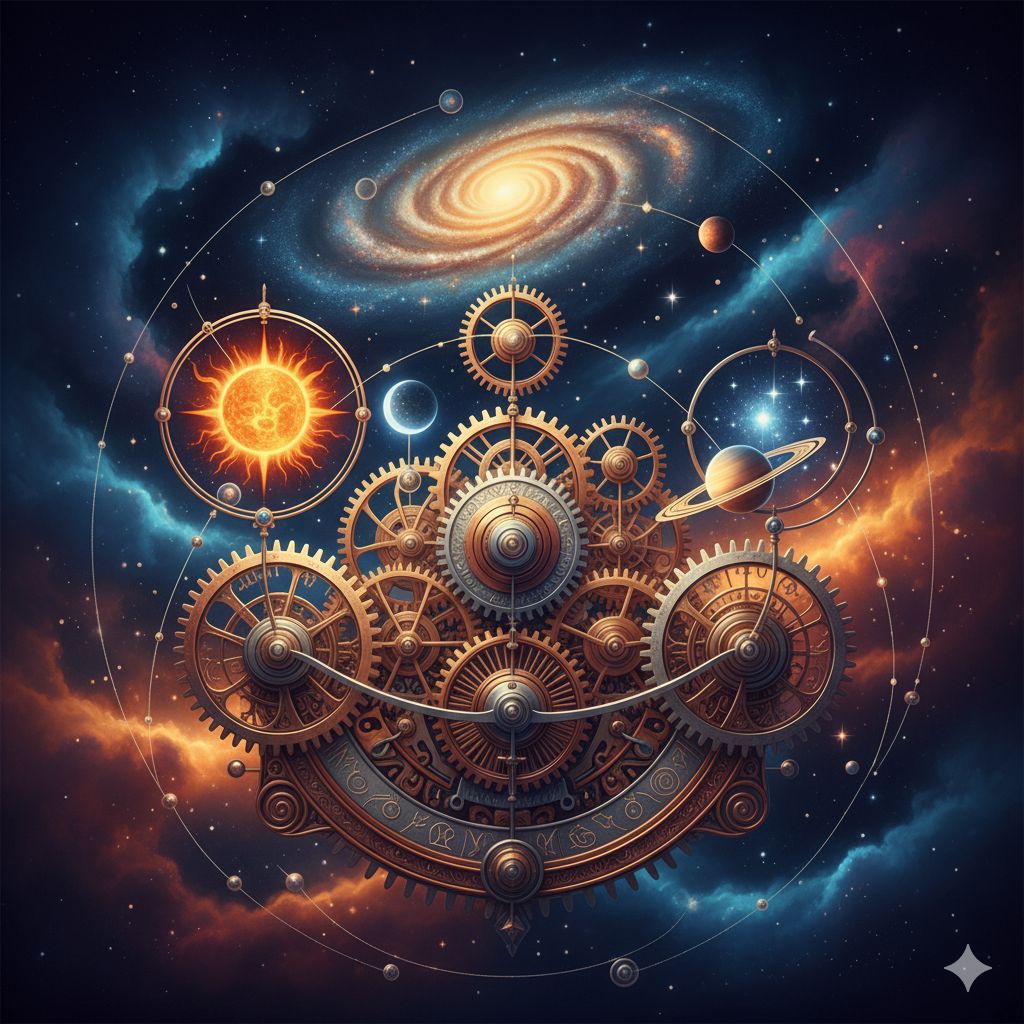
The Clockwork Cosmos: Periodic Celestial Events
From a "Supermoon" making headlines to the silent changing of the seasons, our sky is a stage for powerful, periodic events. These recurring phenomena—like eclipses, solstices, meteor showers, and planetary alignments—are not random; they are the predictable, gravitational dance of the Earth, Moon, and Sun. This article is your complete guide to understanding these celestial wonders, exploring the precise science that governs them and the rich tapestry of myths, legends, and folklore they have inspired across human history.
H2: What Are Periodic Celestial Events and Why Do We Care?
Periodic celestial events are astronomical phenomena that occur at regular, predictable intervals. Their predictability stems from the stable, orbital mechanics of our solar system. For millennia, humans have used these cycles for:
Timekeeping: The lunar cycle gave us the "month," and the solar cycle (marked by solstices and equinoxes) gave us the "year."
Navigation: Stars and planets provided a map for sailors and travelers.
Agriculture: The solstices signaled the right times for planting and harvesting.
Cultural Awe: These events—eclipses, comets, and "blood moons"—were seen as omens, divine messages, or disruptions of the natural order, weaving them deeply into our mythology.
H2: What Are the Most Famous Lunar Phenomena?
The Moon is our closest and most dramatic celestial partner. Its 29.5-day cycle creates several named events.
1. The Supermoon (Perigee-Syzygy)
The Science: The Moon's orbit around the Earth is not a perfect circle; it's an ellipse. Perigee is its closest point to Earth, and apogee is its farthest. A "Supermoon" is a modern term for a Full Moon or New Moon that occurs when the Moon is at or near its perigee. It can appear up to 14% larger in diameter and 30% brighter than a Full Moon at apogee (a "Micromoon").
Scientific Curiosity: The "Moon Illusion" makes a Supermoon look enormously large when it's on the horizon. This is a powerful psychological illusion; the Moon isn't physically larger there. Your brain compares it to trees and buildings, tricking you into perceiving it as massive.
Myths and Legends: The term "lunacy" comes from luna (moon). Many cultures traditionally link the Full Moon (especially a Supermoon) to heightened emotions, strange behavior, and an increase in werewolf sightings. Scientifically, there is no proven correlation between the lunar cycle and human behavior, though it does create stronger "perigean spring tides."
2. The "Blood Moon" (Total Lunar Eclipse)
The Science: This is not a separate phenomenon but rather the name for the appearance of a Total Lunar Eclipse. It happens when the Earth passes directly between the Sun and the Moon, casting its full shadow (the umbra) over the Moon.
Scientific Curiosity: Why red? The Moon turns a deep red or copper color because the only sunlight reaching it is filtered through Earth's atmosphere. Our atmosphere scatters blue light (which is why our sky is blue) but allows red light to pass through and bend (refract) onto the Moon. The exact shade of red depends on how much dust or pollution is in Earth's atmosphere at the time.
Myths and Legends: A red moon was almost universally seen as a terrible omen. The Inca believed a great jaguar was attacking and eating the Moon, and they would shout and beat their drums to scare it away. In Mesopotamia, it was seen as an assault on the king, who would sometimes be temporarily replaced by a "substitute" to take the brunt of the omen.
3. The Blue Moon
The Science: This has nothing to do with the Moon's color. It has two common definitions:
Monthly: The second Full Moon to occur in a single calendar month (since the lunar cycle of 29.5 days is just shorter than most of our 30-31 day months).
Seasonal: The traditional "Maine Farmer's Almanac" definition: the third of four Full Moons in a single astronomical season (the period between a solstice and an equinox).
Scientific Curiosity: The Moon can physically appear blue, but it is an incredibly rare atmospheric event. Fine smoke or ash particles in the atmosphere (from a massive forest fire or volcanic eruption like Krakatoa in 1883) can scatter red light, making the Moon appear blue-tinted. This is the origin of the phrase "once in a blue moon" to mean something incredibly rare.
Myths and Legends: As this is mostly a calendrical quirk, there are few ancient myths. Its folklore is more modern, tied simply to the concept of rarity and special occasions.
H2: What Is the Difference Between a Solar and Lunar Eclipse?
Eclipses are the most dramatic examples of "syzygy"—the alignment of three celestial bodies. The difference is simply what is blocking what.
| Feature | Solar Eclipse | Lunar Eclipse |
| Alignment | Sun - Moon - Earth (S-M-E) | Sun - Earth - Moon (S-E-M) |
| What's Blocked | The Sun is blocked by the Moon's shadow. | The Moon is blocked by the Earth's shadow. |
| Lunar Phase | Occurs during a New Moon. | Occurs during a Full Moon. |
| Visibility | Visible only on a tiny, narrow path on Earth (the "path of totality"). | Visible from the entire night-side of Earth. |
| Safety | EXTREMELY DANGEROUS to view without special, certified eclipse glasses. | Perfectly safe to view with the naked eye. |
Scientific Curiosity: A Total Solar Eclipse is a stunning cosmic coincidence. The Sun is about 400 times larger than the Moon, but it is also about 400 times farther away. This makes them appear to be the exact same size in our sky, allowing the Moon to perfectly cover the Sun's disk.
Myths and Legends: A solar eclipse was the most terrifying omen. The universal theme was that a creature was devouring the sun. In Norse mythology, the wolf Sköll chases the sun, and a "Great Eclipse" will signal Ragnarök when he finally catches it. In Vietnam, a giant frog was believed to be eating the sun.
H2: Why Do We Have Solstices and Equinoxes?
These are the four events that mark the official change of our seasons. They are not caused by the Earth being closer to or farther from the Sun; they are caused entirely by the Earth's 23.5-degree axial tilt.
Solstices (Winter & Summer):
What they are: The two days of the year when the Earth's tilt is at its maximum lean either toward or away from the Sun.
Summer Solstice: (Around June 21 in the N. Hemisphere) The longest day of the year. The Sun is at its highest point in the sky.
Winter Solstice: (Around Dec. 21 in the N. Hemisphere) The shortest day of the year. The Sun is at its lowest point.
Myths & Curiosity: Stonehenge in the UK is perfectly aligned with the sunset of the winter solstice and the sunrise of the summer solstice, suggesting it was a massive ceremonial calendar.
Equinoxes (Spring & Autumn):
What they are: The two days of the year when the Earth's tilt is "side-on" to the Sun.
Meaning: The name means "equal night." Day and night are of almost perfectly equal length everywhere on Earth.
Myths & Curiosity: At Chichen Itza in Mexico, the grand pyramid of El Castillo is built so that on the equinoxes, the setting sun creates a shadow of a serpent (Kukulkan) that appears to "crawl" down the pyramid's staircase.
H2: What Other Celestial Events Can We See Regularly?
Beyond the "big four" (Moon, Sun, Solstices), here are the other predictable events to watch for.
1. Meteor Showers (e.g., Perseids, Geminids)
The Science: These are not "falling stars." They are the "crumbs" of comets. When Earth passes through the trail of dust and ice debris left by a comet (or sometimes an asteroid), these tiny particles (often the size of a grain of sand) burn up in our atmosphere at incredible speeds, creating bright streaks of light.
Scientific Curiosity: Each shower is named for the constellation from which the meteors appear to radiate (the "radiant point"). The Perseids (in August) appear to come from Perseus and are debris from Comet Swift-Tuttle. The Geminids (in December) appear to come from Gemini and are (unusually) from an asteroid, 3200 Phaethon.
Myths and Legends: Universally, they are known as "shooting stars" or "wishing stars." The Perseids peak around the feast day of St. Lawrence, leading to the Catholic folklore name "The Tears of St. Lawrence."
2. Planetary Conjunctions and Oppositions
Conjunction: An event where two or more celestial bodies (like planets, or a planet and the Moon) appear to be very close together in the sky from our point of view.
Opposition: This is the best time to see an outer planet (like Mars, Jupiter, or Saturn). It's when Earth passes directly between that planet and the Sun. The planet will rise at sunset, be visible all night long, and be at its closest and brightest to Earth.
Myths & Curiosity: Conjunctions were the cornerstone of astrology, seen as powerful unions of planetary "forces." The "Great Conjunction" of Jupiter and Saturn is a leading theory for the Star of Bethlehem that the Magi followed, as it was a rare and brilliant alignment that would have been interpreted by astrologers of the time as heralding a new king.
H2: Frequently Asked Questions (FAQ)
Q: What is the difference between astronomy and astrology?
A: Astronomy is the scientific study of celestial objects and phenomena, using mathematics, physics, and chemistry to explain their origins and evolution. Astrology is a belief system or pseudoscience that claims the positions of celestial bodies can influence human affairs and terrestrial events.
Q: Can a Supermoon or an eclipse actually cause earthquakes or tsunamis?
A: No. While a Supermoon (or New Moon) does exert a slightly stronger gravitational pull, creating higher "perigean spring tides," the U.S. Geological Survey (USGS) and other scientific bodies have stated there is no scientifically established correlation between these events and large-scale disasters like earthquakes or volcanic eruptions. The tectonic forces far outweigh the minor tidal stresses.
Q: How rare is a total solar eclipse?
A: A total solar eclipse happens somewhere on Earth about once every 18 months. However, the path of totality is very narrow, so the chance of one passing over a specific city or location is extremely rare, happening on average only once every 375 years for any given spot.