
The Forgotten Riola in Pistoia Mountains: Part 1

Traveling along the tortuous road that climbs from the scorching plains of Pistoia towards the Apennine ridges is akin to taking a journey through varying layers of atmosphere and time. As soon as you leave the city limits behind and the asphalt begins to wind upwards, navigating the first hairpin bends, the oppressive sultriness of the urban summer miraculously gives way. The air becomes crisp, lighter, and fragrant with resin and damp earth. This is the gateway to the "Forgotten Riola," a territory where lush nature patiently reclaims its space, offering a sanctuary for those willing to slow down.
The landscape changes rapidly, almost violently, with altitude. Initially, the lower slopes are dominated by mixed deciduous woods and oaks, but as you continue towards the Acquerino forest, the scenery shifts to the noble majesty of beech trees (Fagus sylvatica) and ancient chestnut groves. It is a biological transition that prepares the traveler for a unique encounter with a biodiversity hotspot that few expect to find just twenty minutes away from a major Tuscan city.
The Green Cathedrals: The Mystery of the Douglas Firs
One of the most striking and somewhat alien features of this specific area of the Pistoia Mountains is the presence of the Douglas Fir (Pseudotsuga menziesii). Hiking through the Acquerino forest, visitors are often struck by the sudden change in the environment. You enter vast patches of forest that feel different: darker, taller, more silent.
These are not native trees; they are guests from North America. They were planted here at the beginning of the last century in a massive reforestation experiment intended to revitalize the timber industry and stabilize the slopes. The experiment was a biological success. These conifers, similar to our indigenous firs but with a much faster growth rate, have adapted perfectly to the Apennine climate.
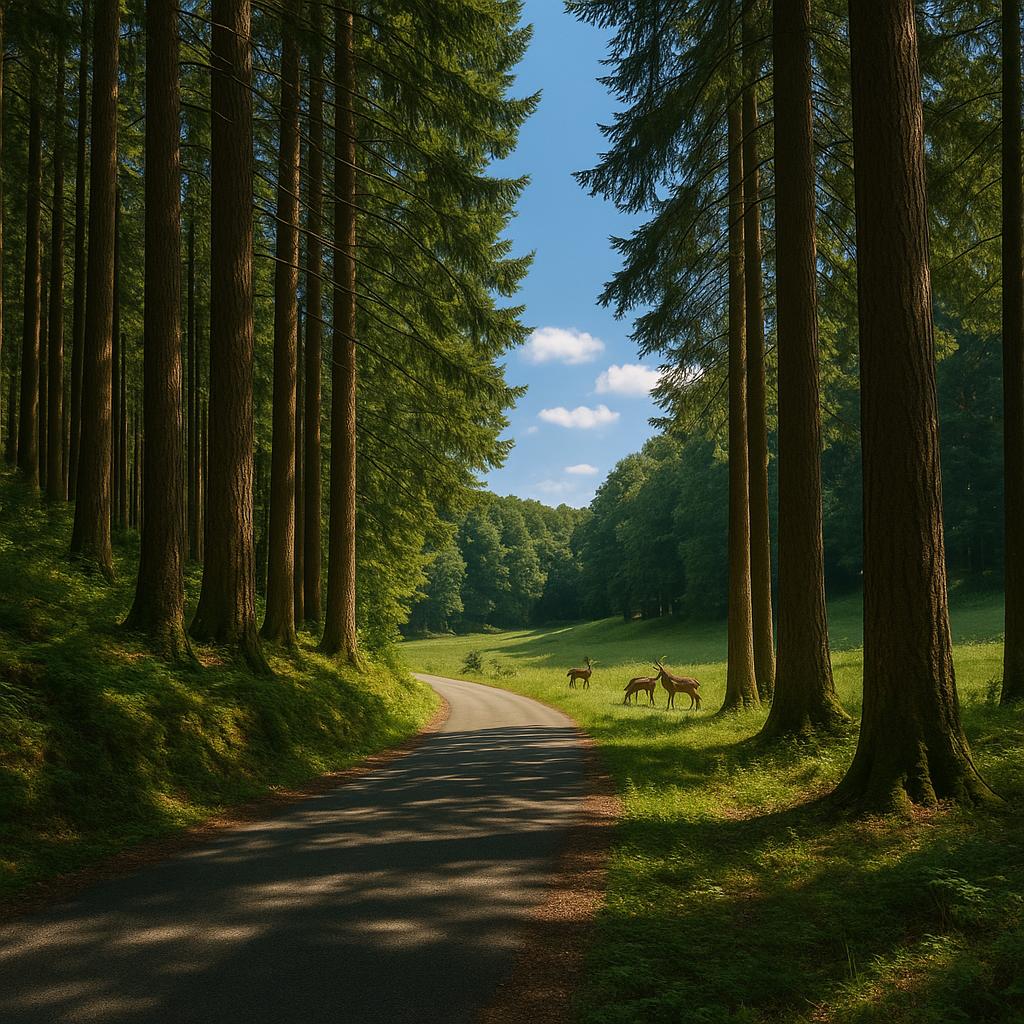
Walking among them feels like entering a natural cathedral. Their trunks rise straight for the sky like pillars, reaching impressive heights. Because their canopy is so dense, very little light filters through to the ground. This creates a forest floor that is almost devoid of undergrowth—no brambles, no shrubs, just a soft, silent carpet of needles that muffles footsteps. The silence here is profound, offering a meditative experience that contrasts sharply with the noisy chaos of modern life. Their deep root systems play a crucial engineering role, holding the mountain together and preventing landslides on these steep, fragile slopes.
A Sanctuary for Wildlife: Predators and Prey
Before reaching the village of Monachino, the dense wall of the forest occasionally opens up into lush meadow clearings ("radure"). These are not just empty spaces; they are the stage for a complex ecological drama. The area, formally known as the Acquerino Cantagallo Nature Reserve, is a protected haven where the Tuscan fauna has found a balance that was lost for centuries.
The Return of the Wolf
The most significant ecological event of the last few decades in this valley is the return of the Apennine Wolf (Canis lupus italicus). After being hunted to the brink of local extinction, the wolf has returned naturally, following the expansion of its prey. It is an elusive ghost of the forest, rarely seen but constantly present. Its return is a positive signal: the wolf acts as a natural selector, keeping the population of wild boars and deer in check, preventing them from destroying the forest regeneration.
The Herbivores
It is not difficult, for the patient observer equipped with binoculars, to spot herds of Red Deer (Cervus elaphus) grazing peacefully at dawn or dusk in the meadows near the road. These majestic animals share the woods with the smaller, more elusive Roe Deer, huge families of Wild Boars, red Foxes, Squirrels, and the nocturnal Porcupines.
The River Life: The Crayfish Indicator
Descending towards the valley floor, we find the Limentra stream. Its waters are a treasure of purity. Unlike many rivers in the plains, the Limentra here is free of industrial and agricultural pollution. This purity allows the survival of the Freshwater Crayfish (Austropotamobius pallipes).
This small crustacean is a "bio-indicator." It cannot survive in polluted water. Its presence is the ultimate certification that the water here is pristine. Seeing a crayfish hiding under a river stone is a rare privilege in modern Europe, a glimpse into a pre-industrial past.
The Villages: Monachino and the Legacy of Lentula
Continuing along the route, human presence becomes sparse but deeply fascinating. The first significant settlement is Monachino. The small church stands as the first building one encounters, acting as a spiritual guardian to the village. In winter, Monachino can seem like a "ghost village," wrapped in mist and silence, with chimneys smoking from only a few houses. The local tavern, often the only social hub, opens its doors on weekends to welcome hikers and locals with the smell of polenta and game sauce.
However, in summer, the village undergoes a metamorphosis. It becomes a cozy retreat. Shutters are thrown open, geraniums bloom at every window, and courtyards are filled with the voices of returning families. It represents the resilience of the Limentra valley, a trend common to many areas of the Tuscan-Emilian Apennines where the population fluctuates with the seasons.
Lentula and the Water Industry
Further down the valley lies Lentula, a place that bears the visible scars of economic change. To the casual observer, it is just a cluster of houses, but historically, this village was the industrial heart of the valley. Lentula was famous for its water. The "Lentula" mineral water bottling plant was not just a factory; it was the lifeblood of the community.
For years, this facility employed about twenty people from the neighboring towns—a huge number for such a small community. It provided stability, allowing families to stay in the mountains rather than emigrate to the industrial plains of Prato or Pistoia. Its closure years ago was a traumatic economic event, a blow that accelerated depopulation. Today, the building stands as a monument to industrial archaeology, reminding us of the fragile economic balance of mountain communities.
Living Traditions: The Art of Charcoal and Chestnuts
For those few who have stubbornly remained, fighting against the convenience of city life, existence follows the ancient, cyclical rhythms of the seasons. The economy here is still viscerally tied to the forest.
The Chestnut Cycle
In late autumn, the harvest begins. The chestnut is not just a fruit here; it is culture. As in past centuries, chestnuts are collected and brought to the "metato," a small, two-story stone building found in the groves. Here, they are dried by a slow, smoldering fire for about 40 days. The smoke dehydrates the chestnuts, giving them a unique flavor. They are then ground into the sweet flour used for necci and castagnaccio.
The Charcoal Burners (I Carbonai)
A rare but fascinating sight, usually at the end of summer, is the traditional production of charcoal. This is an art form that dates back to the Etruscans. The "Carbonai" build large, conical wood pyres called "carbonaie."
The process is delicate: the wood must burn without a flame, carbonizing slowly over days. The charcoal burner must watch the pyre day and night, adjusting the air vents to prevent the wood from turning to ash. Seeing the blue smoke rising from these mounds in the woods is like stepping back into the 19th century. The resulting charcoal is prized for winter heating and barbecues, a product of immense labor and skill.
Travel Tips: Navigating the Wild Road
A note of honest caution for the visitor: this area of the Apennines is "forgotten" also in terms of infrastructure. This contributes to its wild, untouched charm but implies that the visitor must be prepared. The road is not a highway; it is a mountain track that demands respect.
Driving Advice for the Explorer:
- Road Conditions: The asphalt is old, often uneven, and marked by potholes. Maintenance has been sporadic for years. There are narrow sections where two cars can barely pass, and overhangs that can be dizzying for the unprepared driver.
- Winter Warning: In the winter months, this route transforms. The fog can be so thick that it reduces visibility to zero, and the humidity from the river turns the roadway into a dangerous sheet of black ice ("verglas"). Winter tires or chains are not just recommended; they are essential survival gear.
However, do not let this discourage you. For those willing to drive slowly, to accept the bumps and the curves, the lack of heavy traffic and the stunning, raw views make it a rewarding journey. It is a road for travelers, not for tourists in a hurry.