
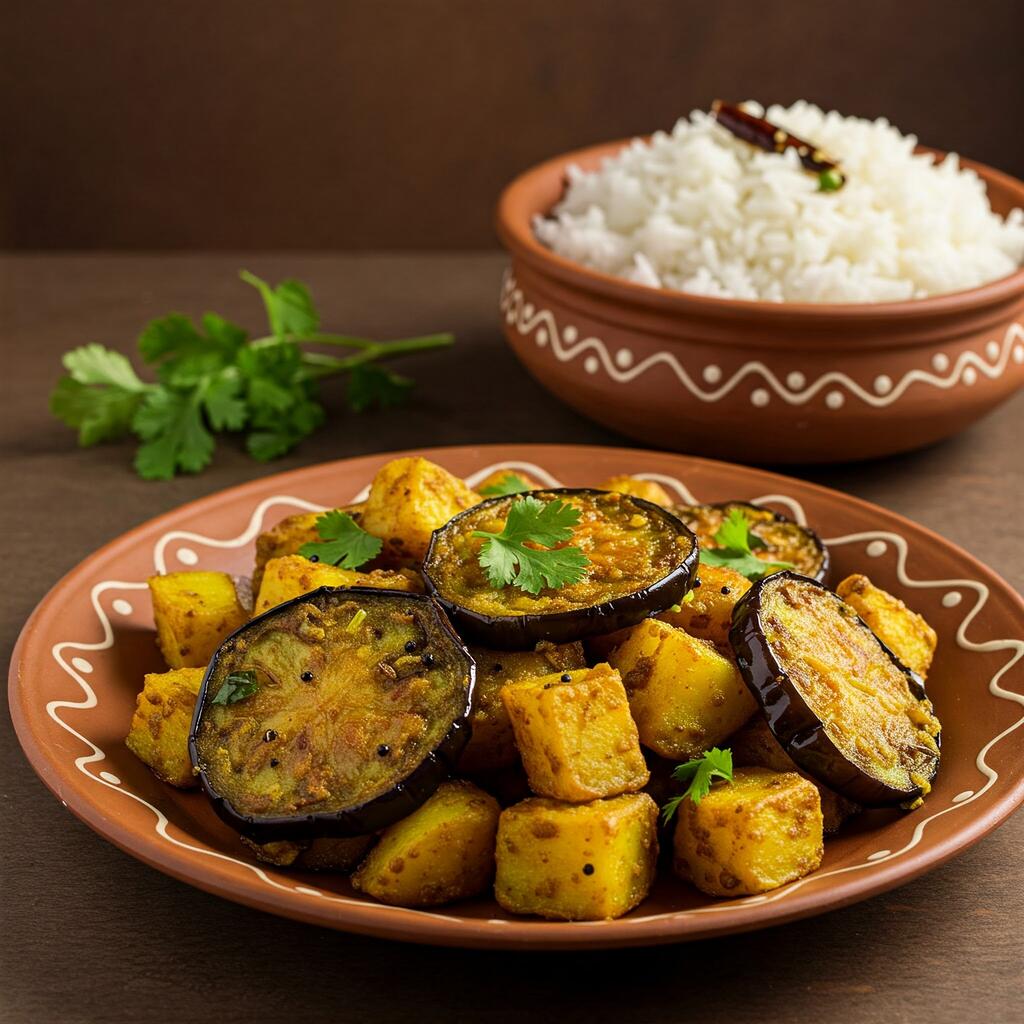
Beguni Ghonto Recipe: A Delicious Bengali Dish

This recipe was sent to me directly by a friend of mine from India. It is a traditional dish that was even handed down to her by her great-grandmother.
Origins
Apparently, it is a very old recipe from Bangladesh and was created to be a vegetarian dish in its own right that is quick and easy to prepare.
Ingredients
- Large, round aubergines - 500 gms;
- Fenugreek seeds - 1 tsp;
- Bay leaves - 2;
- Peanuts (peanuts) - 1/2 cup;
- Cumin powder - 2 teaspoons;
- Shredded coconut - 1/2 cup;
- Shredded ginger - 2 tsp;
- Green chillies (whole) - 3-4;
- Oil - 2 tbsp;
- Salt and turmeric powder - to taste;
Preparation
- Pressure cook the aubergines for 15 minutes.
- Drain the aubergines and remove the seeds, then mash them with a colander.
- Heat the oil in a heavy-bottomed pan.
- Add the fenugreek seeds and bay leaves until the seeds crackle.
- Saute the peanuts for 2-3 minutes. Add the crushed aubergines and mix well. Add the salt and turmeric and mix well.
- Cook over a medium heat for 10 minutes, stirring occasionally.
- Add the cumin powder and ground coconut and mix well. Let it cook for another 10 minutes, stirring occasionally so that it does not stick to the bottom.
- Add the green chillies, chopped ginger and stir for a further 2 minutes.
- Serve with hot steamed rice!
Acknowledgements
Endless thanks go from our whole community to my friend in Mumbai.
The Anthropological Resonance of Oral Culinary Traditions
The transmission of recipes through generations, as seen in this dish handed down from a great-grandmother, represents more than just a set of cooking instructions. It serves as a vital conduit for cultural preservation, maintaining a tangible link to the past through sensory memory. In many South Asian cultures, the kitchen functions as a primary classroom where history is taught not through books, but through the rhythm of chopping and the blending of spices.
Oral traditions in gastronomy are inherently fragile, relying entirely on the continuity of practice and the willingness of the younger generation to observe and learn. When a recipe is documented solely in the mind of an elder, it carries the nuances of their specific regional dialect and personal touch. The act of writing it down, or sharing it digitally as done here, creates a permanent archive of a fleeting cultural moment.
This specific dish, with its roots in Bangladesh and migration to Mumbai, illustrates the fluidity of borders in culinary history. Recipes travel with people, adapting to new environments while retaining the core spirit of their origins. The "great-grandmother" archetype in this context symbolizes the guardian of authenticity, ensuring that the essential character of the dish remains intact despite the passage of time.
Furthermore, the communal aspect of sharing such recipes reinforces social bonds within the diaspora. It transforms a simple meal into a narrative of survival, adaptation, and identity. The ingredients chosen centuries ago were likely dictated by local availability and seasonal cycles, yet they persist today as choices of heritage.
Analyzing the lineage of this preparation offers a glimpse into the domestic economy of the past. It suggests a time when meals were constructed around a single star vegetable, augmented by pantry staples. This reflects a philosophy of resourcefulness that is increasingly relevant in modern discussions about food waste and conscious consumption.
Ultimately, the value of this recipe lies not only in its flavor profile but in its ability to tell a story. Each preparation is a reenactment of a ritual performed by ancestors, creating a sense of continuity in a rapidly changing world. By preparing this dish, one participates in a living history that spans borders and generations.
Botanical Profile and Historical Cultivation of the Aubergine
The aubergine, or eggplant (Solanum melongena), is the central protagonist of this dish and holds a significant place in the agricultural history of the Indian subcontinent. Believed to have originated in the India-Burma region, it has been cultivated for thousands of years. Its presence in this traditional recipe is a testament to its status as a staple crop that has sustained populations for millennia.
Botanically, the aubergine is a berry, though it is treated as a vegetable in culinary applications. The variety specified here, "large, round aubergines," is crucial for the texture of the final dish. These varieties typically possess a high moisture content and a spongy flesh that collapses perfectly upon cooking, acting as a vehicle for the complex spices.
The skin of the aubergine contains nasunin, a potent antioxidant that gives the vegetable its deep purple hue. Historically, the selection of dark-skinned varieties was often favored in traditional medicine and cooking for their perceived robustness. The flesh, while mild on its own, possesses a unique absorbent quality, allowing it to soak up the oils and aromatics of the tempering process.
In the context of Bangladeshi and Indian agriculture, the aubergine is celebrated for its versatility and hardiness. It thrives in warm climates and can be harvested throughout a significant portion of the year. This accessibility likely contributed to its prominence in daily vegetarian cuisine, providing a reliable source of bulk and nutrition.
The requirement to "remove the seeds" in the preparation step highlights a sophisticated understanding of texture and bitterness. Older varieties of aubergines often contained seeds that were bitter or tough. By removing them, the cook ensures a creamy, uniform consistency that defines the mouthfeel of the finished bharta (mash).
From an agronomic perspective, the continued use of traditional cultivars supports biodiversity. Many modern commercial farming operations favor uniform, tough-skinned varieties for transport. Traditional recipes often demand specific local types, thereby encouraging the preservation of heirloom seeds and genetic diversity in regional agriculture.
The Alchemical Role of Spices in Bengali Cuisine
The spice blend used in this recipe—fenugreek, cumin, turmeric, and ginger—is not merely a flavoring agent but a sophisticated chemical arrangement. In traditional Bengali and Eastern Indian cooking, the sequence in which spices are added is paramount. This technique, often referred to as "baghaar" or "tadka," involves tempering spices in hot oil to release their essential oils.
Fenugreek seeds (methi) are particularly distinctive due to their slightly bitter, maple-like aroma. When added to hot oil, they undergo a rapid chemical change; however, if burnt, they become unpleasantly bitter. The instruction to cook them until they "crackle" indicates a precise thermal point where the flavor is maximized without degradation.
Turmeric, synonymous with Indian cuisine, provides the earthy base note and the characteristic golden color. Beyond its visual appeal, turmeric acts as a bridging flavor that unites the sweetness of the coconut with the heat of the chilies. Its active compound, curcumin, is fat-soluble, which is why adding it to the oil/vegetable mixture is essential for bioavailability and flavor dispersion.
The use of fresh green chilies introduces a raw, grassy heat that contrasts with the warm, toasted notes of the cumin powder. Unlike dried red chilies, which provide a deep, lingering heat, green chilies offer a sharp, immediate pungency. This brightens the heavy texture of the mashed aubergine, preventing the dish from feeling too dense or lethargic on the palate.
Ginger adds a final layer of zest and warmth. Known for its proteolytic enzymes, ginger can also help in the digestion of proteins, though in this vegetarian context, its primary role is aromatic. The interplay between the ginger and the coconut creates a classic coastal flavor profile that is both refreshing and comforting.
It is important to note that the measurements provided (teaspoons, tablespoons) in traditional recipes are often approximations of "handfuls" or pinch estimations. The standardization into metric units helps modern cooks, but the true art lies in smelling the spices as they cook. The alchemy occurs when the distinct aromas merge into a single, cohesive bouquet.
Nutritional Perspectives and Ingredient Synergy
From a nutritional standpoint, this dish represents a balanced approach to vegetarian eating, characteristic of traditional diets. The combination of ingredients creates a nutrient-dense profile that offers macronutrients and micronutrients in a bioavailable form. The aubergine itself is low in calories but high in fiber, which aids in digestive health and satiety.
The inclusion of peanuts introduces a crucial component: plant-based protein and healthy fats. In a vegetarian meal, the addition of nuts or legumes is essential for creating a complete nutritional package. Peanuts also provide niacin and manganese, contributing to the metabolic value of the dish.
Coconut, while often criticized in modern western dietetics for its saturated fat content, is valued in Ayurvedic and traditional systems for its energy-dense properties. The medium-chain triglycerides (MCTs) found in coconut are metabolized differently than other fats, providing a quick source of energy. Additionally, the fat from the coconut and oil is necessary for the absorption of fat-soluble vitamins (A, D, E, K) found in the vegetables.
The spices themselves contribute negligible calories but significant bioactive compounds. Turmeric and ginger are widely recognized in nutritional science for their anti-inflammatory potential. While a single meal does not constitute a therapeutic dose, the cumulative effect of a diet rich in these spices is a subject of ongoing research in functional nutrition.
It is crucial to approach these benefits with a balanced perspective. Traditional diets were often consumed in the context of active lifestyles. The caloric density provided by the oil, peanuts, and coconut was fuel for labor. In a modern, sedentary context, portion control remains relevant, even with healthy ingredients.
This recipe also avoids the heavy use of dairy or refined sugars, making it naturally suitable for vegan diets and those monitoring blood sugar levels. The complexity of flavor is achieved through spice layering rather than salt or sugar loading. This aligns with contemporary dietary guidelines advocating for whole foods and minimal processing.
Textural Dynamics: The Interplay of Soft and Crunch
A successful culinary creation often relies as much on texture as it does on taste. This aubergine dish masterfully employs contrasting textures to keep the palate engaged. The base texture is the mashed aubergine, which, after pressure cooking and mashing, becomes silky, creamy, and almost custodial-like.
Into this soft matrix, the recipe introduces roasted peanuts. These provide a necessary "crunch" that breaks the monotony of the mash. The decision to sauté the peanuts for 2-3 minutes before adding the wet ingredients ensures they retain their structural integrity and do not become soggy immediately.
The shredded coconut offers a third textural dimension. Unlike the hard crunch of the peanut or the smoothness of the aubergine, coconut provides a fibrous, chewy resistance. This fibrous quality adds body to the dish, making it feel more substantial and "meaty" despite being entirely vegetarian.
The preparation method of pressure cooking followed by pan-frying (bhunoo) is critical for texture development. The initial pressure cooking breaks down the cellular structure of the vegetable rapidly. The subsequent cooking in the pan evaporates excess moisture, concentrating the solids and preventing the dish from being watery.
Even the instructions regarding the spices contribute to texture. Whole fenugreek seeds offer tiny bursts of bitterness and a hard bite, contrasting with the powdered cumin which dissolves into the sauce. This variation ensures that every mouthful offers a slightly different sensory experience.
Culinary analysts often point out that "mushy" textures are the most difficult to sell to a global audience. However, by embedding elements of crunch and chewiness, this traditional recipe solves that problem intuitively. It constructs a complex architecture of sensations that rivals more elaborate meat-based preparations.
The Social Sociology of Communal Dining
The final instruction to "Serve with hot steamed rice" opens a discussion on the sociology of eating in South Asian culture. Rice is not merely a side dish; it is the canvas upon which the meal is painted. In Bangladesh and Eastern India, rice is the primary source of sustenance, and dishes like this aubergine mash are technically "condiments" meant to flavor the rice.
The method of eating, traditionally with the hands, enhances the sensory connection to the food. Mixing the soft aubergine with the rice, feeling the different textures of the peanuts and coconut, becomes a tactile experience. This tactile interaction has been shown to influence the perception of taste and satiety.
Such dishes are rarely eaten in isolation. They are designed for "thali" style eating or communal bowls, reinforcing the social structure of the family. The quantity specified (500 gms of aubergine) serves a family unit, implying that the act of cooking is inherently an act of caregiving for a group.
The simplicity of the dish also speaks to the concept of egalitarian dining. While royal cuisines (Mughlai) are famous for rich curries and expensive meats, dishes like this belong to the "people's cuisine." They are accessible to the wealthy and the poor alike, bridging socio-economic gaps through shared culinary heritage.
In a modern context, serving this dish can be an act of slowing down. It requires sitting, mixing, and savoring, contrasting with the "grab-and-go" culture of urban life. It invites conversation and presence at the dining table, elements that are increasingly valuable in a digitized society.
The pairing with rice also highlights the wisdom of complementary proteins. While the dish contains peanuts, the combination of legumes/nuts with a cereal grain (rice) creates a complete protein profile. This intuitive nutritional wisdom is embedded in the cultural practice of how the food is served.
Important for Health
The information provided in this article, including the analysis of ingredients and nutritional properties, is for educational and informational purposes only. It is based on general culinary knowledge and historical context regarding traditional ingredients. It does not constitute medical advice, diagnosis, or treatment.
While ingredients such as turmeric, ginger, and fenugreek are widely recognized in various cultures for their properties, their effects can vary significantly between individuals. No specific health benefits or cures should be inferred from the descriptions provided. Scientific understanding of nutrition is an evolving field, and traditional uses do not always align with current clinical evidence.
Individuals with specific allergies, particularly to peanuts or other nuts, must exercise extreme caution. This recipe explicitly calls for peanuts, which are a common and potent allergen. Cross-contamination in kitchens where these ingredients are handled is also a risk factor that should be considered.
Furthermore, dietary changes should always be undertaken in consultation with a qualified healthcare professional or registered dietitian. This is especially important for individuals with pre-existing health conditions, those who are pregnant, or those taking medication, as certain spices can interact with pharmaceuticals.
The preparation methods described, such as the use of pressure cookers and hot oil, involve inherent risks of thermal injury. Users should follow all safety manufacturer guidelines for their specific kitchen appliances. The authors and publishers assume no liability for any adverse reactions or accidents resulting from the preparation or consumption of this dish.
This content is an original synthesis intended to explore the cultural and culinary dimensions of the recipe. Any resemblance to specific proprietary processes or branded products is unintentional. The focus remains strictly on the analysis of the generic traditional preparation methods and ingredients.