
The Forgotten Riola in Pistoia Mountains: Part 2

Summer is rapidly approaching, and with the rising temperatures comes the instinctive, almost primal desire to move. We feel the need to leave the oppressive heat of the city asphalt behind and seek relief in the coolness of our mountains. The Pistoia Apennines offer more than just a temperature drop; they offer a perfect refuge, a world of deep greenery, silence, and flowing waters just a few minutes away from the chaos of urban life.
Exploring these valleys is not merely a way to regenerate the spirit or escape the heat; it is a journey into a "forgotten" Italy that is incredibly rich in culture and history. It is also a fundamental act to support the local economy. Small businesses, historic bars, and family-run inns scattered across the mountain villages are the true guardians of tradition. They keep the lights on in valleys that would otherwise risk depopulation. They offer hospitality and authentic flavors at modest prices—dishes that recount the history of the territory, such as homemade tagliatelle with wild boar sauce or the rich venison stew.
Visiting these places is the perfect opportunity to buy genuine local products: Pecorino cheese from the mountains, artisanal cured meats, and the inevitable chestnut flour, the "gold" of the Pistoia mountains. But above all, it is a chance to take our grandparents or children for beautiful walks in the woods, perhaps organizing a picnic on the banks of a stream, rediscovering a slower pace of life that modern society has all but erased.
The Pistoia-Riola Road: A Corridor of Nature and Engineering
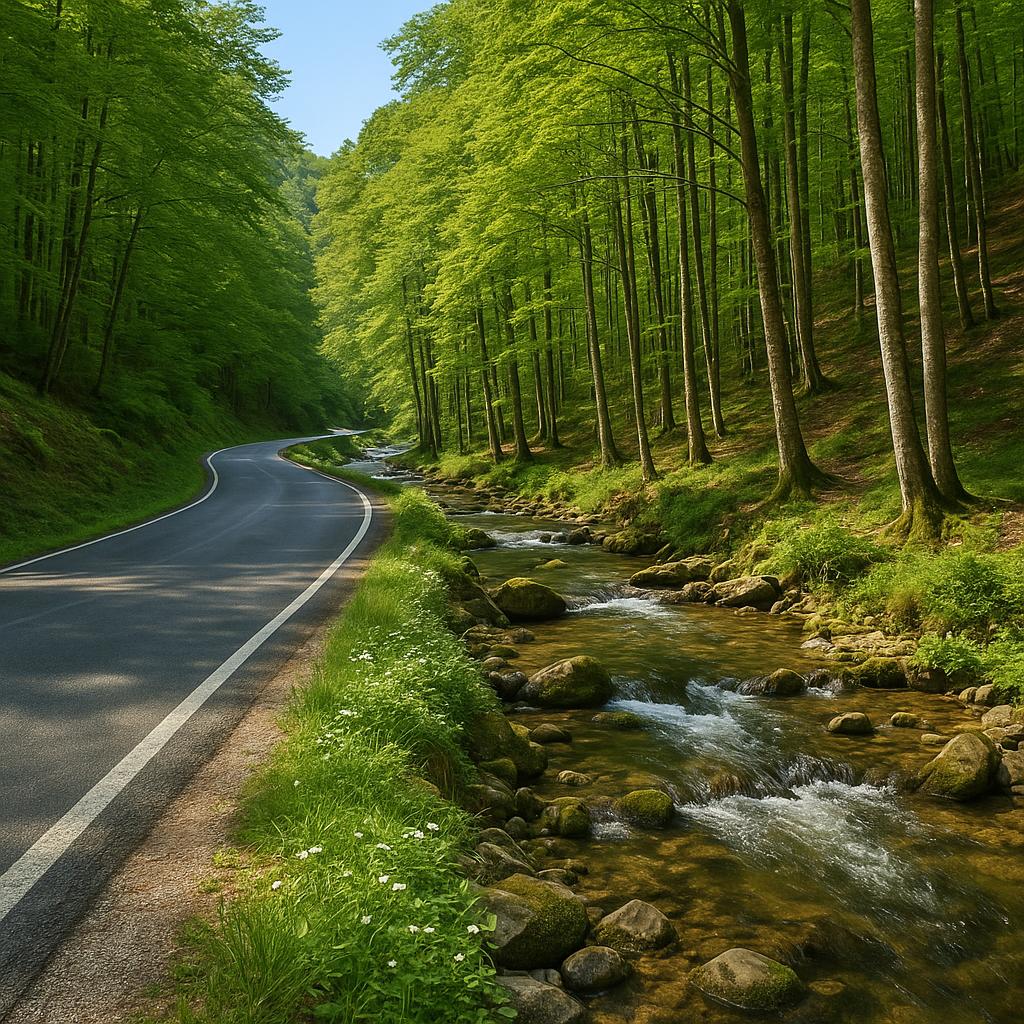
The Provincial Road 24 (SP24), known locally as the "Pistoia-Riola," is an itinerary that deserves to be rediscovered slowly, gear by gear. It is not merely a connection between Pistoia and the Emilia-Romagna border; it is a scenic route that plunges into the heart of the Apennines, following ancient geological fault lines.
Passing the locality of Cascina and descending towards Monachino, the route runs alongside the Limentra Orientale River. This watercourse is the soul of the valley. Unlike other Apennine torrents that dry up in summer, the Limentra maintains a flow of clear, cold water thanks to the numerous springs in the Acquerino forest. For centuries, these waters have shaped the landscape, carving out natural pools and creating scenery that seems to have come out of a fairy tale. The sound of the river accompanies travelers along the winding bends, offering a natural soundtrack that immediately lowers stress levels.
The "Civilization of the Chestnut": An Anthropological Heritage
To understand the "forgotten" Riola valley, one must understand the "Civilization of the Chestnut" (Civiltà del Castagno). For centuries, before the advent of industrialization and the potato, the chestnut tree was the "bread tree" for the people of these mountains. It was not just a food source; it was the cornerstone of survival.
As you drive along the Riola road, look at the forests. You will see that they are not random; they are often ancient chestnut orchards ("castagneti da frutto"), planted and grafted centuries ago. In the past, every family owned a "metato" (a small stone building used for drying chestnuts). Smoking chestnuts for 40 days over a slow fire and then grinding them in water-powered mills produced the sweet flour that is still a delicacy today.
When you stop at a local inn ("trattoria"), you are tasting this history. Do not miss:
- Necci: Thin crepes made from chestnut flour and water, cooked between two heavy iron plates ("testi") and filled with fresh ricotta cheese.
- Castagnaccio: A dense cake made with chestnut flour, pine nuts, walnuts, rosemary, and olive oil.
- Polenta Dolce: Sweet polenta made from chestnut flour, traditionally eaten with herring or sausage to create a sweet-salty contrast.
Historical Depth: From Pilgrims to the Gothic Line
This valley is not just nature; it is a corridor of history. In the Middle Ages, these paths were crossed by pilgrims travelling between Lombardy and Tuscany. A testament to this era is the nearby Badia a Taona (Abbey of San Salvatore), located just a short detour from the main Riola road. Founded in the 11th century, this abbey was a powerful monastic center that controlled the roads and offered shelter to travelers crossing the dense, bandit-filled forests.
The Wounds of World War II
More recently, the mountains surrounding the Riola road played a crucial and dramatic role during World War II. This area was part of the Gothic Line (Linea Gotica), the German defensive line established to halt the Allied advance into Northern Italy.
The dense forests of the Acquerino and the slopes leading down to the Limentra offered cover for partisan brigades. Walking through the trails today, observant hikers can still find traces of trenches or defensive stone walls. It is a place of memory, where the beauty of nature has reclaimed battlefields, turning them into places of peace.
The Acquerino Cantagallo Reserve: A Biodiversity Hotspot
We are on the edge of the Acquerino Cantagallo Nature Reserve, a vast protected area of over 3,500 hectares. This is one of the most successful examples of environmental rewilding in Tuscany.
The Return of the Great Deer
The absolute protagonist of this area is the Red Deer (Cervus elaphus). Extinct in the area for decades, the deer were reintroduced smoothly and have found an ideal habitat here. It is not uncommon, especially at dawn or dusk, to spot these majestic animals grazing in the glades near the road. In autumn, the forest echoes with the "bramito," the powerful roaring call of the male deer during the mating season, attracting nature photographers from all over Italy.
Fishing and The River Ecosystem
The Limentra river is also a destination for sustainable fishing. Its waters are home to the Fario Trout, a species that requires highly oxygenated and pollution-free water. The presence of the Fario Trout is a biological indicator of the excellent health of the river ecosystem. Along the riverbanks, you can also find signs of otters and herons, further proof of a restored natural balance.
Hiking and "Slow Tourism" Itineraries
For hiking enthusiasts, the area offers a network of trails maintained by the CAI (Club Alpino Italiano). Here are two recommended options:
- The Medieval Mill Route (Easy): Starting from the locality of Monachino, a path leads to the ruins of ancient hydraulic mills. It is a flat walk suitable for children, allowing you to see how the force of the river was harnessed to grind grain and chestnuts.
- The Ridge Hike to Cascina di Spedaletto (Medium): For those seeking a workout, trails lead up from the valley floor to the ridges, offering panoramic views that stretch as far as Florence on clear days.
A Call to Preserve and Enjoy
I remember how years ago, on the banks of the Limentra between Acquerino and Monachino, there were many families eating by the stream. Children played by building small dams with river stones, while the elderly relaxed on deckchairs, lulled by the gurgling of the water. Today, although times have changed and frenetic rhythms dominate our lives, that magic is still there, waiting for those who have the patience to stop, turn off their engines, and look.
Rediscovering the pleasure of a "merenda" (afternoon snack) with fresh bread, Tuscan salami, and a glass of red wine in front of a small tavern is a ritual we should never lose. It teaches us, and our children, respect for nature and the value of a less wasteful, more authentic life.
There will always be time to travel to distant international destinations, but in the meantime, let's enjoy the wonders we have right around the corner. The forgotten mountains of Pistoia are waiting to be rediscovered, one curve, one flavor, and one story at a time.